A pair of $3,256 aluminum axles is an extravagant solution to broken housings and failed differentials, but the upgrade has a clear purpose beyond spectacle. Repeated damage to the stock setup has made durability the central problem with this heavily modified Raminator, and the replacement axles address several obvious weak points with one-piece 7075 aluminum housings, removable differential assemblies, double-jointed driveshafts, and substantial steering hardware. The price remains extreme, yet the engineering differences are demonstrated well enough to make the expense more understandable.
The teardown is particularly useful because the new components are not simply installed and praised. The axles are partially disassembled so their construction can be compared with the stock design, including the locating pins around the differential carrier and the easier method of removing the differential without splitting the entire housing. Screws are also checked for threadlocker, differential fluid is topped up, and grease is added before installation. Some durability expectations remain speculative until much harder testing is completed, but viewers get a meaningful look at why these parts might survive better rather than being asked to accept the price as proof of quality.
Installing four powerful servos adds another technically interesting layer. The explanation of synchronizing paired servos, listening for signs that they are fighting one another, setting travel limits, and avoiding mechanical binding is practical and grounded in what is happening on the workbench. Rear-steering setup also receives thoughtful attention through caster angle, servo-saver tension, reduced steering travel, and dramatically slowed servo movement. The presenter openly prefers independently controlled rear steering because it better resembles his real monster truck, making clear that the decision is about personal realism rather than claiming it is objectively the best control configuration.
That experiment ultimately exposes one of the build's biggest compromises. Despite tightening the rear servo saver heavily and restricting the steering response, the rear wheels still move under the enormous forces generated during hard acceleration and landings. The truck becomes unstable enough that the presenter decides the rear steering is probably unsuitable for this particular high-powered build and plans to return it to a solid rear axle. That failure actually improves the credibility of the episode: an expensive component is not treated as automatically successful, and the conclusion changes based on what happens during testing.
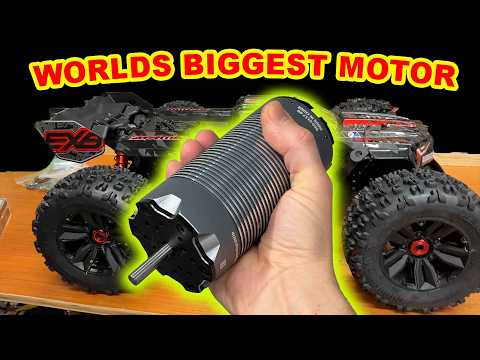
Another sensible decision is removing one of the truck's two enormous motors. The twin-motor configuration delivered impressive excess but also required additional batteries, extra electronics, more weight, and a drivetrain capable of surviving power that the presenter admits was destroying parts almost immediately. Switching back to one motor while increasing the pinion from 14 to 17 teeth produces what appears to be a faster and more manageable truck during the run. There are no measured speed figures or controlled before-and-after performance tests, however, so claims that it is faster remain observational rather than quantified.
The actual durability test is entertaining but much lighter than the ambitious setup initially suggests. The truck accelerates hard, struggles with rear-steer instability, and completes a substantial double backflip, after which the axles appear straight and undamaged on inspection. That is encouraging, but it is not yet enough punishment to establish that $3,256 axles have solved the drivetrain's durability problems. The presenter acknowledges this limitation and says harder jumps are planned, making this episode more of an installation and first shakedown than a definitive stress test.
The closing studio tour broadens the episode considerably, showing the new work areas, RC storage, larger-scale vehicle workspace, future projects, giveaways, and plans ranging from a petrol Raminator to a water-crossing record attempt. It provides useful context for where future builds will happen and reflects the channel's enthusiast personality, though it also makes the ending feel detached from the axle project. Promotional mentions of parts links, memberships, competitions, and merchandise are frequent enough to be noticeable, but the mechanical work and willingness to abandon an unsuccessful rear-steering setup keep the core project from feeling like a simple advertisement.
Pros
- Opens the expensive axles and clearly demonstrates meaningful construction differences rather than relying on price or appearance alone.
- Explains servo synchronization, steering travel, caster, binding, and rear-steering setup with practical hands-on examples.
- Honestly acknowledges that the rear-steering experiment remains unstable and plans to remove it rather than presenting every modification as successful.
- Reducing the truck from two motors to one shows a welcome willingness to prioritize usability and durability over maximum power.
- Provides an initial real-world shakedown that includes hard acceleration and a substantial double backflip.
Cons
- The promised durability testing is relatively limited, so the long-term strength of the extremely expensive axles remains unproven.
- Performance claims after changing to a single motor and larger pinion are not supported by measured speed or controlled comparison data.
- Rear steering consumes considerable setup time before quickly proving unsuitable for the truck's current power level.
- The lengthy studio tour, future-project discussion, giveaways, and promotional links dilute the focus toward the end.
The costly axle upgrade is made compelling by unusually detailed mechanical inspection and a willingness to show where the accompanying rear-steering experiment falls short. The first outing suggests the truck is moving toward a lighter, more usable configuration, but much harder testing is still needed before the new axles can justify their extraordinary price through proven durability.