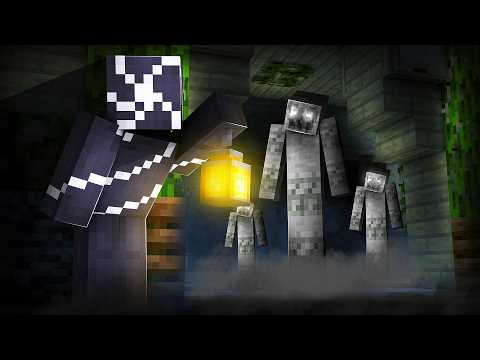
Buddy’s transformation from a brightly colored dancing unicorn into a towering axe-wielding threat gives the adventure a simple but effective horror engine. The opening deliberately leans into children’s television imagery—talking furniture, a cheerful classroom, dance parties and a mailbox with a face—before gradually corrupting those ideas. That contrast does most of the atmospheric work, turning an intentionally silly Minecraft setting into something increasingly hostile without abandoning the playful tone that defines the group’s interactions.
The early stretch is especially patient about establishing Buddy as harmless. Summoning him by saying his name three times, joining Frankie Frank’s dance routine and wandering through the colorful house all make the scenario feel more like an absurd roleplay than horror. Teacher Tina’s unexplained disappearance provides the first real warning sign, while Buddy’s claim that she has gone to “dance island” introduces a recurring joke that becomes much darker once other characters begin disappearing. The shift is predictable by design, but the gradual escalation gives it more impact than immediately revealing Buddy as a monster would have.
The envelope hunt provides a useful bridge between comedy and pursuit. Dolly witnessing Buddy apparently kill Frankie Frank creates distrust inside the group, particularly because the others initially struggle to reconcile that account with the friendly character they have met. Buddy’s increasingly forceful insistence that everyone follow the rules then gives the threat a clear behavioral logic: survival depends less on defeating him than on avoiding whatever arbitrary violation might provoke him. That makes even basic objectives more tense once his friendly persona begins collapsing.
Buddy’s physical deterioration is one of the stronger horror ideas. After the characters retreat into the well, he claims to have removed parts of himself so he can fit through the underground passages, and the resulting imagery turns the previously cuddly mascot into something grotesque. The dark sewer maze, limited supplies and repeated dead ends also create one of the more sustained chase sequences, particularly when the players are trying to climb back toward the surface while hearing him approach. Fire becoming one of the few things that appears to slow him down gives later encounters a useful tactical element rather than reducing every chase to simple running.
Comedy remains constant, sometimes to the sequence’s benefit and sometimes at the expense of tension. Frankie Frank jokes, arguments over blocks, frantic repetition of names and comments about Buddy’s appearance keep the personalities lively and prevent the roleplay from becoming overly self-serious. At the same time, nearly every frightening development receives an immediate joke or burst of shouting, leaving relatively little room for suspense to settle. The performance style is intentionally loud and reactive, but quieter pauses could have made Buddy’s slower appearances considerably more unnerving.
The final act improves the structure by shifting from survival to escape. The mailbox reveals that the group needs the televisions, Buddy must be summoned again to activate them, and Pepper attempts to distract him with drawing before sneaking toward the studio. Losing Kipling and eventually the mailbox raises the apparent stakes, while recovering the flint and steel provides a payoff to the earlier discovery that fire can hurt Buddy. The studio’s hide-and-seek sequence is straightforward but effective because Buddy’s slow search contrasts well with the frantic attempts to locate the correct television.
The eventual escape delivers a clean conclusion rather than stretching the scenario beyond its premise. Buddy is not deeply developed as a villain, and the rules governing his behavior remain intentionally loose, but the concept succeeds through visual escalation, recurring callbacks and a steady succession of objectives. What begins as a parody of an overly friendly children’s character becomes an energetic Minecraft horror chase with enough mechanical variety to avoid feeling like one uninterrupted pursuit.
Pros
- Buddy’s progression from cheerful dancing mascot to mutilated pursuer gives the horror premise a clear and memorable escalation.
- Children’s-show imagery, talking furniture and “dance island” create an effective contrast between colorful absurdity and increasingly disturbing events.
- The envelope search, sewer escape, fire mechanic and television objective provide varied goals rather than relying entirely on chase scenes.
- Buddy altering his body to follow the players into the well is a particularly effective piece of visual horror.
- Recurring characters and jokes give the group interactions personality while still supporting the central scenario.
- The final television-studio sequence brings earlier clues and mechanics together into a satisfying escape attempt.
Cons
- Constant shouting and rapid joking frequently interrupt moments that could otherwise build stronger suspense.
- Buddy’s rules are loosely defined, making some transitions from friendly behavior to violence feel driven more by the next set piece than consistent logic.
- Supporting characters such as Teacher Tina and Frankie Frank primarily function as disappearance jokes rather than becoming meaningful parts of the story.
- Several chase sequences rely on repeated frantic dialogue and navigation through similar spaces, creating some repetition before the final studio section.
A deliberately goofy Minecraft setup develops into an entertaining mascot-horror scenario because Buddy’s appearance and behavior become progressively more disturbing while the objectives keep changing around him. The relentless comedic reactions occasionally undermine the fear factor, but the colorful setting, grotesque escalation and well-structured final escape make the concept work remarkably well.