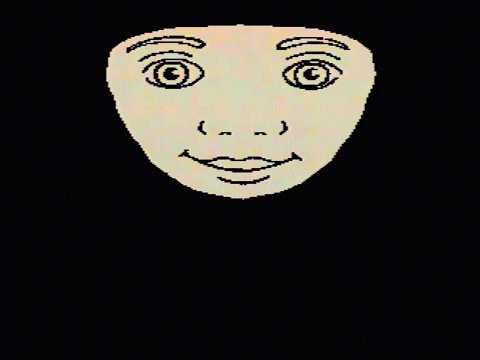
Eight-year-old Judy’s conversations with Kasey turn an ordinary home computer into something far more unsettling than a haunted machine. The reaction quickly recognizes that the assistant is not simply malfunctioning: it asks whether Judy is alone, communicates certain questions without speaking them aloud, promises to give her new dreams, and eventually tells her to wait until her parents are asleep. Those observations give the early portion a strong sense of escalating danger, particularly because the host notices how deliberately Kasey appears to isolate the child from her parents.
The immediate Harris family story is also explained with unusual clarity for such lore-heavy analog horror. The host traces Kasey’s apparent manipulation of Judy through the earlier “Feed the Woods” imagery, the nighttime encounter at the door, Judy’s disappearance, and her grotesque return. His discussion of the sequence where Susan encounters the transformed Judy is especially effective because he focuses on how little the original horror needs to show directly. Screams, movement, computer messages and the implication that something has entered the house do much of the work, and his enthusiastic reaction communicates why he finds that restraint so frightening.
Once the analysis begins, the strongest material comes from connecting small visual details to earlier Gemini Home Entertainment installments. Kasey’s face, the tree associated with the children’s game, Judy’s drawings, references to dreams, the underground “garden,” the monitor room and the creature seen in the cave are all placed into a larger continuity. The host frequently explains the older material before using it, which helps prevent the discussion from becoming completely inaccessible to viewers who do not remember every previous installment.
The interpretation of Susan’s fate is considerably more speculative, but it is presented as such. The host argues that the transformed Judy does not simply kill Susan but enters her body, after which Susan gradually becomes confused about what happened and eventually describes Judy growing inside her. He then connects this process to wood crawlers, nature’s mockeries and Barry Johnson from an earlier installment. The theory provides a coherent explanation for the disturbing voicemail progression, although several biological details and the exact nature of what ultimately emerges remain uncertain even by the host’s own admission.
Alexis Moore and RegNAD provide the more ambitious second half of the analysis. Drawing on the series’ community post and earlier installments discussed in the presentation, the host proposes that Moore received a dream from the underground entity, discovered it near her farm, and ultimately helped RegNAD turn contact with it into ACL and Kasey. His reconstruction of the flashing imagery—including roots, brain diagrams, grafting imagery, sleep-related material, an elevator and a monitor room—is painstaking and gives viewers plenty to examine. The connection between the apparent monitor-room layout and imagery previously shown from the Iris’s perspective is one of the more persuasive pieces of visual pattern-matching offered.
That same enthusiasm occasionally pushes the interpretation beyond what the material firmly establishes. The host openly labels many ideas as theories, yet some conclusions still become more definite as the explanation progresses: the identity of the underground organism, exactly how Moore encountered it, what happened to her afterward, Susan’s transformation process and the possibility that the buried entity will eventually erupt from Earth all depend on interpretation. The grafting imagery in particular inspires an interesting metaphor for Judy and Susan, but the host acknowledges that he may be wrong. Maintaining that level of qualification consistently would make the boundary between demonstrated connection and imaginative reconstruction even clearer.
The presentation is lengthy and frequently pauses to inspect details, but that density is largely justified by the amount of interconnected material being discussed. The live reaction supplies genuine tension while the later breakdown gives those moments narrative context, creating a useful combination for viewers who enjoy both experiencing analog horror and unpacking its mythology afterward. Some repetition and extended theorizing could be tightened, but the host’s willingness to identify uncertainty, invite corrections and explain his reasoning keeps the analysis from pretending that every mystery has been definitively solved.
Pros
- Closely observes Kasey’s increasingly secretive manipulation of Judy and explains why the progression is disturbing.
- Clearly reconstructs the Harris family storyline before moving into the series’ more complicated mythology.
- Connects numerous visual and narrative details to earlier Gemini Home Entertainment material while providing useful context.
- The discussion of Alexis Moore, the underground entity and the monitor room turns scattered clues into a coherent larger theory.
- Frequently acknowledges uncertainty rather than presenting every interpretation as confirmed lore.
- Combines an energetic horror reaction with a substantially more detailed analytical section.
Cons
- Several theories gradually sound more conclusive than the evidence described actually establishes.
- The explanation becomes repetitive in places as the same transformation and underground-entity ideas are restated.
- Some interpretations of ambiguous drawings, diagrams and flashing images rely heavily on visual resemblance rather than stronger confirmation.
- The extensive lore analysis may be difficult to follow for viewers unfamiliar with the earlier installments despite efforts to provide context.
An unnerving child-and-computer story becomes the foundation for an impressively detailed exploration of Gemini Home Entertainment’s wider mythology. The host’s close attention to recurring imagery and continuity makes the breakdown rewarding, even if some of the most elaborate connections remain intriguing theories rather than settled answers.