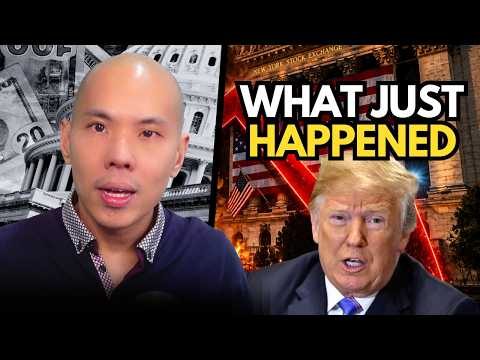
The video builds its explanation around an unusually striking piece of currency policy: the US Treasury stepping in to support the Japanese yen after it weakened beyond the levels Japan had previously defended. The opening efficiently establishes the sequence of events, including Scott Bessent describing the yen as undervalued, Japan’s earlier interventions and the move beyond 160 to the dollar. That gives the later discussion a clear question to answer rather than turning the subject into a general lecture on foreign exchange markets. The brief flag survey interrupts that momentum almost immediately, but the main argument resumes quickly.
The background on Japan is accessible and mostly well organized within the video’s own account. It connects the yen’s prolonged decline to inflation, interest rates, government debt and rising borrowing costs, giving viewers enough economic machinery to understand why simply raising rates is presented as difficult. Importantly, the video acknowledges that there is no wholly satisfactory explanation for the yen’s weakness and describes inflation as only a probable contributor. That qualification is valuable, although several subsequent economic relationships are explained in simplified cause-and-effect terms that make an exceptionally complicated currency market sound more mechanically predictable than the presentation’s initial uncertainty would suggest.
The intervention itself is the strongest part of the story. The video emphasizes the unusual choice to use euros rather than dollars, notes the yen’s immediate move back below 160 and supplies earlier signals that intervention might be coming, including Bessent’s comments and the New York Fed rate check. It also correctly limits the significance of the immediate currency movement within its own argument by describing the apparent success as short term. The historical characterization of coordinated US-Japanese support as exceptionally unusual is important to the premise, but the video provides little historical detail with which viewers could independently judge how this episode compares with previous interventions.
The proposed reasons for American involvement are sensibly separated into three overlapping explanations: helping an ally, attempting to address the US trade deficit with Japan, and continuing a broader pattern of using American financial power abroad. The discussion is strongest when it identifies tensions within those explanations. In particular, if weakening the dollar relative to the yen is supposed to improve the US-Japan trade balance, using euros raises an obvious question about what that action implies for European competitiveness under the administration’s own stated trade logic. However, claims about what Trump and his team “presumably think,” as well as the interpretation of the intervention as part of a broader political pattern, remain the video’s analysis rather than demonstrated motives of the Treasury decision.
That distinction becomes even more important in the discussion of why euros were used. The video explicitly says that nobody is entirely sure of the reason and then proposes political optics as a probable explanation, suggesting the administration may not want to appear to be giving dollars to Japan. It is an interesting hypothesis because it feeds directly into the subsequent credibility argument, but no evidence for that motivation is presented here. The same limitation applies to the inference that American involvement indicates Japan lacks the “stomach” to deploy enough of its own foreign assets: it is a plausible interpretation offered by the video, not something established merely by the fact of US participation.
The final section nevertheless gives the episode a useful forward-looking framework. Rather than claiming the intervention has permanently rescued the currency, the video argues that its durability depends on whether traders believe the US and Japan are willing to commit sufficient resources to defend the yen. That turns the immediate exchange-rate movement into a larger question about credibility and makes the “for now” nature of the argument meaningful. The two reasons offered for skepticism are coherent extensions of that framework, although both depend substantially on inferred political intentions, so the conclusion is more persuasive as a scenario to watch than as a firm prediction of what happens next.
Presentation is generally concise, approachable and well structured for a subject that can quickly become technical. Exchange rates, reserves, bond yields and intervention are introduced without burying the central story beneath terminology, while the video regularly distinguishes uncertainty with phrases such as “probably” and “no one’s entirely sure.” The largest structural distraction comes after the substantive conclusion, when an extended magazine promotion ranges across Europe, America, US-China relations, Ukraine, British politics and subscription bundles. That commercial material does not diminish the preceding explanation, but it adds a substantial unrelated tail to an otherwise tightly focused economic analysis.
Pros
- Establishes the yen’s decline, Japanese intervention and subsequent US action in a clear chronological sequence.
- Explains interest rates, inflation, debt servicing and currency intervention in accessible terms without overwhelming the central story.
- Acknowledges uncertainty about both the underlying causes of yen weakness and the reason euros were used.
- Organizes the possible US motivations into three distinct explanations and identifies tensions within the trade-deficit rationale.
- Treats the yen’s immediate recovery as a short-term result rather than evidence that the underlying problem has been permanently solved.
- The credibility framework provides a useful way to understand why future trader expectations may matter as much as the initial intervention.
Cons
- Some complex relationships between inflation, interest rates, bond demand and currency values are presented more straightforwardly than the video’s own acknowledgment of uncertainty might warrant.
- The claim that Japan lacks the willingness to deploy its assets aggressively enough is an inference rather than a demonstrated explanation for US involvement.
- The proposed political-optics explanation for using euros is explicitly speculative and is not supported with direct evidence in the video.
- Assertions about the intervention fitting a broader pattern of American financial influence receive limited supporting context.
- More historical comparison would strengthen the claim that this particular form of US-Japanese currency coordination is exceptionally unusual.
- The lengthy magazine promotion substantially extends the video after its substantive argument has already concluded.
This is an effective introduction to an unusual currency intervention, particularly when it explains the mechanics and separates immediate market movement from the harder question of long-term credibility. Its weaker passages turn reasonable interpretations of Japanese and American motives into arguments supported more by inference than demonstrated evidence. As an accessible explanation of what happened and why it might matter, it is strong, provided the political and market interpretations are treated as hypotheses rather than settled conclusions.