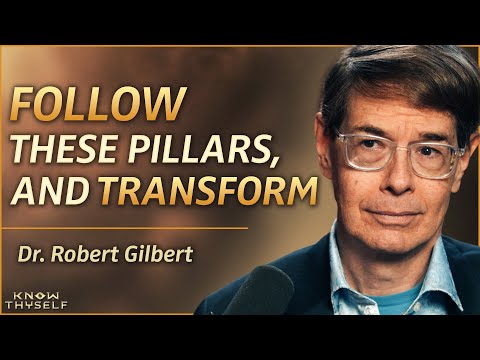
This lengthy conversation explores spirituality through the lens of Rosicrucian philosophy, with Dr. Robert Gilbert discussing subjects ranging from subtle bodies, meditation, sacred geometry, karmic biography, and dream work to the practical challenges of personal transformation. Rather than presenting a broad survey of different traditions, the discussion consistently returns to one central theme: genuine spiritual growth requires disciplined practice and lived experience rather than the passive accumulation of intellectual knowledge.
One of the presentation's strengths is its willingness to move beyond abstract philosophy. The conversation repeatedly emphasizes that ideas only become meaningful when integrated into daily life through self-observation, meditation, truthfulness, and consistent personal discipline. Gilbert frequently distinguishes between studying spiritual concepts and embodying them, describing a developmental path in which knowledge serves as a foundation for direct experience rather than an end in itself. That practical emphasis gives the discussion greater coherence than many conversations that simply collect esoteric concepts.
The interview also succeeds because it remains conversational despite tackling highly complex material. The host asks thoughtful follow-up questions that encourage Gilbert to explain not only his ideas but also the experiences that shaped his own path, including his military service, academic studies, interest in sacred geometry, and the development of the Vesica Institute. These autobiographical sections provide context for his worldview without overwhelming the broader discussion about spiritual practice.
Much of the presentation centers on concepts that fall outside established scientific consensus. Ideas such as subtle bodies, communication with non-physical beings, reincarnation, karmic biographies, energetic centers beyond the physical body, guardian angels, and spiritual hierarchies are presented as components of Rosicrucian metaphysics rather than claims supported by mainstream empirical research. The discussion generally frames these as parts of an esoteric spiritual tradition, but viewers should recognize that these teachings reflect a particular philosophical and mystical framework rather than conclusions accepted by contemporary science.
Another notable strength is the recurring emphasis on humility and personal responsibility. Gilbert repeatedly cautions against spiritual ego, stresses the importance of honesty with oneself, encourages regular self-examination, and advocates practices such as reviewing one's day in reverse to recognize missed opportunities and recurring behavioral patterns. Even viewers who do not accept the broader metaphysical framework may still find value in these reflective exercises as tools for increasing mindfulness and intentional living.
The discussion of sacred geometry follows a similar pattern. Rather than treating geometry simply as mathematical forms, Gilbert presents it as the study of underlying patterns that organize both nature and human development. This broader symbolic interpretation fits consistently within the interview's overall worldview, although many of its proposed relationships between geometry, consciousness, energy, and physical reality remain speculative and extend well beyond accepted scientific understanding.
At well over several hours of conversation, the presentation favors depth over accessibility. Topics frequently branch into detailed descriptions of Rosicrucian initiation, Taoist internal alchemy, Rudolf Steiner's writings, Gurdjieff, dream practices, meditation methods, and comparative spirituality. For viewers already interested in Western esotericism, this richness is likely to be a major attraction. Those new to the subject, however, may occasionally struggle to distinguish symbolic teachings, personal spiritual interpretations, historical references, and factual claims without additional context.
Pros
- Presents a consistent message that emphasizes lived spiritual practice over collecting abstract knowledge.
- Explores Rosicrucian philosophy in considerable depth while connecting it to meditation, self-observation, sacred geometry, dreams, and personal development.
- The host asks thoughtful questions that encourage detailed, reflective answers rather than superficial summaries.
- Encourages humility, honesty, disciplined practice, and regular self-reflection instead of promising quick spiritual breakthroughs.
- Uses personal experiences to illustrate broader philosophical ideas without allowing autobiography to dominate the conversation.
- Maintains a respectful, inquisitive tone throughout an exceptionally long discussion.
Cons
- Many central claims regarding subtle bodies, reincarnation, non-physical beings, energetic centers, and karmic development are presented from an esoteric spiritual perspective rather than being supported by mainstream scientific evidence.
- The sheer volume of terminology and interconnected concepts may overwhelm viewers unfamiliar with Rosicrucian or Western esoteric traditions.
- Historical, metaphysical, and symbolic interpretations are sometimes presented in close succession, making it difficult for newcomers to distinguish between established history and spiritual belief.
- The conversation occasionally revisits similar ideas from different angles, contributing to a slower pace.
This conversation offers an unusually thorough exploration of Rosicrucian spirituality and its approach to personal transformation. Rather than focusing on sensational experiences or mystical claims alone, it consistently returns to themes of disciplined practice, self-observation, truthfulness, and intentional living. While many of its metaphysical conclusions—including discussions of subtle bodies, reincarnation, guardian beings, and higher spiritual communication—reflect beliefs that lie outside established scientific consensus, they are presented within a coherent spiritual framework that remains internally consistent throughout the interview. For viewers interested in Western esotericism, comparative spirituality, and reflective self-development, it provides an engaging and substantial discussion that rewards careful listening.