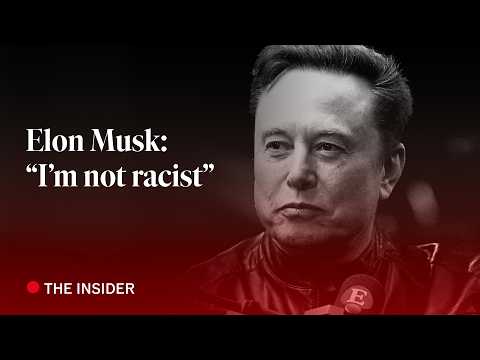
The strongest moments come from the underlying interview rather than the commentary surrounding it. Economist editor Zanny Minton Beddoes presses Elon Musk on accusations of racism, his views toward Muslims, and his repeated claims that Britain is headed toward civil conflict. Musk’s responses give the hosts plenty to examine, particularly when he cites his family and executives at his companies as evidence against racism, then immediately describes himself as opposed to Muslim immigration when he believes immigrants hold values contrary to Western norms. The juxtaposition is inherently revealing, and the video is most effective when it simply lets that exchange unfold.
The discussion becomes more substantive when Beddoes challenges Musk’s depiction of Britain as increasingly dangerous and socially unstable. She emphasizes that she actually lives there, while Musk concedes that he has not visited for several years, yet he still insists she inhabits a “cloistered existence.” That reversal gives the interview genuine tension because it exposes a basic question of perspective: Musk is making sweeping claims about conditions in a country he has not recently experienced firsthand, while dismissing the experience of someone who lives there. Her criticism that his enormous reach can shape American perceptions of Britain gives the segment a useful media-literacy dimension beyond the personalities involved.
The hosts also connect Musk’s remarks to broader accusations involving his political associations, workplace culture, personal conduct, immigration rhetoric, and amplification of stories about grooming gangs. Some of these references are tied to reported lawsuits or investigations, while others are presented much more aggressively as settled proof of Musk’s ideology and motivations. That distinction matters. Calling him a Nazi, white supremacist, or racist repeatedly may communicate the hosts’ judgment clearly, but the video does not methodically establish every one of those conclusions from the evidence it presents. The criticism would be stronger if allegations, documented conduct, political associations, and interpretations were separated more carefully.
A similar weakness appears in the treatment of crime and immigration. The hosts counter Musk’s portrayal of Britain by asserting that London is safer than American cities, violent crime is declining, and wealthy Western countries do not face the level of danger portrayed by the right. These may be testable claims, but the segment supplies no statistics, timeframes, definitions, or sources to establish them. Musk’s claims about demographic change leading eventually to “civil war” are likewise speculative in the material shown. The reporter does a better job exposing how little grounding he provides for that prediction than the hosts do in supporting several of their own factual counterclaims.
Presentation is intentionally combative, full of profanity, ridicule, interruptions, jokes, and personal attacks. Some of that energy works because Musk’s exchange with Beddoes contains moments worth highlighting, particularly his inability to answer her challenge about firsthand familiarity with Britain without attacking her perspective. But lines mocking his wealth, intelligence, appearance, lifestyle, and personality gradually overwhelm the analytical thread. References to apartheid South Africa, Nazi propaganda, ICE, climate migration, capitalism, birth rates, elder care, nurses, Nigel Farage, Jeffrey Epstein, alleged sexual misconduct, and American television journalists all enter the discussion, creating breadth at the expense of focus.
The result is persuasive primarily as partisan commentary rather than as a carefully constructed examination of Musk’s claims. Beddoes provides the clearest model of effective confrontation: ask what Musk means, challenge the factual basis of his assertions, point out the influence his platform gives those assertions, and force him to defend his conclusions. Whenever the hosts follow that approach, the video is sharp. Whenever they replace it with insults or jump from one accusation to another without fully establishing the connection, they make their case easier to dismiss than it needs to be.
Pros
- The original interview contains pointed questioning that directly challenges Musk’s claims about racism, Muslims, Britain, and civil conflict.
- Beddoes effectively contrasts Musk’s sweeping portrayal of Britain with his admission that he has not visited for several years.
- The discussion raises a worthwhile question about the responsibility that accompanies enormous social-media reach.
- Musk’s own responses are given enough space for viewers to assess the tensions in his arguments themselves.
- The hosts connect individual remarks to broader themes of immigration rhetoric, political messaging, and media influence.
Cons
- Repeated labels such as Nazi, racist, and white supremacist are asserted more confidently than the evidence presented within the video establishes.
- Several factual counterclaims about crime, immigration, demographics, and social conditions are made without supporting data or sourcing.
- Personal insults and extended mockery frequently substitute for analysis.
- The discussion sprawls across numerous political and personal controversies without developing several of them sufficiently.
- Allegations, reported incidents, ideological interpretations, and established facts are not always clearly distinguished.
- The strongest material—the reporter directly testing Musk’s claims—sometimes gets buried beneath the hosts’ commentary.
The video has compelling material at its center because Beddoes challenges Musk with specific questions and exposes the gap between his certainty about Britain and his limited recent experience there. The surrounding commentary identifies legitimate issues concerning inflammatory rhetoric and the influence of a powerful platform owner, but its reliance on unsupported assertions, ideological labeling, and relentless ridicule weakens what could have been a more rigorous critique. The interview makes the case most effectively when Musk is required to defend his own claims; the video would have benefited from trusting those exchanges more and embellishing them less.