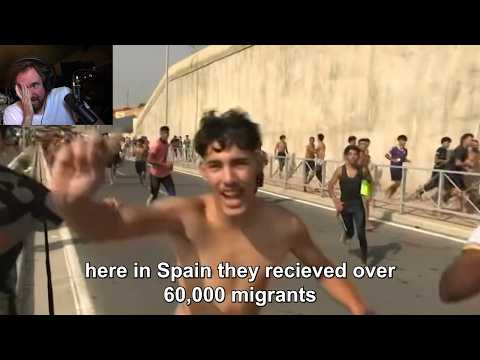
The video presents a firsthand exploration of a tense migration situation at the Spain–Morocco border, focusing on the people who remained in the Spanish enclave of Ceuta after a large border crossing event. Rather than approaching the subject only through statistics or political debate, it relies heavily on direct conversations with migrants, residents, and observations from the streets. This approach gives the audience a sense of the atmosphere and human impact, though many of the video's strongest conclusions are based on the creator's own interpretation of what he sees.
One of the video's most effective elements is its effort to show multiple perspectives. Interviews with migrants reveal their motivations, including hopes for employment, improved living conditions, and a future elsewhere in Europe. The video also speaks with local residents who describe feelings of frustration, insecurity, and abandonment. These contrasting viewpoints help illustrate that the situation involves both individual human aspirations and the practical challenges faced by communities receiving sudden arrivals.
The presentation is built around a strong sense of immediacy, with the creator walking through beaches, border areas, and city streets while documenting what he encounters. This creates a powerful visual record of the environment and makes the issue feel tangible rather than abstract. However, the reporting style is highly personal and sometimes moves quickly from observation to certainty, making it difficult to separate what is directly witnessed from broader claims about government actions, media coverage, or the overall scale of the situation.
The video raises important questions about why people undertake dangerous journeys and what conditions drive migration. The creator shows empathy toward migrants by acknowledging that economic hardship and limited opportunities can motivate people to seek a better life. At the same time, the discussion of illegal border crossings and local concerns highlights the difficult balance between humanitarian considerations, border enforcement, and the responsibilities of governments.
A major weakness is that the video frequently challenges unnamed or broadly defined media sources without providing enough evidence to verify the comparisons being made. Claims about exact numbers of migrants remaining, government decisions, and the accuracy of other reports are presented largely through interviews and personal estimates rather than documented sources. The footage provides valuable perspective on conditions in specific locations, but it does not by itself establish every broader conclusion the video makes.
The strongest moments come from the human interactions rather than the political commentary. Conversations with migrants reveal personal ambitions and uncertainty, while discussions with local residents show how a sudden crisis can affect people living in the area. These encounters create a more complicated picture than a simple argument for or against migration, even though the video's narration occasionally pushes toward a particular interpretation.
Overall, the video succeeds as an immersive street-level account of a controversial event, offering viewers a look at people and places that are often discussed from a distance. Its emotional impact is clear, but its investigative value is limited by a lack of independent verification for several major claims. Viewers looking for a personal perspective on the border situation may find it compelling, while those seeking a fully documented analysis will need additional sources.
Pros
- Provides direct conversations with migrants and local residents, showing different experiences and perspectives.
- Captures the human side of migration beyond political arguments and statistics.
- Uses on-location footage to create a strong sense of place and immediacy.
- Acknowledges that both migrants and local communities face difficult circumstances.
Cons
- Relies heavily on personal observations and interviews rather than independently verified evidence for major claims.
- Makes strong accusations about media coverage and official responses without sufficient supporting documentation.
- The emotional presentation sometimes overshadows deeper analysis of the legal and political complexities involved.
This is a compelling but highly subjective look at a complicated border issue, with its greatest strength coming from personal encounters rather than definitive conclusions. The video effectively shows the human tension surrounding migration, but viewers should approach its broader claims with caution and consider additional reporting for a fuller understanding.