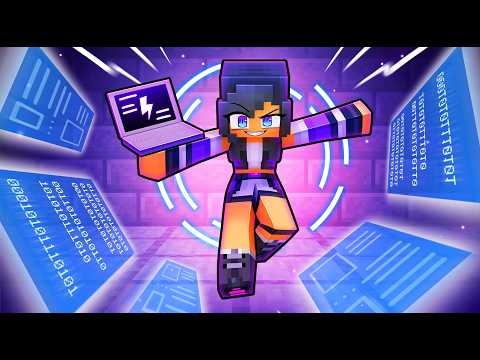
A mysterious stage and diamond skull turn an ordinary day on the server into a game where Aphmau becomes the objective and everyone else is suddenly responsible for keeping her alive. The premise establishes itself through an obstacle course filled with sharks, webs, parkour, and other hazards, with the group quickly realizing that winning is less important than protecting Aphmau from whatever dangerous situation the game creates next. That inversion gives the episode a useful comic foundation: Aphmau repeatedly treats obviously risky scenarios as opportunities for fun while Zane and the others scramble to prevent her curiosity from becoming fatal.
The early beach-themed section makes good use of that conflict. Sharks surround the course, beach balls become potential threats, and falling coconuts are treated as another reason Aphmau needs constant supervision. The humor comes from the gap between her enthusiasm and everyone else's alarm, particularly when harmless-looking objects are interpreted as possible ways for her to die. These scenarios are intentionally ridiculous rather than genuinely suspenseful, but the game provides enough structure for the danger to feel connected rather than simply appearing as unrelated Minecraft chaos.
The diamond skull soon becomes more interesting than the original obstacle course because whoever controls it appears able to influence the game, shrink characters, move everyone between challenges, and turn other players into collectible miniature versions. Aphmau becomes especially delighted by tiny Zane, treating him more like a doll than a teammate and immediately imagining outfits and a dollhouse. That joke expands as additional characters are miniaturized and Aphmau starts wanting a complete collection. The mechanic works because it changes the relationships between the characters as well as their size, giving the cast new reasons to chase, capture, bargain with, and annoy one another.
The episode keeps reinventing itself through new game environments. A pink area introduces predators and cherry-themed dangers, another scenario leads into a supposed park that becomes a trap, and a castle sequence brings trains, potions, fire, poison, regeneration, witches, and more attempts to control the skull. The variety keeps the visuals moving and gives each character opportunities to react differently to the changing rules. Zane's repeated attempts to protect Aphmau are especially effective because his caution is constantly undermined by Aphmau herself, while Pierce, Ian, and Garroth add their own competitive or impulsive behavior to the mix.
That abundance of ideas also creates the episode's biggest weakness. The skull's abilities are never defined with much precision, and the characters move from shrinking to teleportation, potions, regeneration, cloning, doll collecting, and new game environments faster than the rules can be established. Some sequences appear to exist primarily because they provide another visual gag rather than because they advance the central challenge. The dialogue compounds the problem: shouting, repeated phrases, overlapping reactions, and abrupt scene changes can make it difficult to determine who currently controls the game or what exactly must happen for someone to win.
Several of the later transformations are memorable despite that looseness. Potions produce unexpected effects, regeneration complicates attempts to harm Aphmau, and one experiment results in multiple Zanes appearing, which naturally turns into another joke about collecting versions of the character. By this point, protecting Aphmau has evolved into competition over who gets the skull and what can be done with its powers. That shift is amusing because the supposed protectors increasingly become part of the danger themselves, but it also weakens the original premise. Survival becomes less of a sustained objective as the episode focuses more heavily on transformations and possession of the skull.
The ending embraces that contradiction rather than resolving it through a conventional winner. Characters argue over the skull, Aphmau continues collecting miniature versions of her friends, and the group eventually recognizes that fighting over control has become the larger problem. The suggestion that they simply stop starting the dangerous games is an appropriately obvious solution after so much unnecessary chaos. It is not a particularly strong narrative payoff, but it suits an episode whose appeal comes from escalating character comedy more than from competition rules or suspense. The central idea of protecting Aphmau gives the action a recognizable purpose, while the cursed skull, tiny characters, bizarre potions, and constantly changing challenges provide enough novelty to sustain the roleplay even when its internal logic becomes increasingly difficult to track.
Pros
- Making Aphmau the person everyone must protect creates an effective comic contrast between her curiosity and the group's increasingly desperate caution.
- The diamond skull provides a flexible centerpiece for shrinking characters, changing games, triggering transformations, and creating conflicts over control.
- Tiny Zane and Aphmau's desire to collect miniature versions of her friends develop into one of the episode's strongest recurring jokes.
- Sharks, parkour, beach hazards, themed environments, potions, witches, fire, regeneration, and cloning keep the scenarios visually varied.
- Zane's protective behavior and the other characters' competitive impulses give the changing challenges a consistent source of personality-driven humor.
Cons
- The skull's powers and the rules of the individual games remain loosely defined, making cause and effect increasingly difficult to follow.
- Rapid scene changes, overlapping dialogue, repeated shouting, and constant transformations sometimes overwhelm the underlying objective.
- Later sections focus so heavily on shrinking, potions, and fighting over the skull that the original challenge of keeping Aphmau alive becomes less important.
- The conclusion resolves the conflict with the obvious idea of simply stopping the games rather than providing a stronger payoff to the competition.
The survival-game premise works best as an excuse to reverse the usual dynamic, making Aphmau's friends responsible for protecting someone who seems determined to investigate every dangerous possibility placed in front of her. The diamond skull's transformations and miniature-character comedy provide plenty of playful escalation, but increasingly vague rules and frantic presentation keep the collection of inventive scenarios from becoming an equally strong competitive story.