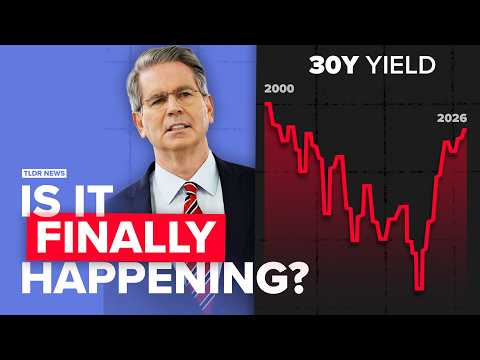
The video presents a strongly opinionated argument that recent financial and industrial developments favor Canada while signaling deeper structural problems for the United States. Rather than focusing on day-to-day political events, it attempts to connect sovereign credit ratings, government borrowing costs, foreign investment flows, and critical mineral development into a broader narrative about changing economic influence. The presentation is energetic and confident, with a clear effort to build a single overarching thesis from multiple news stories.
A significant portion of the discussion centers on the downgrades issued by the major credit rating agencies and the implications for U.S. government debt. The explanation of what credit ratings represent and why institutional investors monitor them provides useful context for viewers who may not regularly follow financial markets. However, the video frequently moves from factual reporting about ratings and debt figures to much stronger conclusions about investor behavior and national decline without fully demonstrating that every claimed consequence follows directly from the evidence presented.
The discussion of Canadian government bonds and foreign investment serves as the video's central comparison. Statistics regarding investment inflows, bond yields, debt levels, and economic growth are presented as evidence that investors increasingly view Canada as a more attractive destination. While these comparisons help support the video's narrative, the presentation leaves little room for alternative explanations or the broader complexity of global capital allocation. Financial markets are influenced by many overlapping factors, and the video generally frames developments as supporting only one interpretation.
The second half shifts toward Canada's approval of a major nickel project and argues that control over critical minerals will strengthen the country's long-term strategic position. The explanation of nickel's importance for batteries, defense applications, and semiconductor manufacturing gives viewers useful context for why the project matters economically. Even so, the broader claims that the development permanently reshapes North American leverage or places key industries beyond U.S. influence are presented as predictions rather than established outcomes.
Throughout the presentation, political commentary is tightly woven into the financial analysis. Descriptions of government leaders and policy decisions are delivered in openly partisan language, making it clear that the video is intended as advocacy as much as analysis. This approach creates an engaging, fast-paced narrative for viewers who already share its perspective, but it also weakens the distinction between verifiable financial developments and subjective political interpretation. The repeated rhetorical flourishes occasionally overshadow the underlying economic discussion.
From a production standpoint, the material is well organized and easy to follow despite covering several interconnected subjects. Each section builds logically toward the concluding argument, and the presenters maintain a consistent pace while introducing statistics and examples. The overall structure keeps the discussion accessible, although a more balanced examination of competing viewpoints or potential uncertainties would have strengthened the video's credibility and analytical depth.
Pros
- Explains the significance of sovereign credit ratings, bond markets, and government borrowing in language that is accessible to a broad audience.
- Connects financial news with resource development to present a coherent long-term economic narrative.
- Maintains a clear structure that links multiple topics without becoming difficult to follow.
- Provides context for why critical minerals such as nickel are strategically important beyond their immediate commercial value.
Cons
- Frequently presents speculative or interpretive conclusions as though they naturally follow from the cited financial developments without sufficiently acknowledging uncertainty.
- Strong partisan rhetoric and personal attacks on political figures reduce the distinction between factual reporting and opinion.
- Gives limited attention to alternative explanations for investment flows, bond market movements, or broader economic conditions.
The video succeeds in presenting an engaging and accessible discussion of sovereign credit ratings, investment trends, and critical mineral policy, but its strongest claims often extend beyond what the cited information alone can establish. Its clear organization and economic focus make it informative, while its highly partisan framing and tendency toward sweeping conclusions limit its overall analytical balance.