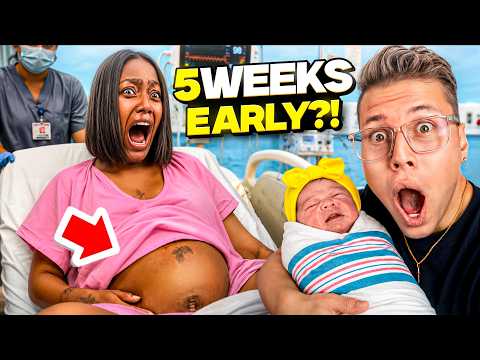
A sudden fever and contractions transform what was supposed to be a routine return to the hospital into an emergency delivery, giving this deeply personal update an immediate sense of uncertainty. The couple had already spent weeks waiting after Eva’s water broke unusually early, only for the situation to stabilize long enough that the danger began to feel almost distant. That contrast makes the rapid shift from packing calmly to rushing into maternity care especially effective.
The account of the birth works because Parker does not exaggerate what he knew in the moment. Left outside during the emergency C-section, he repeatedly emphasizes his lack of information as the neonatal incubator passes him and family members begin asking questions he cannot answer. Eva later adds her perspective from the operating room, creating a fuller account without pretending either parent understood every medical detail while events were unfolding.
Their description of Zoe’s early days in intensive care is similarly grounded in personal experience rather than medical authority. Tubes, oxygen assistance, alarms, feeding equipment, and the inability to hold her initially are presented primarily through the parents’ fear and confusion. Particularly affecting are smaller milestones: Parker realizing he was allowed to reach through the incubator to touch his daughter, Zoe grabbing his finger, and her eventual move into a more open bed as her condition improved.
The gradual progression from emergency delivery to taking Zoe home gives the story an unusually satisfying emotional structure. Instead of treating the successful birth as an instant happy ending, the couple acknowledges the uncertain days afterward, Eva’s inability to see her daughter for roughly 24 hours, and the daily conversations with doctors who could offer little more than wait-and-see answers. That willingness to leave some discomfort in the story makes the relief of bringing Zoe home feel earned.
Unfortunately, the lengthy Helix Sleep sponsorship arrives at almost the worst possible moment. It interrupts the narrative immediately after Parker introduces his newborn daughter and before the couple explains what happened following the birth. Claims about improved deep sleep from a company study are presented as promotional information rather than independently examined evidence, and the abrupt move from neonatal intensive care to mattress marketing substantially weakens an otherwise intimate sequence.
Once the family is home, the focus broadens effectively from medical uncertainty to identity, community, and new parenthood. The explanation of Zoe’s Greek-derived name connects her to Calabria’s historical Greek influence, while the tradition of displaying a birth ribbon, welcoming visitors, and offering confetti gives the update a distinctive local dimension. Some historical and linguistic explanations are presented conversationally rather than substantiated in detail, but they serve mainly as cultural context rather than the central argument.
The final stretch is warm without pretending that parenthood has instantly become effortless. Feeding dominates daily life, sleep has become scarce, Eva is still recovering from major surgery, and both parents openly acknowledge that books cannot fully prepare them for the practical realities of caring for a newborn. Their gratitude toward viewers and their neighbors could easily become sentimental, but the accumulated uncertainty behind the celebration gives that warmth genuine weight.
Pros
- The emergency birth is recounted with unusually clear emotional progression from weeks of waiting through sudden crisis and eventual relief.
- Both parents contribute distinct perspectives, giving the story greater depth without overstating what they knew medically.
- Small neonatal-care milestones, especially the first opportunities to touch and closely interact with Zoe, provide powerful specific moments.
- The discussion of local birth traditions and community visits adds meaningful cultural context to the family update.
- The couple remains candid about sleeplessness, recovery, feeding demands, and the uncertainty surrounding premature birth.
Cons
- The lengthy mattress sponsorship sharply interrupts the most emotionally sensitive point in the story.
- Promotional sleep-study claims are presented without independent context or scrutiny.
- Several historical and cultural explanations are offered casually and without enough detail to assess their accuracy from the presentation alone.
- Some repetition around feeding, visitors, and early-parenthood adjustments slightly loosens the pacing after the central birth story concludes.
What begins as an anxious account of premature delivery ultimately becomes a thoughtful portrait of relief, adjustment, and an entire community welcoming a new child. The intrusive sponsorship and occasional conversational digressions weaken the pacing, but the parents’ vulnerability, specific memories, and refusal to minimize the frightening parts make the celebration feel sincere rather than manufactured.