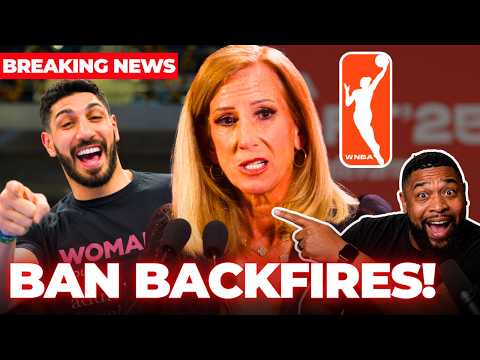
The WNBA’s eligibility rules become the centerpiece of a forceful argument about sex, inclusion, and competitive fairness, with the presenter repeatedly returning to language he says appears in the league’s collective bargaining agreement: “only players who are women are eligible to play.” From there, he argues that the league cannot simultaneously enforce an eligibility boundary and avoid publicly explaining how it defines that boundary. That is a legitimate question to examine, but the presentation quickly turns it into an ideological confrontation rather than carefully establishing what the league’s current policies actually require.
Much of the discussion revolves around Sophie Cunningham, whom the presenter describes as opposing biological males competing in women’s sports, and the reaction he says followed from other WNBA figures. The problem is that those reactions are mostly summarized rather than presented in enough detail to evaluate independently. The presenter repeatedly characterizes the league and its personnel as “woke,” “lunatics,” and detached from reality, language that communicates his position unmistakably but substitutes ridicule for a more precise examination of what individual players, coaches, or executives actually said.
Commissioner Cathy Engelbert’s departure and congressional scrutiny provide the strongest potentially consequential material. The presenter says Engelbert has announced her retirement and that Rep. Marlin Stutzman and other members of Congress sent a letter seeking answers about eligibility, physical play, fan confrontations, and enforcement standards. Yet he goes beyond the information presented when he interprets Engelbert’s retirement as effectively fleeing a controversy she helped create. Without evidence establishing her motive for leaving, that remains the presenter’s interpretation rather than a demonstrated explanation.
The Enes Kanter and Royce White episode gives the argument a concrete test case. According to the presentation, the former NBA players declared themselves WNBA prospects as a protest, sought draft consideration, and were deemed ineligible. The presenter uses that claimed rejection to argue that the league necessarily has some eligibility boundary and therefore should articulate it clearly. That logical question is worth exploring, but the segment would be considerably stronger with the relevant eligibility rules, league explanation, and procedural details laid out directly rather than treating the outcome itself as sufficient proof of the presenter’s broader characterization of WNBA policy.
His discussion of fairness is more coherent than the partisan rhetoric surrounding it. Comparisons involving weight classes, professionals versus amateurs, and adults versus children illustrate the basic point that organized sports routinely impose eligibility restrictions and that inclusion does not mean every person qualifies for every competition. However, moving from that general principle to the specific eligibility standard the WNBA should use requires additional argument and evidence. The presenter treats his preferred conclusion as self-evident instead of seriously addressing competing definitions, legal considerations, or the precise policy language at issue.
Pacing also suffers from a lengthy mid-video promotion for a five-day program about building AI-assisted income streams. The advertisement is substantially removed from the WNBA controversy and interrupts the argument just as the congressional and eligibility questions are developing. Once the commentary resumes, it becomes increasingly repetitive, returning several times to the same contention that defining eligibility necessarily defines ineligibility. That repetition, combined with insults and escalating rhetoric, makes the closing section feel more like a rallying speech than an attempt to investigate an unresolved policy dispute.
Pros
- The eligibility language attributed to the WNBA gives the commentary a specific policy question to examine rather than leaving the entire discussion at the level of culture-war abstractions.
- The Kanter and White example provides a concrete way to ask how the league determines who qualifies for participation.
- The explanation that competitive sports inherently contain eligibility restrictions is clearly expressed and easy to follow.
- Congressional questions and Engelbert’s departure give the discussion identifiable developments around which to organize the argument.
Cons
- Important claims about WNBA policy, congressional action, player reactions, and draft eligibility are asserted or summarized without enough underlying documentation to evaluate them fully.
- Engelbert’s retirement is characterized as an attempt to escape controversy without evidence establishing that motive.
- Repeated insults and ideological labels overwhelm potentially substantive questions about eligibility standards and competitive fairness.
- The argument gives little meaningful consideration to opposing interpretations or the legal and policy complexities surrounding the issue.
- The extended AI-income promotion sharply disrupts the pacing and has little connection to the subject being discussed.
- The final portion repeats the same inclusion-versus-exclusion argument several times without materially advancing it.
There is a worthwhile policy question at the center of the commentary: if the WNBA maintains eligibility restrictions, explaining those standards clearly would make discussion of them more concrete. The presentation weakens that inquiry through unsupported interpretations, limited engagement with competing arguments, repetitive rhetoric, and an aggressive ideological tone that too often replaces careful examination.