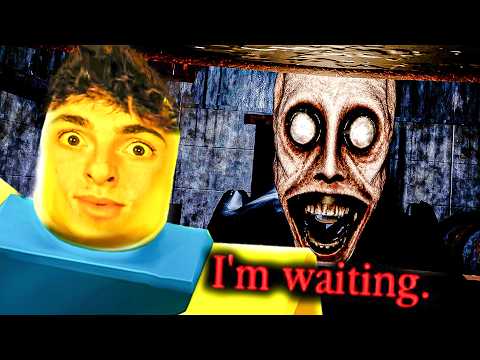
A supposedly threatening performer arrives with an intimidating list of rules, yet almost everything that follows makes him seem less dangerous. The player must build a house with stairs, windows, and lights, avoid hitting the character, hide when instructed, and survive various games until the final trials become available. That framework has the ingredients for a tense survival experience, but the commentary quickly discovers how easily most of its threats can be neutralized.
The funniest material comes from treating the antagonist with complete disrespect. His jump scares are mocked, his attempts to enter the house become running jokes, and failed attacks earn insults rather than panic. Even the character's musical interludes become an excuse to appreciate the beat instead of fear what might happen next. The sarcastic insistence that this is supposedly terrifying works particularly well when something finally does cause a genuine reaction, such as the unexpected appearance on the roof.
There is also some entertaining experimentation with the mechanics. A trap is constructed in hopes of luring the pursuer into a hole, the roof becomes a hiding place, and the player deliberately tests how the character responds to being attacked. These moments give the otherwise repetitive waiting period a sense of improvisation. The discovery that the antagonist can dodge the hole or simply fails to reach certain locations reinforces the central joke that the monster is surprisingly ineffective.
Unfortunately, the underlying rules often seem more confusing than frightening. The game apparently punishes the player for retaliating after the character attacks first, while several instructions are vague enough to require trial and error. The final face-looking challenge is a good example: the player understands that the face must be watched but initially fails for being "too close," without an immediately obvious indication of the required distance. Confusion can strengthen horror when uncertainty itself creates danger, but here it more often produces irritation.
Pacing is the larger weakness. Progress toward the final trials requires roughly an hour, leaving long stretches where familiar encounters repeat without substantially increasing the pressure. Hide-and-seek is especially easy to exploit, and the music-freezing challenge can apparently be beaten by simply remaining stationary from the beginning. The commentary keeps these stretches reasonably lively through jokes and experimentation, but it cannot completely disguise how little escalation occurs.
The closing sequence at least provides a tangible objective. Completing the later hiding, freezing, and face-watching trials gives the session more direction, and figuring out the proper distance for the final challenge produces a modest sense of accomplishment. Yet the conclusion is strangely understated: the character leaves, the player waits several minutes to confirm that nothing else is happening, and the experience appears to be over. For a game built around surviving a persistent visitor, the victory feels considerably less dramatic than the setup promises.
Pros
- Sarcastic commentary turns the ineffective scares and awkward monster behavior into consistent comedy.
- Experimenting with traps, hiding locations, combat, and the game's rules adds spontaneity to a repetitive survival structure.
- Occasional unexpected appearances briefly produce the tension that the broader experience struggles to maintain.
- The final trials provide a clearer objective after the lengthy waiting period.
Cons
- The antagonist is generally too easy to evade or exploit to sustain meaningful horror.
- Several mechanics and instructions are confusing, particularly retaliation rules and the required distance during the face challenge.
- Waiting roughly an hour for the final trials creates substantial repetition without enough escalation.
- Some challenges can be trivialized by simple strategies, undermining their intended suspense.
- The eventual victory is anticlimactic and provides little payoff for the extended setup.
The entertainment comes primarily from watching an allegedly frightening pursuer repeatedly fail to live up to his role, with sarcastic commentary making that mismatch much funnier than the horror itself. Amusing experimentation and a few genuine surprises help carry the session, but repetitive encounters, exploitable challenges, and an understated ending leave the game's central threat feeling decidedly toothless.