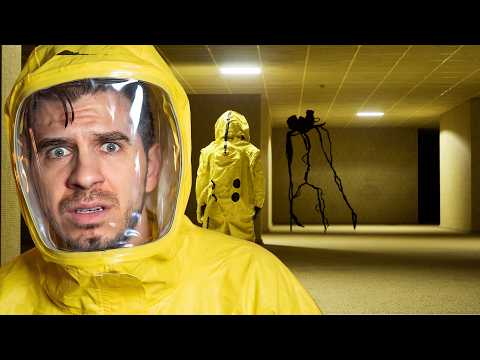
An imitation of the player's own mother joining the Roblox session provides the standout scare, precisely because it does not initially look like a conventional monster encounter. The player genuinely questions whether his mother has entered the game, only to discover that the familiar avatar is part of the horror design. That moment captures what works best here: the experience uses the expectations and social mechanics of Roblox itself to create uncertainty rather than relying exclusively on creatures jumping out of dark hallways.
The larger exploration is equally important to the appeal. Nearly 30 points of interest encourage wandering through interconnected liminal spaces, including corridors, furnished rooms, a furniture store, basements and an extensive pool-room section. Doors closing in the distance, footsteps, changing ambience and occasional glimpses of entities keep relatively quiet stretches tense. The player repeatedly gets lost, doubles back and debates which route to take, but that confusion feels appropriate for a Backrooms setting and helps communicate the scale of the environment.
Several sequences demonstrate particularly effective environmental design. The Ottoman Empire furniture store becomes a prolonged encounter involving Captain Clark, whom the player simultaneously fears and jokingly treats like a celebrity. Later, the pool rooms shift the mood from threatening corridors toward brightly lit, strangely inviting architecture before danger intrudes again. The transition works because attractive liminal spaces and hostile entities coexist rather than every location being uniformly dark or grotesque.
The commentary is highly reactive and often very funny. Calling himself "John back room," asking monsters for selfies, insisting he is an expert while obviously lost and repeatedly trying to negotiate with Captain Clark creates an entertaining contrast with his visible anxiety. His excitement also feels unusually specific: he notices recognizable environments, talks about favorite areas, searches for hidden routes and repeatedly praises the developers after discovering new sections. That enthusiasm makes the playthrough feel like someone actively engaging with the game rather than mechanically moving from scare to scare.
That same improvisational style is also the main weakness. Directions from chat, donation acknowledgments, repeated declarations of fear, extended arguments about staircases and frequent backtracking can make progression difficult to follow. There are stretches where very little changes beyond the player wondering whether he has already visited a room. Viewers primarily interested in seeing the game's environments, mechanics and entities efficiently may find the loose livestream pacing substantially more tiring than the horror itself.
The presentation ultimately succeeds because the player's reactions reveal several different strengths of the game without turning into a formal review. Social deception, pursuit sequences, environmental sound, large exploratory spaces and dramatic changes in atmosphere all receive meaningful attention through play. He finishes without finding every point of interest and notes that additional areas remain, so the run is not comprehensive, but his repeated conclusion that it ranks among his favorite Backrooms games feels earned by the amount of genuine surprise and enjoyment displayed throughout.
Pros
- The fake-mother encounter cleverly uses Roblox's social expectations to produce a memorable scare rather than relying on a routine jumpscare.
- Varied environments, including the furniture store and expansive pool rooms, give the exploration a strong sense of discovery.
- Doors, footsteps, disappearing ambience and roaming entities maintain tension even during relatively quiet exploration.
- Energetic humor and obvious enthusiasm make the player's fear entertaining rather than monotonous.
- The playthrough demonstrates a surprisingly large, interconnected environment with numerous points of interest and optional areas.
Cons
- Heavy backtracking and repeated uncertainty about previously explored rooms make portions of the playthrough drag.
- Constant chat interaction, donation acknowledgments and repeated reactions frequently interrupt the exploration.
- The run ends without discovering every point of interest, leaving parts of the game unseen.
- The extremely repetitive vocabulary of fear and praise can become exhausting during longer stretches.
Clever social scares, richly varied liminal spaces and unpredictable exploration make this an unusually entertaining Backrooms playthrough. The livestream-style repetition and wandering keep it from being a particularly clean showcase of the game, but the player's authentic panic, humor and escalating enthusiasm provide plenty of personality. It is messy, funny and frequently tense in exactly the way an exploratory horror session should be.