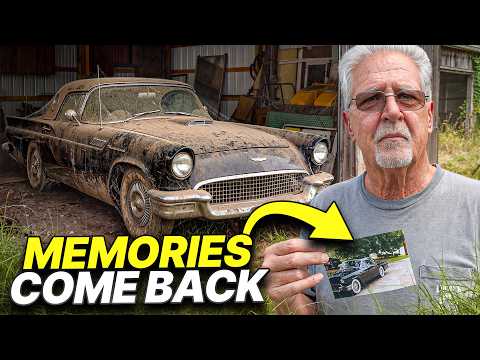
Thirty years of garage dust, mouse nests and mechanical uncertainty give this 1986 Pontiac Firebird restoration an unusually strong emotional foundation. Candace contacts the detailing team because the car belongs to her 83-year-old father, who has owned it since it was nearly new and still clearly associates it with happier driving memories. That personal connection gives the cleaning work a purpose beyond cosmetic transformation: the real goal is to make the car usable enough for father and daughter to enjoy it again.
The project develops naturally from discovery into troubleshooting. A jammed driver’s door, damaged plug wires, disconnected vacuum lines, a questionable intake setup and years of inactivity create enough uncertainty that getting the Firebird to run feels earned rather than inevitable. Mechanic Adam’s diagnosis is presented in approachable terms, particularly when he works through the fuel system, ignition issues and missing air-box problem. The car eventually moves and stops under its own power, although the team appropriately notes that the brakes still deserve inspection and that the bald tires need replacement before regular driving.
Detailing remains the centerpiece, and the restoration produces plenty of genuinely satisfying before-and-after material. The wheels receive intensive cleaning around their many spokes, decades of debris are vacuumed from the engine bay, oxidation is polished from the paint, and the heavily soiled interior is stripped down far enough to expose mouse nests beneath the seats. Removing the rear louvers also allows neglected areas to be cleaned rather than simply working around them. Replacing the missing wheel center cap is a small touch, but it matters because the owner had specifically mentioned it earlier.
The mouse contamination gives the interior work an added challenge, although some of the narration makes stronger sanitation claims than the presentation establishes. Ozone treatment, enzyme cleaner, pressure washing and extraction are shown as part of the cleanup, but statements that the process eliminates all bacteria, germs or contamination are asserted rather than demonstrated. Similarly, the claim that old engine grease necessarily traps enough heat to harm hoses is delivered with more certainty than the surrounding evidence supports. These points do not undermine the cleaning itself, but the explanatory narration occasionally overstates what can be concluded from the procedures shown.
Automotive researcher Mike adds welcome historical flavor by discussing the third-generation Firebird’s lighter construction, aerodynamic emphasis, interior design, color and aftermarket louvers. His contributions fit the project well because they explain why various styling details are interesting rather than treating the car purely as a dirty object awaiting transformation. Some historical and engineering assertions, including production percentages, aerodynamic comparisons and period-specific design claims, are presented conversationally without supporting evidence, so they work better as enthusiast commentary than as rigorously established automotive history.
Presentation is energetic and generally well paced despite the substantial amount of work involved. Mechanical troubleshooting, detailing, historical commentary and light humor alternate frequently enough to keep the restoration from becoming repetitive, and the live mouse discovery provides an unexpected complication without consuming too much time. The major disruption is the extended Corvette giveaway advertisement, which arrives while the restoration is building momentum and temporarily turns the episode into a product-and-sweepstakes pitch. Additional website promotion and repeated engagement prompts are less intrusive but collectively add commercial clutter.
The final reveal succeeds because it pays off details established much earlier rather than relying only on a shiny finished car. The team initially pretends the Firebird could not be started before its engine gives away the surprise, the father recognizes the sound, and attention is drawn back to the restored interior and missing center cap. His restrained but clearly pleased response feels more convincing than an exaggerated manufactured reaction would have. Ending with the owner immediately taking the car toward a mechanic also provides an appropriately realistic note: the detail and basic revival are complete, but the Firebird still has mechanical work ahead before its comeback is truly finished.
Pros
- Gives the restoration genuine emotional weight through Candace’s effort to revive a car that remains important to her 83-year-old father.
- Combines detailing with credible mechanical troubleshooting instead of pretending decades of inactivity can be solved through cleaning alone.
- Shows substantial, varied restoration work across the wheels, engine bay, mouse-contaminated interior, paint, tires and missing center cap.
- Mike’s automotive commentary adds useful context about the Firebird’s styling and period character without overwhelming the restoration.
- The final reveal effectively pays off earlier details and produces a warm reaction without forcing excessive sentimentality.
Cons
- Claims that ozone, enzyme treatment and extraction completely eliminate bacteria, germs and contamination are stronger than what is demonstrated.
- Several automotive-history and engineering statements are presented confidently without evidence or qualification.
- The lengthy Corvette giveaway promotion significantly interrupts the restoration’s momentum.
- Repeated engagement prompts and promotional material occasionally crowd out an otherwise focused story.
A neglected family Firebird becomes much more engaging than a routine detailing project because the mechanical revival, deep cleaning and emotional objective reinforce one another. Some explanatory claims are overstated and the commercial interruptions are noticeable, but the thorough transformation and understated father-daughter payoff make the project satisfying from both automotive and human perspectives.