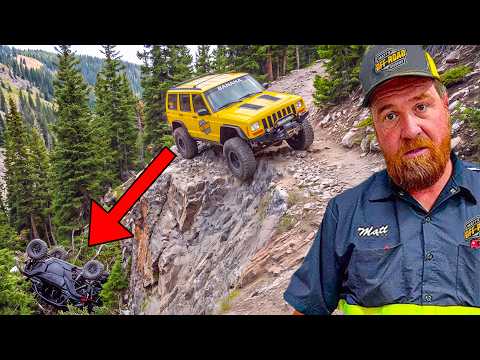
Recovering two abandoned vehicles from a steep hillside above Montana's Flathead River requires more than a powerful tow truck. With damaged vehicles resting below a difficult embankment and the surrounding landscape needing protection, the operation calls for careful planning, specialized winching equipment, and experienced recovery operators. Riley joins Matt's Off Road Recovery with his massive Marine Corps MTVR 7-ton truck, providing a heavy anchor for an ambitious cleanup effort. What follows is an entertaining combination of backcountry travel, mechanical problem-solving, and collaborative vehicle recovery.
The adventure begins well before the recovery site, with Riley and his friend Andy traveling through Idaho and Montana in the military 6×6. Riley introduces the truck's Caterpillar C12 engine, Allison seven-speed transmission, locking differentials, and six-wheel steering while explaining some of its practical limitations. Its enormous fuel consumption becomes an immediate concern when they discover the tank is nearly empty shortly after leaving town. These early details establish the vehicle's capabilities while giving the journey a relaxed, unpredictable atmosphere that feels genuinely spontaneous.
The overnight journey provides some of the video's most memorable moments, although it also exposes questionable preparation. After struggling to locate a campsite, Riley and Andy find themselves driving through extremely dark conditions with inadequate headlights. A frightening encounter with an elk prompts them to stop and install an auxiliary light bar using a separate battery system because the truck's 24-volt electrical setup is incompatible with their 12-volt accessories. The improvised solution makes a dramatic difference, but the situation raises legitimate concerns about undertaking a remote nighttime drive without properly preparing essential lighting equipment beforehand.
Camping beside a railway line, watching wildlife, fishing, and enjoying breakfast add personality and variety to the experience. Andy's enthusiasm and easygoing exchanges with Riley create an enjoyable friendship dynamic, particularly when their supposedly peaceful campsite turns out to have trains passing throughout the night. The scenery also receives considerable attention, from clear waterways and distant elk to the changing Montana landscape. However, the extended stops for groceries, snacks, fishing, and sightseeing delay the main attraction considerably. Viewers primarily interested in the recovery operation may find the opening portion longer than necessary.
Once the crew reaches the Flathead River recovery site, the presentation becomes substantially more focused and technically interesting. Riley explains that the cleanup is taking place on Confederated Salish and Kootenai Tribes property, with the intention of removing abandoned vehicles while minimizing disturbance to the hillside. Matt's recovery equipment is positioned alongside the military truck, which serves as an anchor rather than directly pulling the vehicles out. The explanation of snatch blocks, distributed pulling forces, and multiple winch lines provides useful insight into how complicated recoveries can be managed without simply dragging heavy machinery across sensitive terrain.
The actual recoveries are the video's strongest material. The first vehicle is turned onto its wheels before being lifted toward the road, requiring Matt to coordinate winch operation with repositioning his recovery truck. The second vehicle presents a more demanding challenge, with additional winch lines introduced to provide redundancy as the crew manages heavier loads and potentially worn cables. Riley's curiosity helps make these procedures accessible, particularly when Matt explains the trade-offs involved in building a recovery vehicle light enough to navigate difficult trails but powerful enough to handle substantial loads. Still, the coverage would benefit from a more systematic explanation of the rigging arrangements, equipment ratings, and safety precautions. The successful extractions demonstrate the crew's practical abilities, but they should not be mistaken for a complete technical guide to safe vehicle recovery.
The closing portion shifts toward the people behind the operation, offering a surprisingly warm exchange between Matt and his son Rudy about working together and learning from one another. Riley's enthusiasm for eventually sharing similar experiences with his own children gives the conversation an emotional connection beyond the machinery. His opportunity to drive Matt's specialized recovery truck, complete with independently controlled rear steering, provides another entertaining mechanical highlight. The subsequent promotion of an upcoming Ford Ranger racing event feels less organically connected to the recovery, but the central adventure has already delivered a satisfying conclusion through the completed cleanup and the crew's camaraderie.
Pros
- The military MTVR's mechanical specifications, tire-pressure adjustment system, and off-road performance provide fascinating insight into a highly specialized heavy-duty vehicle.
- Riley and Andy's natural chemistry, spontaneous camping experiences, and encounters with Montana wildlife make the journey personable and entertaining.
- The recovery operation introduces practical concepts involving snatch blocks, anchor vehicles, multiple winch lines, and load distribution in an accessible manner.
- Matt's experienced crew demonstrates impressive coordination and adaptability while extracting two difficult-to-reach vehicles from a steep hillside.
- The emphasis on removing abandoned vehicles while minimizing damage to the surrounding landscape gives the recovery a worthwhile environmental purpose.
- Riley's genuine curiosity and willingness to learn make the technical discussions approachable without pretending that he already understands every procedure.
- The conversation between Matt and Rudy adds meaningful emotional depth, highlighting the family relationships behind the demanding recovery work.
Cons
- The lengthy travel, shopping, fishing, and camping sequences substantially delay the recovery operation promised by the title.
- Beginning a remote nighttime drive with inadequate lighting creates an avoidable safety concern that the improvised light-bar installation only partially addresses.
- The recovery explanations lack detailed information about load calculations, cable capacities, anchor stability, and safety procedures, limiting their technical usefulness.
- The actual condition and positioning of the abandoned vehicles receive relatively little background, leaving some uncertainty about the specific challenges involved.
- The extended racing-event promotion interrupts the otherwise natural conclusion to the recovery adventure.
Riley's Montana adventure succeeds by combining the spectacle of a military 6×6 with an impressive real-world recovery operation and an engaging group of personalities. Although the leisurely opening and limited technical depth prevent it from becoming a tightly focused recovery documentary, the careful teamwork, mechanical ingenuity, and environmental cleanup provide substantial entertainment and practical interest. The result is an enjoyable off-road collaboration whose strongest moments come from watching experienced operators solve difficult problems together.