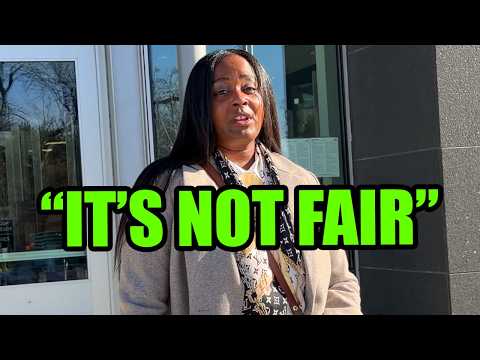
The strongest material here is the contrast between one woman's satisfaction with her new surroundings and the backlash she says followed when she described them publicly. Her central point is straightforward: she moved from the East Coast to a predominantly white community on the West Coast, finds her surroundings quiet, clean and peaceful, and believes the move has given her son a better environment. The host reasonably defends her right to prefer those conditions and rejects the idea that choosing where she wants to raise her child should itself constitute racial betrayal.
That potentially useful discussion becomes much more complicated when an individual experience is treated as evidence about racial groups and neighborhoods generally. The woman's descriptions explicitly contrast what she associates with black neighborhoods against her overwhelmingly white surroundings, while the host repeatedly asks whether she is simply acknowledging an uncomfortable reality. Yet the video establishes almost nothing about her previous neighborhood, her current community, their respective socioeconomic conditions or crime levels. Her happiness after moving is evidence of her own experience; it does not by itself establish why the two places differ or how representative either one is.
The host does make an important distinction when she says undesirable behavior is not inherent to black people and argues that mindset rather than skin color is ultimately the issue. She also identifies legitimate subjects for discussion, including neighborhood safety, disorder, parenting, schooling, exposure to different opportunities and expectations within families and communities. Those points could support a serious examination of how environments improve or deteriorate. The problem is that they are asserted largely through anecdotes and broad social conclusions rather than developed with evidence capable of separating race, culture, economics, crime, education and other potentially relevant factors.
That evidentiary weakness becomes especially noticeable when the host invokes "crime stats" and argues that white people are not the problem facing black Americans, without actually presenting those statistics or defining the comparison. Likewise, references to fights at restaurants, gangs, theft, prostitution and locked-up merchandise accumulate into a picture of dysfunction without demonstrating how widespread these phenomena are or establishing their causes. The opposing clip from a black woman who says she would feel safer around Crips and Bloods than white people is an extreme statement worth challenging, but one person's provocative opinion cannot establish the broader attitudes the host attributes to black Americans.
The discussion of systemic explanations is similarly one-sided. The host characterizes a prevailing narrative in which black Americans blame "the white man," oppression and generational trauma, then counters that individuals can break cycles through different choices. Personal agency and structural conditions are not inherently mutually exclusive, however, and the video does little to examine how both might operate simultaneously. Calling community problems "self imprisonment due to mindset" may express the host's position clearly, but the argument needs considerably more support before it can explain complex patterns across entire communities.
Presentation also works against the video's more defensible message. The featured woman's increasingly profane responses contain sweeping insults toward people she associates with "the hood," and the host largely treats that escalation as justified bluntness rather than separating the reasonable desire for a safer environment from the racial and class generalizations surrounding it. The host's own speculation compounds the issue: she assumes the woman's white neighbors probably welcome her, assigns critics to categories such as people trapped in destructive cycles or "white leftists," and describes motivations that the video does not establish. A calmer distinction between what is actually known, what the featured woman reports and what the host infers would have made the commentary substantially stronger.
There is nevertheless a worthwhile argument underneath the provocation: people should be able to criticize harmful behavior within communities, seek safer and more peaceful surroundings, and pursue better opportunities for their children without being accused of betraying their race. The video is also right to recognize that improving troubled neighborhoods would require more than rhetoric and that parenting, schools and community expectations are legitimate areas for discussion. But by using one woman's experience and a handful of inflammatory examples as a platform for sweeping conclusions about black communities, systemic explanations and ideological opponents, it turns a potentially nuanced conversation about environment and personal agency into a much broader argument than its evidence can sustain.
Pros
- Defends an individual's right to seek a safer, quieter environment for herself and her child without framing that choice as racial disloyalty.
- Recognizes that criticizing destructive behavior is different from claiming that all members of a racial group behave the same way.
- Raises legitimate questions about parenting, schooling, community expectations, personal agency and the difficulty of improving troubled neighborhoods.
- Challenges the extreme claim that rival gangs should inherently feel safer than being around white people.
Cons
- Generalizes from one woman's personal experience without providing meaningful information about either her former or current community.
- Invokes crime statistics and broad patterns of social dysfunction without actually presenting evidence that would support the conclusions drawn from them.
- Treats complex questions about systemic conditions, generational disadvantage and individual responsibility as more mutually exclusive than the video establishes.
- Speculates about the attitudes of the woman's white neighbors and the identities and motivations of her online critics without supporting evidence.
- The featured woman's racialized and class-based insults are largely endorsed rather than critically separated from her more defensible argument about wanting better living conditions.
- Heavy reliance on provocative anecdotes and ideological framing makes the discussion less rigorous than its serious subject matter requires.
There is a defensible and potentially valuable argument here about personal agency, community standards and the freedom to choose a better environment for one's family. But the commentary repeatedly expands a single person's experience into broad claims about race, culture and systemic explanations without supplying the evidence or nuance those conclusions require. A more disciplined treatment could have preserved the challenge to destructive behavior while avoiding unsupported assumptions about entire communities and the people debating them.