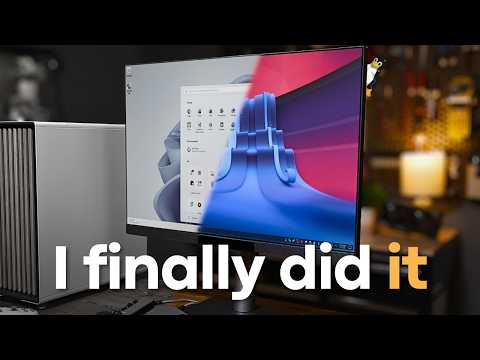
The video explores a question that has long circulated among PC enthusiasts by comparing memory usage on otherwise identical Windows 11 and Linux Mint systems across everyday workloads and games. Rather than treating the topic as an abstract debate, the presentation builds around a series of live demonstrations, measuring RAM consumption while browsing the web, using communication apps, and launching several games. The central finding presented is that Linux consistently uses substantially less memory than Windows in these scenarios, though the host is careful to acknowledge that the testing is informal rather than a controlled scientific benchmark.
One of the video's greatest strengths is its transparency about methodology. The creators explain the software environment, driver updates, operating systems, and why Linux Mint was selected before testing begins. They openly state that the experiment is intended to resemble how many people actually use their computers—with browsers, Discord, and games running simultaneously—rather than isolating individual applications in laboratory conditions. That framing makes the results easier to interpret while also setting reasonable expectations about the limits of the experiment.
The live format also gives the discussion an engaging quality because neither the hosts nor the audience appear to know exactly how each test will unfold. The consistently widening memory gap during web browsing, Discord usage, and multiple game launches creates a clear narrative without requiring exaggerated editing. Humor between the presenters keeps the technical material approachable, while the visible real-time RAM counters allow viewers to judge the demonstrations for themselves instead of relying solely on verbal descriptions.
Importantly, the video generally distinguishes observation from explanation. It documents that Windows consumed more RAM throughout the tested workloads, but when attempting to explain why, the hosts repeatedly acknowledge uncertainty. Several theories involving memory management, graphics drivers, runtime environments, and game behavior are presented explicitly as speculation rather than established fact. That restraint strengthens the credibility of the presentation, even if many of the underlying technical questions remain unanswered by the end.
The discussion also avoids reducing the issue to a simplistic conclusion. Although Linux demonstrates lower RAM usage throughout the demonstrations, the creators recognize that lower memory consumption alone does not determine the best operating system for every user. They point to software compatibility limitations, mentioning applications that lack native Linux support and acknowledging that troubleshooting can still be part of the experience. This broader perspective prevents the comparison from becoming a one-sided endorsement despite the favorable benchmark results.
Some limitations remain. The creators repeatedly note that the testing is not exhaustive, and the small selection of applications means the findings should not be treated as universal across all hardware, drivers, software, or Linux distributions. Likewise, while Windows consistently shows higher reported memory usage, the video also notes that operating systems can intentionally cache data differently. That distinction is important because higher RAM usage is not automatically evidence of inefficient design, even if the measured differences are genuine within these specific tests.
By the conclusion, the video succeeds less as a definitive technical study than as an accessible investigation into a practical question many gamers ask when considering hardware upgrades or operating system changes. Its willingness to expose unexpected results, admit uncertainty, and balance performance observations with real-world software compatibility concerns makes the presentation both informative and approachable, even if viewers seeking rigorous benchmarking across a wider range of workloads will naturally want additional evidence.
Pros
- Clearly explains the testing setup and openly acknowledges the experiment's limitations.
- Uses live demonstrations with visible RAM usage, allowing viewers to follow the results directly.
- Distinguishes measured observations from speculative explanations when discussing technical causes.
- Balances Linux's lower memory usage with practical discussion of software compatibility and troubleshooting.
Cons
- The testing covers only a limited selection of applications and games, limiting how broadly the results can be generalized.
- Several technical explanations for the observed differences remain speculative because the underlying causes are not fully investigated.
- The lengthy sponsor segment interrupts the flow near the end of the discussion.
This is an engaging and well-structured exploration of a practical PC performance question that favors observation over sweeping conclusions. While its demonstrations are not comprehensive enough to settle the broader debate, they present consistent evidence within the tested workloads and are accompanied by appropriate caveats about compatibility and methodology. Viewers interested in gaming performance or Linux adoption are likely to come away with useful information as long as they recognize the difference between the measured results and the hosts' interpretations.