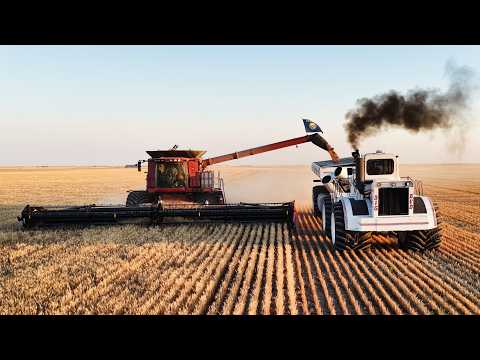
A 1978 Big Bud 525 tractor unexpectedly appearing on the farm provides an exciting opportunity to examine a piece of agricultural machinery history. The massive tractor belongs to a crew working on a natural gas pipeline project that requires ripping a trench across part of the property. Rather than simply acknowledging its presence, the host takes viewers on an enthusiastic walkaround, examining its mechanical features, custom modifications, and similarities to the Big Bud tractors already in his collection. What begins as an unexpected machinery discovery gradually transitions into a working farm vlog featuring difficult harvesting conditions, equipment recovery, and family interactions.
The inspection of the visiting Big Bud is easily the most interesting portion of the presentation. Identified as the fourth tractor produced in 1978, the machine features a Cummins KTA engine that the host estimates produces approximately 500 to 525 horsepower. He points out its Clark axles, distinguishing them from the Caterpillar axles on his own tractors, and explains why replacement parts availability makes the Clark components particularly appealing. Comparisons involving the chain cases, cab configurations, steering columns, and transmission controls demonstrate how much these machines varied during production. His familiarity with Big Bud equipment gives the examination credibility, even when certain details remain uncertain.
One particularly useful observation concerns the visiting tractor's reinforced drawbar. The host explains that the drawbar on his own Big Bud 700 has begun bending under the weight of a grain cart, making the additional steel reinforcement on this machine an attractive potential solution. This practical comparison turns a casual inspection into an opportunity to learn from another operator's modifications. The homemade ripping attachment receives similar attention, with its heavy construction, hydraulic cylinder, leveling components, and improvised hardware demonstrating how specialized agricultural equipment can be adapted for industrial applications. The enthusiasm feels genuine because the host clearly appreciates the ingenuity required to make unconventional machinery perform demanding jobs.
The walkaround also offers a realistic perspective on maintaining decades-old equipment. Faded paint, deteriorating rubber, a damaged window, and a bent fender illustrate the accumulated effects of age and heavy use. The host reasonably acknowledges that restoring these machines requires considerable effort and that the amount of investment depends on how frequently the equipment will be operated. However, the examination is primarily observational rather than a comprehensive mechanical assessment. Estimates concerning horsepower, the origins of certain modifications, and possible causes of damage are presented as informed impressions rather than confirmed findings, leaving some potentially interesting technical questions unanswered.
After the tractor inspection, attention shifts to wheat harvesting in increasingly difficult field conditions. Excessive moisture has created muddy areas that complicate equipment movement, while uneven crop performance and persistent weeds add to the workload. The host discusses disappointing yields in fields with challenging soil characteristics and explains why certain areas produce less grain than others. These observations provide useful agricultural context, particularly when he describes the advantages of using a Big Bud tractor and grain cart to transport harvested wheat through areas inaccessible to semi-trucks. The combination of equipment capability and difficult terrain illustrates the practical demands of running a large farming operation.
The most dramatic harvesting development occurs when a combine becomes stuck after entering a wet area near a roadside ditch. Rather than continuing to spin the tires and risk sinking farther, the crew retrieves a recovery rope and soft shackles, using a Big Bud tractor to pull the machine backward toward firmer ground. The preparations and explanations provide an engaging look at how the crew approaches an unexpected field problem. Although the recovery is less elaborate than the initial situation might suggest, it adds an element of uncertainty and reinforces the importance of having capable support equipment available during harvest.
Family interactions introduce a lighter atmosphere between machinery discussions and harvesting responsibilities. Young helpers ride along, joke about providing massages, handle grain, and answer questions about how wheat moves from the combine to the grain cart, semi-truck, and storage bins. These exchanges make the farming operation feel personal and approachable while introducing basic agricultural processes in an entertaining way. However, the extended casual conversations occasionally interrupt the progression of the machinery and harvesting coverage. Viewers primarily interested in Big Bud tractors may find the transition from the detailed opening inspection to everyday family moments somewhat unfocused.
The closing section returns to the realities of maintaining productivity under imperfect conditions. The host encounters questionable grain cart scale readings, continues loading trucks based on experience, and eventually ends the workday when falling temperatures and rising moisture make wheat harvesting increasingly difficult. These details reinforce the authenticity of the farming experience, showing that equipment problems, changing field conditions, and weather-related limitations frequently dictate the day's schedule. Although the presentation lacks a tightly structured narrative and never returns to the visiting tractor for a more detailed operational demonstration, its combination of mechanical curiosity, practical problem-solving, and spontaneous farm life provides a satisfying experience for viewers who enjoy agricultural machinery and working-farm content.
Pros
- The unexpected appearance of a 1978 Big Bud 525 provides an engaging opportunity to examine an uncommon piece of agricultural equipment.
- Detailed comparisons of axles, drivetrain components, cab configurations, and other mechanical features demonstrate the host's practical familiarity with Big Bud tractors.
- The reinforced drawbar inspection offers a valuable example of learning from another operator's equipment modifications.
- Examination of the homemade pipeline ripper highlights the creativity and engineering involved in adapting heavy machinery for specialized applications.
- The muddy combine recovery and discussion of grain cart accessibility illustrate genuine operational challenges during difficult harvesting conditions.
- Natural family interactions provide warmth and humor while introducing younger viewers to basic agricultural processes.
Cons
- Several technical details, including engine output and the origins of certain modifications, remain estimates or unanswered questions rather than verified information.
- The visiting tractor receives a detailed visual inspection but no operational demonstration, limiting the examination of its actual performance.
- The transition from the Big Bud discovery to harvesting activities creates a somewhat disjointed structure, particularly for viewers attracted primarily by the tractor-focused title.
- Extended family conversations and routine harvesting footage occasionally slow the pacing without contributing substantially to the central machinery discussion.
- The grain cart scale problem and other operational concerns are introduced without detailed troubleshooting or clear resolutions.
The host delivers an enjoyable and authentic farming vlog that combines genuine enthusiasm for historic Big Bud tractors with the unpredictable challenges of a wet wheat harvest. The detailed machinery comparisons, homemade ripper inspection, and practical equipment recovery provide the strongest material, while the family interactions add personality to an otherwise equipment-heavy presentation. Although the shifting focus and limited technical follow-through prevent it from becoming a definitive examination of the visiting tractor, the combination of mechanical knowledge and everyday agricultural experience makes this a worthwhile watch for farming enthusiasts.