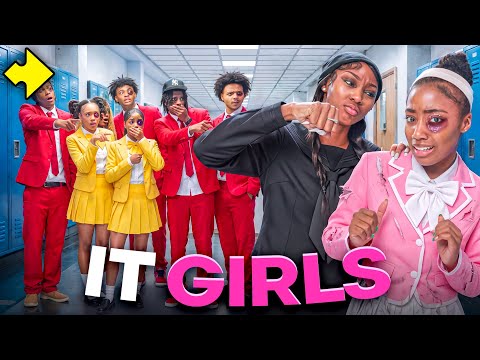
Gabby arriving at school with a bag over her head immediately gives the Brookhaven story a clear mystery: something has damaged her confidence badly enough that she no longer wants anyone to see her face. Her friends initially treat the situation with their usual playful energy, but the discovery that she believes she is no longer “pretty enough” for the school dance gives the scenario a more serious emotional foundation than its exaggerated roleplay style might suggest.
The bullying storyline establishes the source of that insecurity quickly. Two girls openly insult Gabby’s appearance, while her friends confront them and try to convince her that their cruelty should not determine whether she attends the dance. The basic message about standing by a friend who is being bullied is positive and easy to understand, although the dialogue is deliberately broad and repetitive rather than especially nuanced. Gabby’s willingness to tolerate attacks on herself while becoming concerned when her friends are targeted is also a small but effective character detail.
Much of the entertainment comes from the group’s chaotic attempts to cheer Gabby up. An improvised drawing of her as a “purple queen,” repeated teasing about Jack’s apparent crush, the trip for food and the running diary joke keep the story moving between its more emotional scenes. That energy suits the playful Brookhaven format, but calls for viewers to like the video and references to followers occasionally make the storytelling feel more like audience engagement machinery than part of Gabby’s predicament.
Jack’s feelings for Gabby provide the clearest secondary storyline. His friends repeatedly embarrass him about his supposed diary entries and attraction to her before the story eventually positions him as her dance partner. The running joke is predictable, but it gives the final makeover and dance preparation a little more payoff than they would have as a purely cosmetic transformation.
The weakest narrative decision is the friends’ plan to discover what is beneath the bag. Rather than waiting until Gabby feels comfortable revealing what happened, they obtain rope, travel to her house, enter through an unlocked door and attempt to remove the bag themselves. Within the deliberately ridiculous roleplay, the sequence becomes a slapstick stealth mission, but it clashes noticeably with the otherwise supportive message because Gabby has repeatedly asked them not to look.
Once the school dance deadline becomes urgent, the pacing accelerates into a frantic makeover sequence. Hair restoration, a dress and Jack volunteering to accompany Gabby give the story the upbeat transformation it has been building toward. The exaggerated countdown works well for momentum, though the emphasis on making Gabby conventionally attractive enough to confront her bullies somewhat muddles the earlier reassurance that she was already worthy of confidence and friendship regardless of her appearance.
The ending shown is energetic but surprisingly abrupt. Gabby receives her makeover, Jack becomes her date, and the group rushes toward the dance intending to prove the bullies wrong, yet the actual confrontation and school-dance payoff are not included. After spending so much time establishing the bullies, the dance and the possibility of Gabby becoming queen, stopping before those threads resolve makes the story feel more like the setup for a continuation than a fully completed arc.
Pros
- Gabby’s sudden insecurity creates an immediate mystery and gives the roleplay clear emotional stakes.
- The friends consistently oppose the bullying and try to restore Gabby’s confidence.
- Jack’s hidden-crush storyline adds a playful secondary thread that connects naturally to the dance.
- The food trip, diary jokes and frantic makeover provide frequent comic movement around the central conflict.
- The approaching dance creates an effective deadline that keeps the later scenes moving quickly.
Cons
- Repeated appearance-based insults and reassurance make the bullying conflict increasingly repetitive rather than more developed.
- Sneaking into Gabby’s home and attempting to expose her face ignores boundaries she has repeatedly established, undermining some of the friendship message.
- Solving Gabby’s confidence crisis primarily through a physical makeover complicates the earlier idea that the bullies’ judgments should not matter.
- Likes, followers and other audience-engagement references periodically interrupt the story.
- The story stops before delivering the school dance and bully confrontation that most of the plot has been building toward.
The combination of bullying drama, friendship, crush comedy and an increasingly frantic makeover gives this Brookhaven roleplay plenty of youthful energy and a straightforward message about supporting someone whose confidence has been damaged. Its emotional lesson becomes inconsistent when respecting Gabby’s boundaries gives way to forced intervention and appearance-focused transformation, while the missing dance payoff leaves the central storyline unfinished.