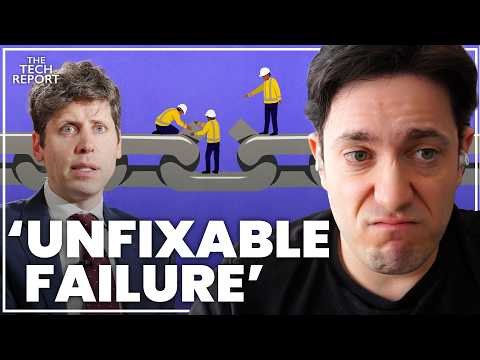
Rather than debating the technical capabilities of artificial intelligence itself, this interview focuses on the political, economic, and social narratives surrounding the AI industry. The discussion centers on public distrust of major AI companies, proposals for increased government involvement in AI development, concerns about venture capital incentives, and the broader concentration of technological and political power. Throughout the conversation, the guest argues that much of today's AI enthusiasm is driven by speculative promises rather than demonstrated reality.
One of the video's strongest qualities is its consistency. The interview never wanders far from its central thesis that AI companies have created much of the public backlash themselves through ambitious marketing, predictions of mass job displacement, and repeated claims about existential risks. The host structures the discussion around polling data regarding public ownership of AI firms, government regulation, transparency, and economic concerns, allowing the conversation to develop logically instead of jumping between unrelated topics.
The interview also spends considerable time examining incentives rather than technical details. Much of the discussion questions whether venture capital funding, investor expectations, and political lobbying have encouraged exaggerated promises about AI's future capabilities. The guest repeatedly frames these issues as structural problems involving corporate power and financial speculation rather than purely technological developments.
Where the presentation becomes less balanced is in the certainty with which many political and economic conclusions are expressed. Numerous claims—including descriptions of the AI industry as a speculative bubble, comparisons to the 2008 financial crisis, assertions about Silicon Valley's political objectives, and predictions of widespread public backlash—are presented as the speaker's analysis rather than established facts. Similarly, discussion of government, elections, and political figures reflects the guest's perspective and would benefit from greater acknowledgement of competing viewpoints or supporting evidence.
The conversation also blends several distinct issues—including AI safety, environmental impacts, job automation, lobbying, cryptocurrency, venture capital, democratic institutions, and authoritarianism—into a single overarching narrative. While these topics are connected thematically, viewers looking for detailed evidence on any individual claim may find that many arguments are introduced without extensive supporting documentation during the interview itself.
The host generally performs well by asking follow-up questions that encourage clarification rather than simple agreement. Instead of accepting broad assertions at face value, many questions invite the guest to explain policy implications, distinguish between short- and long-term consequences, or address potential drawbacks of proposals such as partial public ownership of AI companies. This helps keep the discussion focused even when the subject matter becomes highly ideological.
The interview also distinguishes between what AI companies publicly claim about future automation and what the guest personally believes is likely to happen. The guest explicitly states that he does not fully accept many of the industry's own predictions regarding mass unemployment, instead arguing that these narratives primarily serve investor interests. That distinction adds useful nuance to an otherwise strongly opinionated discussion.
Pros
- Maintains a clear and coherent focus on political, economic, and regulatory questions surrounding AI rather than drifting into unrelated topics.
- Uses public opinion polling as a framework for exploring broader policy questions.
- The host asks thoughtful follow-up questions that encourage deeper explanations rather than superficial sound bites.
- Clearly separates many of the guest's interpretations from descriptions of how AI companies publicly market their technology.
- Raises legitimate questions about incentives, lobbying, corporate concentration, and transparency that are worthy of public discussion.
Cons
- Many major political and economic conclusions are presented confidently without substantial supporting evidence during the interview.
- Strong ideological framing leaves relatively little room for alternative interpretations or counterarguments.
- Comparisons between AI development, nuclear technology, fascism, and previous financial crises are provocative but remain largely argumentative rather than rigorously demonstrated.
- The discussion spends relatively little time examining potential benefits, successful applications, or competing perspectives on AI development.
- Several predictions about future economic collapse, public backlash, and political outcomes remain speculative.
This interview is best viewed as a political and economic critique of the contemporary AI industry rather than a technical analysis of artificial intelligence itself. Its strengths lie in examining incentives, corporate influence, public distrust, and the broader consequences of concentrating technological power. At the same time, many of its strongest conclusions reflect the guest's interpretation of current events and future trends rather than established evidence. Viewers interested in critical perspectives on AI policy will likely find the discussion engaging and thought-provoking, while those seeking a more evidence-driven or ideologically balanced examination may wish for additional supporting data and a broader range of viewpoints.