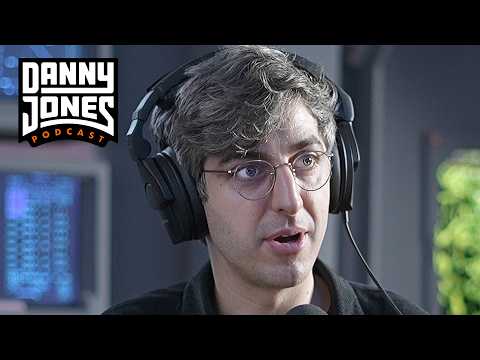
Rather than presenting psychedelic research as a collection of sensational anecdotes, this interview centers on an extended discussion between the host and Carl Hayden Smith about participating in clinical DMT studies, the philosophy of consciousness, and the challenges of interpreting extraordinary subjective experiences. The conversation moves fluidly between neuroscience, experimental design, personal testimony, technology, and speculation, making for an engaging listen even when its conclusions remain highly uncertain.
One of the video's greatest strengths is its willingness to separate the mechanics of the research from the participant's personal interpretations. Smith describes his involvement in intravenous DMT experiments at Imperial College London, explaining practical aspects of EEG, fMRI, continuous DMT infusion, dose escalation, and the difficulties of collecting scientific data while someone is experiencing an intense psychedelic state. These sections provide useful insight into how controlled psychedelic research is conducted without reducing the experience to simple sound bites.
The discussion becomes considerably more speculative whenever Smith describes encounters with entities, apparent messages received during experiences, perceived life reviews, precognition, or theories about consciousness extending beyond the brain. These accounts are presented as his lived experiences rather than established scientific findings, and the host repeatedly asks clarifying questions instead of simply accepting every interpretation at face value. That balance helps the interview remain curious without entirely abandoning skepticism, even though many of the proposed explanations extend well beyond currently accepted evidence.
Another strength is the breadth of topics covered. Beyond DMT itself, the conversation explores dreaming, lucid dreams, journaling, sacred spaces, cyberdelics, altered states versus altered traits, AI, human perception, and the philosophy of consciousness. While this wide scope occasionally causes the discussion to wander, it also gives viewers multiple ways to engage with the material depending on whether their interests are scientific, philosophical, or experiential.
The interview is particularly effective when discussing research methodology and context. Smith repeatedly emphasizes concepts such as mindset, environment, integration, and ethical experimentation rather than portraying psychedelics as universal solutions. Near the end, both participants explicitly caution against treating psychedelics as a cure-all and discuss the commercialization and overenthusiasm that can develop around the field. That nuance adds credibility to an otherwise highly speculative conversation.
Where the video becomes less convincing is in the frequent blending of personal experience with broader claims about reality. Ideas involving multidimensional entities, shared psychedelic spaces, guardian beings, death, consciousness existing independently of the brain, and future technological applications are fascinating to hear discussed, but they remain hypotheses or subjective interpretations rather than established conclusions. Viewers looking for firm scientific evidence may find these sections intriguing yet ultimately unsubstantiated.
The presentation itself remains engaging throughout. Danny Jones allows lengthy, uninterrupted answers while periodically steering the discussion back toward practical questions about study design, pharmacology, and interpretation. Even during nearly three hours of conversation, the pacing rarely feels rushed, and the host does a good job distinguishing between what researchers can measure and what participants believe their experiences mean.
Pros
- Provides an unusually detailed firsthand account of participation in controlled intravenous DMT research.
- Explains practical aspects of EEG, fMRI, dosing, and experimental design in an accessible way.
- Balances scientific discussion with philosophical exploration instead of focusing exclusively on either.
- The host regularly asks clarifying questions that help separate observations from interpretations.
- Includes thoughtful discussion about integration, context, and the risks of treating psychedelics as universal solutions.
- Covers a wide range of related topics, including dreaming, consciousness, AI, perception, and emerging research.
Cons
- Many of the most memorable claims rely entirely on subjective psychedelic experiences rather than verifiable evidence.
- The conversation frequently shifts between neuroscience, spirituality, philosophy, and speculation, making it difficult to distinguish established findings from personal beliefs.
- Several tangents extend well beyond the original discussion of the DMT studies and occasionally slow the overall focus.
- Sponsored segments interrupt the flow of an otherwise immersive interview.
This is an absorbing long-form conversation that succeeds because it gives substantial time to both the scientific framework surrounding psychedelic research and the intensely personal experiences reported by one participant. While the interview explores many extraordinary ideas about consciousness, reality, and non-ordinary states, it generally presents those ideas as interpretations rather than proven facts. Viewers interested in psychedelic research, consciousness studies, and philosophical discussions will likely find it compelling, provided they approach its more remarkable claims with appropriate critical thinking.