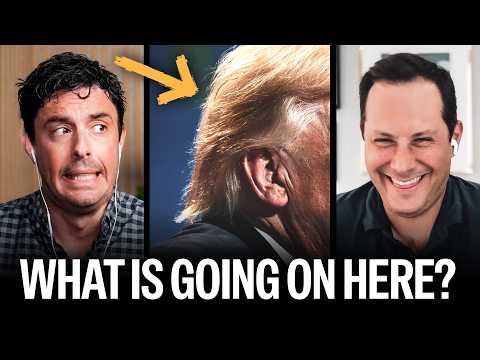
The video takes an unusually trivial political subject and commits to it with enough enthusiasm to make the joke work: Donald Trump's apparently different hairstyle becomes the basis for memes, old footage and a discussion about how his appearance functions as part of his public image. The host makes no attempt to disguise the lightweight nature of the story, repeatedly treating it as mock-breaking news. That self-awareness is important because there is little substantive reporting underneath the comedy.
The opening comparison establishes why the hairstyle attracted attention, with the host pointing to images in which Trump's hair appears noticeably different in color and shape from his familiar appearance. Calling it a "wig," however, moves beyond what the video actually establishes. The images may show an altered hairstyle, but they do not demonstrate that Trump was wearing a hairpiece, and the subsequent discussion with biographer Michael Wolff actually describes an elaborate comb-over rather than providing evidence of a conventional wig.
Most of the entertainment comes from the internet reaction. The host cycles through memes, AI-generated material and jokes about Trump's appearance while repeatedly exaggerating the importance of the subject. His reactions are energetic and occasionally inventive, particularly because he recognizes the absurdity of devoting this much attention to someone's hair. The downside is that several jokes amount to straightforward ridicule of Trump's physical appearance, which becomes repetitive rather than adding anything to the central question.
The archival footage from 2018 is more relevant because it visibly shows Trump's hair being lifted by the wind and therefore gives viewers some indication of how the hairstyle is arranged. Even here, the host mostly reacts rather than investigates. There is no careful attempt to determine when the newer images were taken, whether styling, lighting or other circumstances could explain the difference, or whether anyone directly involved has confirmed that Trump changed what he was wearing or how his hair was constructed.
Wolff's contribution gives the segment its most interesting angle. He describes Trump's hair as an elaborate comb-over maintained with hairspray and recalls accounts attributed to Ivanka Trump and Stormy Daniels concerning Trump's hair and his awareness of its value as a recognizable feature. These remain Wolff's descriptions and recollections within the video rather than independently demonstrated facts here, and his flammability jokes are clearly comic exaggeration. Still, the broader point he develops—that Trump's distinctive appearance can operate as branding—is more substantial than the initial wig speculation.
That discussion expands effectively into Trump's background as a television performer and the importance Wolff assigns to visual presentation in Trump's political career. Rather than remaining entirely focused on whether the hairstyle is genuine, the conversation considers the recognizable hair, tan and overall appearance as components of a deliberately memorable public persona. It is an interesting interpretation, but the video does not provide enough evidence to establish exactly how consciously each element has been cultivated or how important it has been to Trump's political success.
As comedy built around a viral visual oddity, the segment is brisk, expressive and knowingly ridiculous. As an attempt to determine what actually happened to Trump's hair, it remains remarkably inconclusive: the headline premise is asserted more confidently than the material supports, memes occupy more attention than verification, and the most substantive guest commentary points toward a complicated comb-over rather than resolving the supposed wig mystery. The result works better as humorous commentary on political image-making than as reporting on the phenomenon that inspired it.
Pros
- Clearly shows the visual change that prompted the online speculation rather than relying entirely on description.
- The host's exaggerated treatment of the subject gives the lightweight story an appropriately comedic tone.
- Archival footage provides useful context for the unusual construction of Trump's familiar hairstyle.
- Michael Wolff's discussion broadens the segment into a more interesting consideration of appearance, recognizability and political branding.
- Distinguishes itself most effectively when examining Trump's background as a performer rather than merely recycling hair memes.
Cons
- Repeatedly calls the hairstyle a wig without establishing that Trump was actually wearing one.
- Does little investigation into alternative explanations for the apparent change in Trump's hair.
- Several stretches rely primarily on mocking Trump's appearance rather than developing the story.
- Wolff's anecdotes and interpretations are not independently substantiated within the video.
- The extended meme sequence is entertaining but provides essentially no evidence about what actually changed.
- The video's most interesting discussion of branding remains interpretive and is presented without much supporting analysis.
What begins as an intentionally ridiculous investigation becomes mildly more interesting when the conversation shifts from Trump's hair itself to the role of physical presentation in constructing a recognizable public persona. The humor and energetic delivery make the segment entertaining, but anyone expecting the supposed wig mystery to be convincingly solved will find far more speculation and memes than verification.