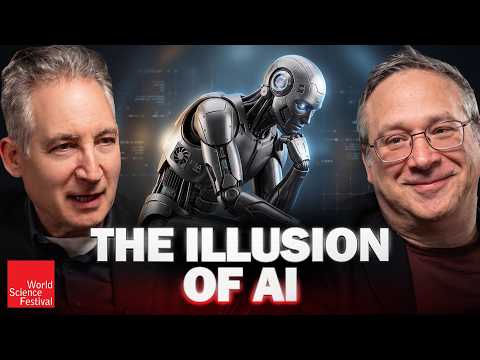
Princeton researchers testing whether AI agents can conduct open-ended AI research provide a useful foundation for a much broader argument about automation. Rather than treating impressive performance on benchmarks as proof that entire professions can be automated, the presentation focuses on the distinction between completing individual tasks and managing the judgment-heavy collection of decisions that constitutes a job. That distinction is valuable, particularly because the research setup described here attempts to move beyond neatly scored benchmark problems into work where quality, originality and direction require subjective evaluation.
The experiment is explained with enough detail to make its significance understandable. Twenty-four researchers from 11 institutions reportedly gave an AI agent the central research question from unpublished work, along with six days, $3,000 in API credits, GPU resources, a computer and web access. The original paper authors then evaluated the resulting work using standards resembling conference review. Importantly, the discussion does not hide the study's weaknesses: the small sample, non-blind evaluation and interpretive ambiguity are explicitly acknowledged, while the researchers' positive finding that current agents can perform portions of the engineering involved in AI research is also included.
Where the presentation is strongest is in describing how the agents reportedly failed. Poor judgment about publishable research, limited creative problem-solving, reluctance to abandon unsuccessful approaches, weak awareness of time and resource constraints, and instruction drift are concrete shortcomings rather than vague claims that machines simply lack human qualities. The examples help considerably: agents left substantial budgets unused, one stopped despite remaining time after another rejection, and page-limit instructions were eventually violated. Equally useful is the observation that the agents apparently did not manipulate unfavorable evidence; according to the account presented here, they withdrew stronger claims when experimental results failed to support them.
The leap from those research failures to a general explanation of human reasoning is considerably less secure. The discussion combines claims about language models, aphasia research and Judea Pearl's ladder of causation into an argument that current LLMs are fundamentally confined to associational reasoning. Pearl's framework is presented clearly at a high level—association, intervention and counterfactual reasoning—but describing all language models as permanently trapped on the first rung is a much larger theoretical conclusion than the research experiment itself establishes. Similarly, observations about how additional inference-time computation improves model performance do not by themselves prove that models are incapable of producing useful forms of reasoning or causal analysis. The presentation is persuasive when documenting demonstrated limitations and more speculative when turning those limitations into architectural impossibilities.
The task-versus-job framework nevertheless gives the discussion practical value. Research is broken into literature review, experimentation, analysis and writing while emphasizing that someone still has to determine which questions matter and when an approach should be abandoned. Accounting provides a second illustration in which bookkeeping and tax preparation sit alongside client communication, goals and contextual judgment. These examples make a convincing case against treating successful automation of a measurable subtask as automatic evidence that an entire occupation has been reproduced.
The weakest part of the broader employment argument is its confidence that productivity gains will translate into expanding demand rather than substantial displacement. Historical examples involving household appliances and programming abstractions illustrate that technological change can create new work and increase demand, but they do not establish that every profession affected by generative AI will follow the same trajectory. Automation can alter staffing requirements even without reproducing every component of a job, and the presentation does not seriously examine that possibility. Consequently, the evidence supports skepticism toward sweeping claims of imminent total job replacement much better than it supports certainty that employment levels will remain protected.
Pros
- Grounds the discussion in a real-world-style research experiment rather than relying exclusively on conventional AI benchmarks.
- Clearly explains the important distinction between automating tasks and reproducing an entire professional role.
- Identifies specific agent failures involving judgment, creative redirection, backtracking, context and instruction adherence.
- Acknowledges the study's small sample, non-blind evaluation and other limitations rather than presenting the experiment as definitive.
- Includes positive findings about AI's research-engineering capabilities and its willingness to retreat from unsupported claims.
- Translates technical ideas into accessible examples involving research and accounting.
Cons
- Extends a limited research experiment into much broader conclusions about employment and the fundamental capabilities of language models.
- The claim that LLMs are permanently restricted to the first rung of Pearl's causal hierarchy is presented with greater certainty than the experiment itself can establish.
- Historical examples of technology increasing labor demand do not prove that AI-driven productivity gains will produce the same employment effects across occupations.
- Gives insufficient attention to the possibility that automating substantial portions of jobs could reduce staffing needs without eliminating the need for human judgment.
- Several neuroscience, reasoning and causal-inference claims are compressed into simplified explanations that would benefit from more qualification and supporting detail.
- The sponsored website-builder segment interrupts an otherwise tightly focused examination of AI research and employment.
The most useful contribution here is not a sweeping guarantee about anyone's career but a framework for separating impressive task automation from the much harder problem of reproducing open-ended professional judgment. The Princeton experiment, as presented, provides meaningful evidence of current agent limitations, but the argument becomes less convincing when those results are treated as proof of permanent architectural limits or broadly reassuring employment outcomes.