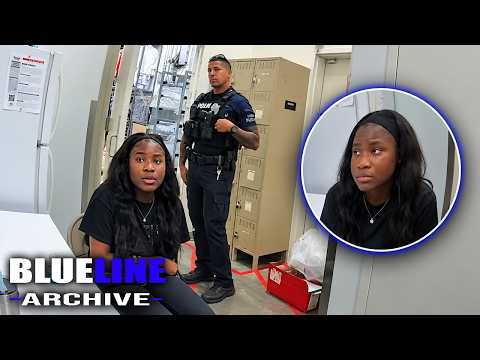
An airport retail theft investigation becomes a complicated legal encounter when a woman suspected of stealing stickers admits to taking additional merchandise from multiple locations, including items she claims came from an aircraft. Officer Wells initially responds to a store employee's report of suspicious behavior, but the investigation expands considerably as the woman acknowledges possessing unpaid merchandise and discusses her drinking and apparent attraction to stealing. The presentation combines bodycam footage with constitutional analysis, examining whether the officer followed proper procedures and how the woman's statements might affect potential criminal charges.
The initial investigation provides a useful foundation for examining reasonable suspicion and probable cause. A store employee describes watching the woman handle stickers, apparently conceal some, and leave without paying. The employee also reports that she appeared unsteady and possibly intoxicated. The analysis emphasizes the importance of eyewitness observations, surveillance footage, and obtaining the store owner's willingness to pursue prosecution. However, it treats the evidence as more conclusively established than the presented material supports. Although surveillance is discussed, the actual footage is not clearly evaluated for viewers, and the employee expresses uncertainty about which items were taken. The suggestion that owner authorization is generally a legal prerequisite for a misdemeanor theft arrest is also too broad without identifying the governing jurisdiction.
The Miranda discussion is among the presentation's more valuable sections because it distinguishes the timing of a warning from proof that the warning was properly administered. Officer Wells announces an intention to advise the woman of her rights before questioning her about the suspected theft, but the available audio does not clearly establish that all four required warnings were delivered. The narrator correctly identifies the potential evidentiary importance of an incomplete record while acknowledging that missing documentation does not automatically prove a constitutional violation. Nevertheless, the analysis overstates the requirement for a complete on-camera recitation. Miranda warnings must be adequately communicated when legally required, but recording every word on bodycam is not itself a universal constitutional requirement. The distinction between a questionable recording and an actual procedural violation deserves greater precision.
The search of the woman's bag introduces another important Fourth Amendment issue. Officers ask about the location of stolen merchandise, and the woman appears to consent to having her belongings examined. The commentary instead emphasizes the search-incident-to-arrest exception, arguing that custody independently authorized the search under established Supreme Court precedent. This explanation introduces relevant legal principles but overlooks important factual and doctrinal distinctions. Being told that one is not free to leave does not necessarily establish a formal custodial arrest, and the permissible scope of a bag search depends on the circumstances. The presentation never adequately resolves the timing of the arrest or whether the bag remained within the woman's immediate control. Consequently, its categorical conclusion that no separate consent analysis was necessary is insufficiently supported.
The woman's increasingly candid admissions give the encounter a compelling human dimension. She acknowledges taking stickers, snacks, and other merchandise, repeatedly apologizes, and describes drinking before the incident. Her comments about stealing providing a thrill are particularly revealing, although they do not establish a clinical diagnosis or explain every aspect of her behavior. The narrator uses these statements to discuss criminal intent, voluntariness, and possible treatment-based diversion. The distinction between police coercion and a suspect's personal emotional state is useful, but the analysis goes too far when it characterizes the admissions as effectively eliminating any defense concerning intent. It also treats statements made during the encounter as spontaneous without consistently distinguishing volunteered remarks from responses to direct police questioning.
The discussion of potential federal jurisdiction is the presentation's most ambitious and least convincing legal argument. The narrator suggests that the woman's admission to taking items from an aircraft could expose her to federal prosecution under 18 U.S.C. § 661, alongside state retail theft charges. While identifying possible jurisdictional complications is worthwhile, the explanation does not establish that the specific aircraft, location, or conduct satisfies the statute's jurisdictional requirements. It also moves too quickly from an ambiguous admission about items taken from a plane to a conclusion that the elements of a federal offense have been established. The acknowledgment that no federal charges have been confirmed provides some restraint, but it does not resolve the underlying uncertainty. Similarly, the discussion of public intoxication assumes that visible impairment in a public airport terminal is sufficient for prosecution without addressing additional requirements that may apply under the relevant state law.
The concluding grades give the presentation a recognizable structure, awarding Officer Wells an A-minus and the woman a D-plus before summarizing procedural lessons for law enforcement. This format makes the legal discussion accessible and gives viewers concrete points to consider, particularly concerning the preservation of evidence and the consequences of incriminating statements. However, the grades imply a level of legal certainty that the analysis has not earned. The officer's evaluation rests partly on unresolved Miranda and search questions, while the woman's grade incorporates speculative federal exposure and moral judgments about her conduct. The commentary is also repetitive, revisiting Miranda compliance, consent, and criminal intent without consistently adding new insight. As a result, an engaging bodycam encounter becomes a useful but uneven legal lesson whose authoritative delivery sometimes exceeds the strength of its evidence.
Pros
- Uses a specific airport theft investigation to illustrate constitutional questions involving detention, Miranda warnings, searches, and criminal admissions.
- Incorporates substantial bodycam dialogue, allowing viewers to hear the employee's observations, the officer's questions, and the woman's responses.
- Identifies the important distinction between announcing Miranda warnings and establishing that the required advisements were actually delivered.
- Introduces relevant Supreme Court decisions and legal doctrines, providing viewers with useful starting points for understanding police procedures.
- Explores the evidentiary consequences of voluntary admissions, including statements that reveal additional suspected offenses.
- Provides an organized concluding assessment that connects the encounter to practical considerations involving evidence preservation and investigative procedure.
Cons
- Repeatedly presents conditional legal conclusions as settled despite unresolved questions about the jurisdiction, arrest timing, and available evidence.
- Overstates the necessity of recording Miranda warnings verbatim and treats incomplete on-camera documentation as a more definitive procedural weakness than the circumstances establish.
- Applies search-incident-to-arrest principles too broadly without adequately examining whether a lawful arrest occurred before the bag search.
- Makes insufficiently supported claims about mandatory store-owner authorization, public intoxication offenses, and the elements of potential federal aircraft theft charges.
- Treats the woman's statements about stealing and intoxication as more conclusive evidence of criminal intent and legal liability than they necessarily establish.
- Uses authoritative grades and repetitive legal summaries that sometimes obscure uncertainty rather than clarify it.
The airport encounter provides an engaging foundation for discussing police procedure, constitutional protections, and the consequences of making incriminating statements during an investigation. Its structured explanations and extensive bodycam dialogue are informative, but overly categorical interpretations of Miranda requirements, search authority, and potential federal jurisdiction substantially weaken its reliability. Viewers interested in legal commentary will find worthwhile questions to consider, although the presentation is more convincing as an introduction to those questions than as a definitive assessment of the officer's conduct or the woman's criminal exposure.