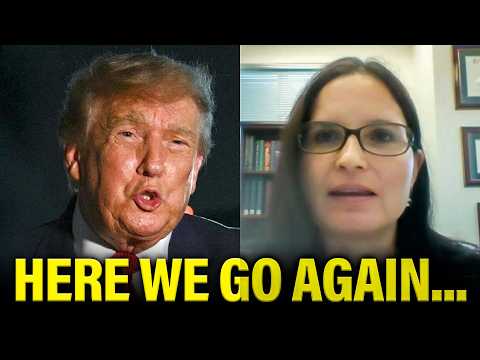
A federal appeals court's rejection of judicial restrictions on the classified documents investigation involving Donald Trump provides the foundation for an aggressive examination of presidential privilege, judicial independence, and legal accountability. The commentary focuses on the Eleventh Circuit's criticism of Judge Aileen Cannon's handling of the case, particularly her decision to appoint a special master to review documents seized from Mar-a-Lago. By combining excerpts from judicial reasoning with television news coverage and forceful political commentary, the presentation turns a consequential procedural ruling into a broader argument about whether powerful political figures can receive preferential treatment under American law.
The strongest material comes from the detailed examination of the appellate court's reasoning. The discussion highlights the judges' conclusion that Trump had not demonstrated a personal interest in the classified documents or established why he needed access to them. Particularly important is the court's explanation that even if documents had been declassified, their status as government records would not automatically change. These distinctions help viewers understand why Trump's public statements about presidential authority did not resolve the legal questions before the court. The inclusion of specific judicial language gives this portion considerably more substance than the surrounding political rhetoric.
Another significant element involves the composition of the appellate panel. The commentary repeatedly emphasizes that two judges were appointed by Trump, presenting their participation in the ruling as evidence that judicial independence can prevail over political expectations. This is a worthwhile observation because it challenges the assumption that judges necessarily decide cases according to the interests of the presidents who appointed them. However, the presentation occasionally stretches this point into sweeping declarations about the entire federal judiciary. A unanimous ruling in one dispute demonstrates agreement among those judges, but it cannot establish how other courts will approach different legal questions.
The examination of Judge Cannon's reasoning provides additional legal substance. The discussion explains how the appellate court challenged her intervention in the investigation and credited the government's explanation that its criminal inquiry was closely connected to national security concerns. References to the FBI counterintelligence official's sworn declaration help establish why the government opposed restrictions on its access to the seized records. The included CBS News exchange with legal contributor Jessica Levinson is especially useful because it clarifies the jurisdictional issue and acknowledges the possibility of further appeal. Her measured explanation offers a welcome contrast to the more absolute conclusions delivered elsewhere.
Unfortunately, the presentation frequently sacrifices precision for dramatic effect. Assertions that Trump was screaming at aides, pacing in panic, or facing the imminent destruction of his personal fortune are presented without supporting evidence sufficient to establish those details. The opening also connects the appellate decision to a separate civil lawsuit without developing that lawsuit's relevance to the documents dispute. More importantly, the commentary repeatedly treats a procedural setback as though it settles the broader criminal investigation or makes an indictment nearly inevitable. The ruling's significance is substantial, but removing restrictions on investigators is not equivalent to determining criminal liability or predicting a prosecution's outcome.
The editing and narrative structure create another weakness. Extended passages revisit the same conclusions about Trump's lack of possessory interest, Cannon's legal errors, and the significance of Trump-appointed judges. The repetition reinforces the central message but eventually diminishes its impact, particularly when similar assertions appear before and after supporting news excerpts. The presentation also contains an internal inconsistency concerning the judges' appointments, initially identifying an Obama appointee before later describing all three as Republican presidential appointees. Combined with emphatic phrases about legal devastation and political humiliation, these problems make the commentary feel more like a partisan victory declaration than a consistently disciplined examination of a judicial decision.
Pros
- Explains important aspects of the appellate ruling, including government ownership of records, classification questions, and limits on judicial intervention.
- Uses specific passages from the court's reasoning to support its discussion of Trump's unsuccessful legal arguments.
- Highlights the participation of Trump-appointed judges as a meaningful illustration of judicial independence.
- Connects the criminal investigation to national security concerns through discussion of the FBI counterintelligence declaration.
- Includes a measured legal analysis from Jessica Levinson that clarifies the jurisdictional dispute and acknowledges potential further proceedings.
Cons
- Presents dramatic claims about Trump's private behavior and personal financial circumstances without sufficient supporting evidence.
- Overstates the ruling's consequences by suggesting that procedural relief effectively determines the direction of the broader criminal case.
- Repeatedly characterizes Judge Cannon's actions as politically motivated without establishing that motivation through the judicial findings presented.
- Contains an inconsistency concerning the appellate judges' presidential appointments.
- Recycles major arguments and inflammatory descriptions, creating unnecessary repetition and weakening the analytical focus.
- Gives little consideration to alternative legal interpretations or the limits of what the appellate decision actually resolved.
The appellate court's rejection of restrictions on the classified documents investigation offers substantial material for an informative examination of judicial authority and presidential accountability. Specific legal passages and expert commentary provide genuine explanatory value, but exaggerated predictions, unsupported personal claims, and repetitive partisan framing undermine the presentation's credibility. The result is an engaging and occasionally illuminating political analysis that would be considerably stronger with greater factual restraint and a clearer separation between judicial findings and political interpretation.