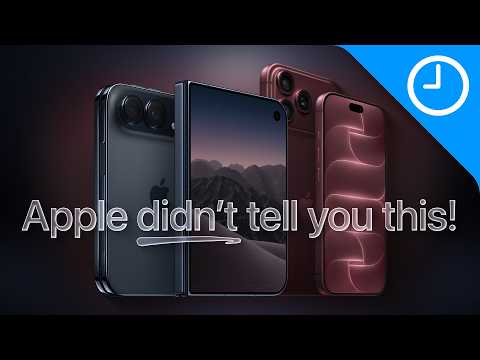
A 7.6-inch inner display that folds down into a device smaller than a notebook gives the iPhone Duo an immediately understandable purpose: provide something approaching an iPad mini experience without requiring a second device. The hands-on presentation communicates that idea effectively through simple physical comparisons with everyday objects and Samsung’s Galaxy Z Fold 8. More importantly, the presenter does not treat novelty alone as proof that the design works, repeatedly separating an encouraging first impression from conclusions that will require extended testing.
The inner display emerges as the most impressive piece of hardware. Its matte surface is praised both for reducing reflections and for making the fold crease extremely difficult to see during the demonstration, especially compared with the visible crease on the Galaxy Z Fold 8. The phone is also described as feeling sturdy despite its folding construction. Those observations are useful, but the presenter wisely acknowledges that a controlled hands-on session cannot establish long-term durability; repeated folding over several months will be a much more meaningful test than anything demonstrated at Apple Park.
Several compromises accompany the new form factor. Face ID is absent, with authentication instead handled through a fingerprint sensor integrated into the power button, while the rear camera system includes only wide and ultra-wide cameras. The lack of a telephoto lens is particularly disappointing given the $1,999 starting price and the presenter’s own preference for telephoto photography. On the more inventive side, the inner selfie and FaceTime camera sits behind the display and becomes visible only when needed, preserving an uninterrupted screen during normal use.
Software provides a stronger argument for the foldable design than sheer screen size. Running Safari and Messages side by side demonstrates a practical advantage over constantly switching between apps, while redesigned Apple applications use two-pane layouts to take advantage of the extra space. The interface can also adapt to different folding angles, including a miniature laptop-like configuration. The presentation only gives a brief look at these features, however, and notes that multitasking resembles the iPad experience with fewer controls, leaving plenty unanswered about how extensively third-party apps will exploit the unusual display.
Battery life is another major unresolved question. Apple is said to claim up to 31 hours of video playback using the inner display and 44 hours using the outer screen, impressive figures on paper for a device powering two differently sized displays. The presenter appropriately avoids treating those manufacturer figures as verified real-world endurance and explicitly says more battery testing is required. That restraint matters because battery performance could substantially affect whether the Duo feels like a practical everyday phone rather than an impressive folding demonstration.
The presentation itself is energetic, tactile and unusually effective at conveying what the hardware feels like without becoming a specification recital. Comparisons involving a passport, sponge and other familiar objects make dimensions easy to visualize, while demonstrations of the hinge, crease, one-handed grip, hidden camera, phone call and multitasking keep the discussion grounded in actual interaction. The humor generally works, although the lengthy Mercury sponsorship interrupts the momentum at precisely the point where the discussion shifts from hardware to software.
Ultimately, the $1,999 price dominates the value equation. The presenter begins as someone who had not particularly wanted a foldable and ends genuinely considering the Duo instead of the iPhone 18 Pro, which is meaningful evidence that the design made a persuasive first impression. At the same time, the limited testing period, unanswered battery questions, unknown long-term folding durability and camera compromises make this much more convincing as an early hands-on assessment than as a definitive buying recommendation.
Pros
- Matte 7.6-inch inner display is described as premium and shows remarkably little visible crease during the hands-on demonstration.
- Practical size comparisons clearly communicate how compact the device becomes when folded.
- Side-by-side multitasking and two-pane app layouts demonstrate genuine uses for the larger screen.
- Folding-angle adaptations add versatility beyond simply turning the phone into a small tablet.
- The presenter clearly distinguishes encouraging first impressions from durability and battery questions that still require extended testing.
Cons
- $1,999 starting price makes the Duo an exceptionally expensive proposition.
- Rear camera system lacks a telephoto lens despite the premium positioning.
- Face ID is absent in favor of a power-button fingerprint sensor.
- Long-term hinge, display and crease durability cannot be judged from a short hands-on session.
- Apple’s quoted battery figures remain unverified through independent extended use.
- The extended sponsorship noticeably breaks the flow between the hardware and software sections.
Apple’s foldable makes a persuasive early case for the form factor through an unusually clean inner display, useful multitasking and a compact design that appears to offer more than novelty. The enormous price and several unresolved real-world questions prevent this hands-on look from establishing whether those advantages justify the compromises, but it succeeds at showing why even a foldable skeptic might be tempted.