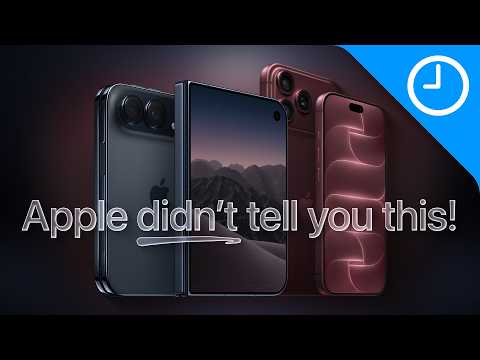
Apple’s nearly creaseless 7.6-inch inner display immediately gives its first foldable a distinctive advantage, at least from the limited hands-on time available here. Michael Fisher describes a pronounced matte, satin-like surface treatment that helps disguise the crease during normal viewing, while acknowledging a possible tradeoff in color accuracy raised during the event. That uncertainty is handled appropriately: the screen earns enthusiastic first impressions without pretending that a short encounter with pre-production hardware can establish its long-term strengths or weaknesses.
The exterior design produces a more mixed reaction. Fisher prefers the symmetry of Samsung’s competing hardware, but finds Apple’s software accommodations for the unusually wide cover display genuinely clever. Moving the dock within easier thumb reach and simplifying the battery and signal indicators demonstrate attention to one-handed usability, although leaving Notification Center in a difficult-to-reach corner undermines that effort. The discussion is strongest when it focuses on these small interface decisions rather than treating the folding mechanism itself as an innovation.
Durability and hardware construction receive similarly useful attention. The titanium rails, Ceramic Shield surfaces and stated IP68 rating make the Duo sound unusually well protected for a foldable, though those specifications are naturally more informative than any durability conclusions that could be drawn at an event. The lengthy ESR sponsorship interrupts the hands-on coverage at an awkward point and spends substantial time promoting cases, stands and screen protectors. Its placement is clearly disclosed, but the commercial detour noticeably slows an otherwise focused first look.
Apple’s late arrival becomes most apparent when the discussion turns to features already familiar from competing foldables. Side-by-side multitasking, drag-and-drop interactions and a hinge that supports partially folded viewing modes are presented without pretending Apple originated them. More interesting are the compromises: Touch ID replaces Face ID, the volume buttons move to the top, and the rear camera system loses the telephoto option found on more photography-focused phones. Fisher also identifies practical omissions in his brief testing, particularly the lack of an obvious one-handed method for taking selfies with the main cameras and the delayed arrival of Apple Pencil support.
Performance and battery claims are treated with welcome caution. Apple says its 820 Pro, additional display engine and vapor chamber can provide substantially higher sustained performance than the iPhone 17 Pro, while fast charging and a larger battery arrangement are supposed to support full-day mixed use. Fisher repeatedly makes clear that these are promises requiring proper testing rather than demonstrated results, especially because dual-screen FaceTime and other foldable-specific workloads could change the endurance picture considerably. At 254 grams and $1,999 for 256GB, this is also unmistakably premium hardware even if the starting price comes in below his expectations.
The under-display inner camera provides the most entertaining example of Apple simultaneously advancing and revisiting foldable ideas. Its ability to become nearly invisible beneath the display impresses Fisher, but he immediately supplies the important context that Samsung introduced similar technology years earlier and subsequently abandoned it. That observation feeds into the larger theme effectively: Apple appears to have studied years of Android experimentation, adopted some discarded concepts and refined others rather than attempting to redefine the category from scratch. Ending with the limitations of pre-production hardware, pre-release software and brief event access appropriately keeps an enthusiastic first impression from being mistaken for a definitive review.
Pros
- Gives the nearly creaseless inner display detailed attention while acknowledging the matte treatment may carry visual tradeoffs.
- Examines practical interface decisions such as dock placement, status indicators and Notification Center accessibility rather than focusing only on specifications.
- Clearly distinguishes Apple's performance and battery claims from results that still require independent testing.
- Places multitasking, under-display cameras and the wider foldable format in the context of earlier competing devices.
- Identifies meaningful first-generation compromises involving cameras, biometrics, weight and delayed Apple Pencil support.
- Transparently explains the limited access to pre-production hardware and the circumstances surrounding the hands-on session.
Cons
- The extended ESR sponsorship substantially interrupts the flow of the hardware discussion.
- Limited hands-on time prevents meaningful testing of battery endurance, thermals, sustained performance, camera quality and everyday durability.
- Several enthusiastic judgments about the display and overall design necessarily remain preliminary.
- Some potentially important questions, including the practical consequences of the unusual dimensions and missing telephoto camera, can only be raised rather than thoroughly evaluated.
This is an engaging and appropriately qualified first look that is most useful when separating Apple's genuine refinements from ideas already established elsewhere in the foldable market. Fisher's enthusiasm never completely overwhelms the limitations of event-based testing, leaving the Duo intriguing rather than prematurely proven.