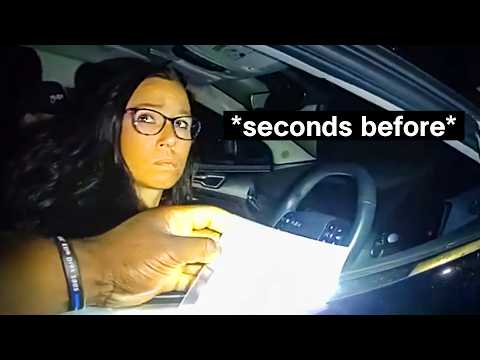
An armed robbery involving an armored cash transport vehicle quickly develops into a dangerous police pursuit and a confrontation inside a family home. What begins with officers interviewing a shaken driver and gathering witness descriptions eventually leads to a suspect fleeing through residential streets, entering an occupied house, and confronting an officer who forces his way inside. The incident provides an unusually dramatic example of how rapidly a criminal investigation can become a life-threatening emergency. Rather than simply presenting the action, the narrator examines police decision-making, officer preparation, witness reliability, and the responsibilities that continue after a suspect has been stopped.
The initial investigation offers a valuable look at how responding officers collect information following a violent robbery. Investigators question the armored truck driver about the suspect's appearance, clothing, weapon, vehicle, and the amount of money stolen while comparing her account with another witness's observations. The narrator explains why separating witnesses can prevent their recollections from influencing one another and highlights the importance of confirming vehicle descriptions and license plate information. His discussion of estimating a suspect's height and weight is particularly practical, suggesting that officers evaluate how accurately witnesses judge physical characteristics before relying too heavily on their estimates.
One of the more questionable elements involves the narrator's repeated invitation to assess whether the robbery victim appears honest. Although he ultimately believes her account is credible, the exercise risks suggesting that sincerity can be reliably determined through appearance, behavior, or conversational impressions. Nervousness, confusion, and inconsistent estimates are not necessarily indicators of deception, particularly following a traumatic experience. His discussion of situational awareness is more carefully qualified. He notices the driver's apparent phone use while approaching her vehicle but acknowledges that he does not know whether it was required for work, avoiding an unsupported accusation about her responsibility for the robbery.
The pursuit sequence delivers considerable intensity through police radio communications documenting changing speeds, road conditions, traffic, and coordination between agencies. The narrator explains that pursuit decisions depend on the severity of the suspected crime and the danger created by continuing the chase. Reported speeds reaching approximately 130 mph underscore the significant public safety risks involved. Particularly interesting is the disagreement between jurisdictions when one agency indicates that it will terminate its involvement while another prepares to assume the lead. However, the narration does not establish why the first agency wanted to withdraw, leaving an important question about pursuit policy and risk assessment unresolved.
The confrontation at the residence becomes the defining moment. After the suspect crashes and runs toward a house while apparently carrying a firearm, the footage shows him entering a home occupied by a mother and young children. An officer rapidly forces entry and fires at the suspect, ending the immediate threat without reported injuries to the family. The narrator supplements the footage with details attributed to the officer's official interview, including his reported firearms instruction, close-quarters training, and tactical experience. These details help explain the officer's preparation, while the discussion of sight alignment raises important questions about the difficulty of using deadly force in a confined space containing innocent people. Nevertheless, the narrator's reliance on the successful outcome as the primary measure of the officer's decision-making leaves limited room for a more independent examination of the tactical risks.
The aftermath adds an important human dimension that distinguishes the presentation from a straightforward police chase compilation. Officers attempt emergency medical treatment on the wounded suspect, including measures associated with controlling serious injuries, despite his alleged involvement in a violent robbery and hostage situation. The narrator appropriately praises their commitment to providing care while recognizing the distress experienced by the mother and children. His recommendation that officers prioritize moving traumatized family members away from the immediate scene is a useful reminder that resolving a threat does not end the responsibility to protect those affected. The reported grand jury decision not to bring charges against the officer also provides relevant legal context, although the presentation offers little explanation of the evidence or standards behind that decision.
The combination of incident footage, police communications, investigative commentary, and references to official records makes the presentation engaging and educational. Its strongest moments connect specific officer actions to broader lessons about policing rather than relying entirely on the excitement of the chase. Still, the narrator's admiration for the responding officers sometimes limits his critical distance, particularly when discussing the pursuit's extreme speeds and the rapid armed entry. His confident suggestion that the family would inevitably have faced a prolonged hostage situation is speculative, even if the circumstances clearly presented a serious threat. The closing challenge coin segment also shifts attention away from the incident's consequences, creating a somewhat unnecessary promotional ending after an emotionally intense account.
Pros
- Detailed coverage of the initial robbery investigation illustrates how officers gather suspect descriptions, compare witness accounts, and verify identifying information.
- Practical explanations of witness reliability, situational awareness, and suspect identification provide useful educational material for aspiring officers and interested viewers.
- Extensive pursuit communications demonstrate the complexity of coordinating multiple law enforcement agencies while monitoring speed, traffic, and public safety.
- References to the responding officer's reported tactical qualifications and official interview add context to the split-second decisions made during the residential confrontation.
- Attention to the mother and children's distress emphasizes the psychological consequences of violent encounters beyond the immediate arrest or use of force.
- Coverage of officers providing emergency medical care to the wounded suspect highlights an important professional responsibility despite the severity of his alleged actions.
Cons
- Repeated encouragement to judge the robbery victim's honesty through observable behavior risks overstating the reliability of informal credibility assessments.
- The narrator's strongly favorable interpretation of police actions limits critical examination of the high-speed pursuit and the risks of entering an occupied residence while using deadly force.
- The reasons behind one agency's decision to terminate its participation in the pursuit remain unexplained despite the potentially important policy implications.
- The grand jury outcome is mentioned without substantial examination of the legal reasoning or evidence supporting the decision.
- Speculation about what the suspect would inevitably have done to the family goes beyond what the available footage establishes.
- The closing challenge coin presentation interrupts the serious tone established by the discussion of the family's trauma and the suspect's death.
This is a gripping and informative examination of an armored truck robbery that escalates into a dangerous pursuit and a deadly confrontation inside a family home. The combination of police footage, investigative explanations, and attention to the aftermath gives the incident substantial educational value, particularly regarding witness interviews, tactical preparation, and emergency medical responsibilities. Although the narrator's admiration for the officers sometimes outweighs independent scrutiny of their decisions, the presentation succeeds in demonstrating both the extraordinary pressures of violent police encounters and the human consequences that remain after the immediate danger has passed.