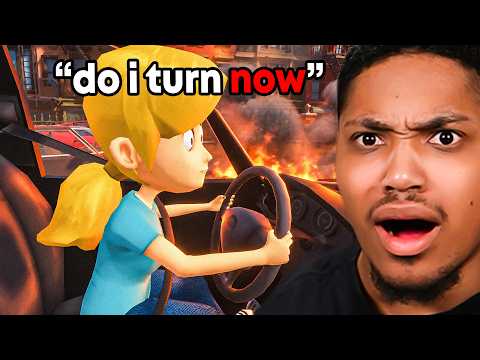
Asala's reluctance to drive creates an entertaining challenge when Ronin decides to help her become more independent behind the wheel. Although she reportedly has a driver's license, Asala regularly relies on family members to transport her because she lacks confidence in her driving abilities. Ronin believes he can change that in a single day, confidently promising to get her onto the highway. The stakes become personal when he agrees to accept a punishment if he fails, establishing a playful competition that combines genuine anxiety, family encouragement, and increasingly unpredictable situations.
The first challenge reveals just how much work lies ahead. Ronin tests Asala's understanding of basic vehicle controls, including the horn, gear selector, accelerator, and brake pedal. Her initial confusion over the pedals raises legitimate concerns about her readiness to drive, particularly considering the ambitious highway objective. Rather than developing these fundamentals through structured instruction, the group quickly shifts into a karaoke competition. The musical diversion provides some lighthearted entertainment and showcases the family's playful chemistry, but its connection to improving Asala's driving skills is practically nonexistent.
The driving course delivers the funniest and most chaotic moments, largely because Asala struggles to navigate even relatively simple obstacles. Ronin and the others arrange traffic cones and challenge her to complete the course before parking within designated lines. Her difficulties with reversing, steering, and maintaining adequate clearance produce a steady stream of nervous reactions and frantic instructions. One particularly memorable exchange occurs when Asala treats a curb as an obstacle that should not have been in her way. The comedy works because the participants respond spontaneously to her mistakes, although the apparent contact with another vehicle introduces a more serious concern.
That parking incident exposes the central weakness in the challenge's execution. Asala appears to scrape a vehicle while attempting to park, prompting immediate alarm from everyone watching. Although the moment creates dramatic entertainment, the group's decision to continue despite her demonstrated difficulties makes the instructional approach questionable. Frequent shouting and conflicting directions also seem poorly suited to someone already nervous about driving. A calmer, more systematic progression emphasizing vehicle control, observation, and parking fundamentals would have made the experience more convincing as an actual driving lesson.
The production maintains its family-oriented atmosphere through additional comedy segments that have little to do with driving proficiency. Ronin briefly helps choose flowers, while a later challenge involves him dressing as a police officer and staging a traffic stop. The pretend officer initially accuses Asala of speeding before abandoning the performance to request an autograph. These sequences demonstrate the cast's willingness to embrace ridiculous situations and keep the mood playful. However, the interruptions weaken the narrative momentum, and the mock traffic stop offers little meaningful guidance about handling a genuine interaction with law enforcement.
The final driving assessment provides a welcome change in tone. With Ronin acting as an examiner, Asala demonstrates noticeably greater composure on public roads. She follows directions, maintains an appropriate speed according to the commentary, and receives praise for yielding to pedestrians and keeping her hands properly positioned on the steering wheel. The atmosphere gradually shifts from exaggerated panic to genuine encouragement as Ronin recognizes her progress. Nevertheless, the assessment remains informal, and the limited driving shown cannot establish that she has developed consistently safe habits or sufficient experience for more demanding conditions.
The most satisfying development arrives when Asala admits she is not comfortable entering the busy highway. Rather than pressuring her to fulfill the original challenge, Ronin accepts her decision and acknowledges how much she has already accomplished. Her explanation that she frequently stays home because she depends on others for transportation gives the experience a more personal dimension. The ending reinforces the importance of respecting individual limits, even if the broader production sometimes treats driving mistakes too casually. Ronin's failed highway promise leads to a joking punishment involving a possible mountain lion exploration, closing the adventure with another family challenge rather than forcing an unsafe conclusion.
Pros
- Asala's genuine nervousness and desire for greater independence give the driving challenge a relatable emotional foundation.
- The traffic cone course provides entertaining, unpredictable moments that highlight the family's spontaneous reactions and playful chemistry.
- The contrast between Asala's early confusion and her calmer performance on public roads creates a satisfying sense of progression.
- Ronin's encouragement during the final assessment introduces a supportive tone that balances the earlier teasing and exaggerated reactions.
- Respecting Asala's decision not to enter the highway delivers a responsible and emotionally rewarding conclusion.
- The karaoke competition, costumes, and mock traffic stop contribute humor and variety to the family entertainment.
Cons
- The driving instruction lacks a systematic approach, particularly after Asala initially struggles to identify the correct pedals.
- The apparent vehicle scrape and repeated close calls raise concerns about the group's approach to safety during the obstacle course.
- Excessive shouting and overlapping instructions create confusion rather than offering clear guidance to an inexperienced, anxious driver.
- Several unrelated comedy segments interrupt the driving challenge without contributing meaningfully to Asala's improvement.
- The final assessment is too limited to demonstrate reliable driving proficiency, despite the enthusiastic praise from the group.
Ronin and the Anazala Family deliver an amusing driving challenge that becomes more meaningful as Asala gradually confronts her anxiety and gains confidence. The natural family chemistry, unpredictable mistakes, and encouraging conclusion make the experience enjoyable, although scattered pacing and questionable instructional decisions diminish its effectiveness as a genuine driving lesson. Its greatest success comes not from achieving the promised highway milestone, but from recognizing that meaningful progress matters more than completing a challenge for entertainment.