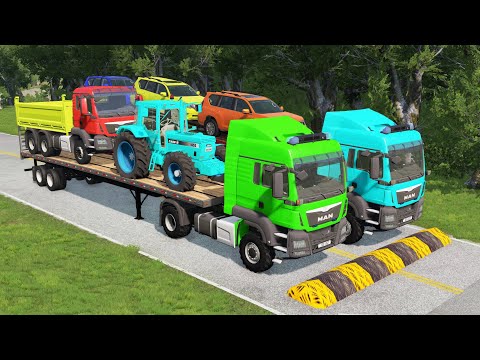
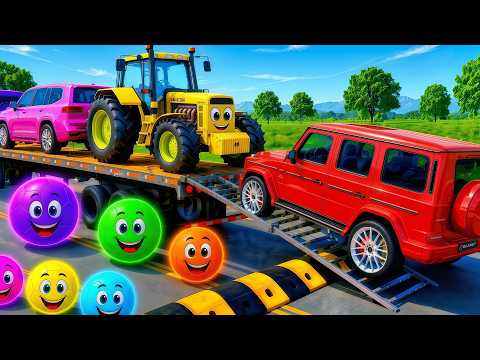
A series of urgent requests for assistance sets the tone for this Lightning McQueen-inspired BeamNG.Drive transportation challenge, where vehicle encounters and road obstacles appear to drive the action. The gameplay centers on a flatbed truck transportation concept, with repeated calls for help, encouragement to keep moving, and warnings about speed bumps. Although the setup suggests an entertaining combination of vehicle recovery and obstacle navigation, the presentation offers little context for understanding what is happening or why individual moments matter.
The transportation theme provides a recognizable foundation for casual driving entertainment. Commands such as "Go, go, go" and "Let's go" create a sense of forward momentum, while occasional expressions of approval suggest that certain tasks have been completed successfully. These exchanges establish a playful atmosphere that could appeal to younger viewers or audiences interested in uncomplicated vehicle simulation content. However, the limited dialogue makes it difficult to determine whether the apparent successes involve transporting vehicles, overcoming obstacles, or completing specific objectives.
Speed bumps are among the few clearly identified environmental challenges, receiving repeated warnings throughout the experience. Their inclusion suggests that the journey involves navigating potentially troublesome road conditions, an idea that fits naturally within BeamNG.Drive's vehicle physics environment. Unfortunately, the commentary never explains how these obstacles affect the truck, its cargo, or the surrounding vehicles. Without meaningful observations about handling, damage, or driving decisions, the hazards function more as recurring interruptions than developed gameplay challenges.
The frequent requests for assistance introduce another potentially interesting element. Characters repeatedly ask for help, prompting brief acknowledgments and encouragement that imply some form of rescue or transportation interaction. One exchange stands out when a request receives a blunt refusal, followed by an apology that suggests the opportunity to help has passed. This moment adds a small amount of personality and contrast to the otherwise agreeable responses, but the absence of further explanation prevents it from becoming a memorable narrative development.
Presentation is the experience's most significant weakness. The dialogue relies overwhelmingly on short expressions such as "Okay," "Please help," and "Good job," with little variation in vocabulary or emotional delivery. Repetition can contribute to the exaggerated humor of arcade-style driving entertainment, but here it becomes predictable without providing additional insight or escalating the situation. The occasional expressions of confusion and discomfort hint at unexpected events, yet they are too brief to communicate their significance independently.
The title's emphasis on a pothole-versus-car scenario also establishes expectations that the commentary does not meaningfully fulfill. Despite the apparent focus on vehicle transportation and road hazards, there is no clear explanation of a pothole encounter, comparison between vehicles, or progression toward a defined outcome. The Lightning McQueen connection supplies recognizable character appeal, but the presentation does not develop that concept beyond the general transportation premise. Viewers looking for an examination of BeamNG.Drive's collision behavior or vehicle physics will find little substantive information.
Ultimately, the experience seems designed primarily around straightforward visual entertainment rather than structured gameplay commentary. Its urgent exchanges and simple obstacle references may complement amusing driving situations, but the spoken presentation provides almost no narrative continuity or technical explanation. Even the ending consists of repeated acknowledgments rather than a clearly communicated resolution, leaving the challenge without a particularly satisfying conclusion. The result is a lightweight driving showcase whose potential depends heavily on the action rather than the commentary supporting it.
Pros
- Uses a recognizable Lightning McQueen-inspired transportation concept that may appeal to fans of playful vehicle simulation content.
- Incorporates speed bumps and repeated assistance requests to suggest multiple driving and transportation challenges.
- Maintains an accessible, energetic atmosphere through urgent commands, encouragement, and exaggerated reactions.
Cons
- Excessive repetition of basic phrases makes the commentary monotonous and contributes little to the entertainment.
- Provides almost no explanation of transportation objectives, vehicle behavior, obstacle consequences, or gameplay progression.
- Fails to meaningfully develop the advertised pothole-versus-car premise or establish a clear comparison between vehicles.
- Assistance requests and apparent successes lack enough context to create a coherent narrative.
- Offers minimal educational value for viewers interested in BeamNG.Drive's driving mechanics, damage modeling, or vehicle physics.
- Ends without a clearly established outcome or satisfying resolution to the transportation challenge.
This BeamNG.Drive transportation showcase offers a simple combination of recognizable vehicle characters, road obstacles, and exaggerated requests for assistance, but its repetitive presentation limits the entertainment value. While the playful premise may appeal to viewers seeking uncomplicated driving spectacle, the lack of meaningful commentary, clear objectives, and narrative progression makes the experience feel underdeveloped. More varied reactions and a stronger connection between the obstacles and their consequences would make the challenge considerably more engaging.