More than six million human remains are said to lie beneath Paris, but the familiar tourist attraction represents only a fraction of the underground passages explored in this ambitious adventure. Determined to find chambers untouched by vandals and largely absent from online exploration videos, a group of urban explorers repeatedly ventures into restricted tunnels, flooded corridors, and unstable passages. What begins as a search for intact skulls gradually becomes an increasingly dangerous expedition involving questionable navigation, unexpected encounters, and a frightening equipment failure. The result is a visually fascinating journey that captures the extraordinary atmosphere of the catacombs while raising serious concerns about the risks taken to document them.
The adventure unfolds across several visits, beginning with guided explorations of relatively well-known underground chambers. The explorers encounter enormous collections of human bones, including the so-called Jenga Room, where skeletal remains have been stacked into formations. Their disappointment with graffiti, damaged skulls, and evidence of previous visitors establishes the central objective: finding places that have escaped similar disturbance. The historical introduction provides useful context about Parisian quarrying and overcrowded cemeteries, although claims about the tunnel network's size, the percentage accessible to tourists, and the age of particular remains receive little supporting explanation. The distinction between abandoned quarry passages and actual burial chambers could also be clearer.
The second expedition introduces more challenging conditions, with narrow crawlspaces, deep water, and lengthy walks leading to unusual discoveries. A throne constructed from human bones becomes one of the more memorable sights, particularly because its deliberate arrangement contrasts with the scattered remains elsewhere. The explorers also encounter a skeletal display associated with an 1883 marking, providing another distinctive destination. These discoveries are visually intriguing, but the presentation occasionally struggles to move beyond repeated expressions of disbelief. More information about the origins of these arrangements, their possible historical significance, and whether they are relatively recent creations would have added substance to the spectacle.
The strongest material arrives when the group returns without guides after obtaining a map from someone familiar with the underground network. Here, the contrast between heavily visited tunnels and less disturbed chambers becomes immediately apparent. Intact skulls, preserved jaws, enormous deposits of bones, and passages largely free of graffiti provide the discoveries the explorers had been seeking. Their decision to conceal the entrance location demonstrates some awareness of preservation concerns. However, descriptions of these areas as previously unseen or undocumented are not independently established, and the presence of other visitors, constructed spaces, and evidence of past activity complicates the suggestion that they are genuinely untouched.
The dangers become increasingly difficult to ignore as the explorers squeeze through crumbling passages, encounter blocked routes, and separate into smaller groups despite limited navigation information and no mobile service. One particularly uncomfortable sequence involves loose material falling from the walls while participants struggle through an extremely confined tunnel. A later encounter with people running through the passages produces confusion about whether security personnel are approaching, although the situation ultimately appears to involve other underground explorers reacting to similar fears. These moments create genuine suspense, but they also expose serious weaknesses in the group's preparation and decision-making. Speculation about violent security encounters and potentially being trapped underground adds drama without sufficient evidence to establish those outcomes as realistic threats.
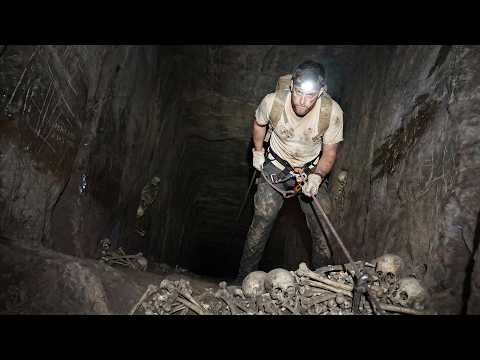
The final descent into another secluded chamber delivers the expedition's most visually impressive discovery. Massive walls of skeletal remains, intact skulls, old wheelbarrows containing bones, and a small underground gathering area create a remarkable contrast between the scale of the burial deposits and the ordinary city above. The explorer's reflections on mortality give these scenes greater emotional weight, especially when he considers the individual lives represented by the remains. Unfortunately, the commentary repeatedly returns to the same reactions, and observations about possible mold, minerals, and historical objects are largely speculative. The presentation would benefit from greater restraint and a more consistent emphasis on treating human remains as burial material rather than extraordinary collectibles or adventure props.
The concluding rope ascent provides the most alarming sequence of the entire journey. After descending approximately 60 feet, the explorer reports that his ascender failed, forcing him to climb the rope without the equipment functioning as intended. His exhaustion and relief upon reaching the surface communicate the seriousness of the experience more effectively than any dramatic narration. It is a powerful ending, but also a troubling reminder that the pursuit of increasingly inaccessible locations has overtaken basic safety considerations. Ultimately, the adventure succeeds through its extraordinary locations, escalating discoveries, and immersive atmosphere, even as its repetitive commentary, limited historical investigation, and increasingly reckless decisions prevent it from becoming a more responsible and informative exploration documentary.
Pros
- Documents striking underground environments, including enormous bone deposits, intact skulls, narrow quarry passages, and unusual skeletal arrangements rarely encountered in ordinary tourist experiences.
- Builds a satisfying progression across multiple expeditions, moving from heavily visited chambers toward increasingly secluded and visually remarkable locations.
- Captures the physical challenges of underground exploration through flooded tunnels, difficult crawls, unstable passages, and exhausting journeys.
- Creates genuine suspense through uncertain navigation, unexpected encounters with other explorers, and the dangerous final rope ascent.
- Includes thoughtful reflections on mortality and the individual human lives represented by the skeletal remains.
- Demonstrates some preservation awareness by withholding identifying details about particularly secluded entrances.
Cons
- Repeated expressions of shock and amazement become excessive, frequently replacing meaningful historical explanations or detailed observations.
- Claims that certain chambers are untouched, previously unseen, or undocumented lack convincing verification.
- Historical background remains limited, with insufficient distinction between quarry tunnels, burial areas, and potentially more recent underground modifications.
- Dangerous decisions involving unstable passages, deep water, separation from companions, and inadequate climbing equipment undermine the expedition's credibility as responsible exploration.
- Speculation about security personnel, unusual substances, and historical objects is sometimes presented without enough supporting information.
- The treatment of human remains occasionally becomes overly casual, particularly when skeletal structures are used as seating or approached primarily as sensational discoveries.
This ambitious underground adventure delivers remarkable imagery, authentic suspense, and a fascinating glimpse into lesser-known sections of Paris's subterranean network. Its strongest moments combine extraordinary discoveries with genuine reflections on mortality, but repetitive reactions, limited historical depth, and troubling safety decisions weaken the overall presentation. An engaging and often unforgettable exploration that would have benefited considerably from stronger research, greater restraint, and a more responsible approach to the dangers involved.