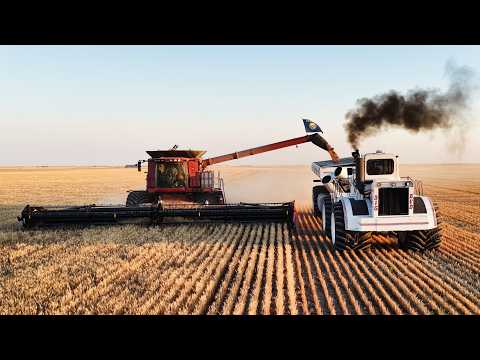
Oil seepage, clutch reliability and weeds threatening to go to seed make this a much more practical test of Big Bud 700 than a simple horsepower showcase. After the previous mechanical work, the tractor is finally being treated like working equipment rather than an ongoing project, and the early signs are encouraging. The operator reports that it is running smoothly, with no unusual behavior, while still deliberately avoiding maximum unloading loads as the upgraded components prove themselves.
Much of the mechanical interest centers on the replacement clutch and the changes made around it. The upgraded unit is described as substantially larger than the failed original, while an additional air chamber and check valve are intended to maintain at least 100 psi for clutch engagement. The absence of the vibration and slipping associated with the earlier setup is promising, although the commentary appropriately remains based on what is being observed during operation rather than pretending a short successful run guarantees long-term reliability.
Temperature monitoring adds another useful layer to the field testing. A reading of roughly 120 degrees Fahrenheit is described as acceptable for the oil being used, while the exposed chain arrangement visibly distributes oil throughout its enclosure. There is a candid acknowledgement that sustained operation under these conditions could justify finding a better cooling solution. That kind of running commentary is valuable because it shows the machine's current compromises alongside its successes instead of presenting the rebuild as completely finished.
The surrounding harvest work gives Big Bud a meaningful context. Green crop conditions cause plugging problems elsewhere in the operation, while another field reveals the consequences of an exceptionally delayed emergence described as stretching from an April seeding into June. The crop monitor initially shows around 17 bushels, with the presenter estimating that the field might have produced roughly twice that under better growing conditions. Those counterfactual yield figures are the farmer's assessment rather than demonstrated results, but the poor crop becomes a useful reminder that even impressive machinery cannot compensate for difficult growing conditions.
Big Bud becomes most convincing when it starts performing ordinary jobs. The tractor runs alongside the combines and grain cart, unloads into a truck, and demonstrates hydraulic controls, auger operation, adjustable gates and the clutch's soft-start behavior. The sequence has an appealing contrast between the machine's enormous scale and the routine nature of the work. A train-horn joke and some playful interaction keep the mechanical demonstration personable without completely overwhelming the practical details.
The episode also benefits from acknowledging the people behind the machine's progress. Tom and John are specifically credited with helping configure the Danfoss system, PBG valve settings and monitor programming, reinforcing how much specialist troubleshooting sits behind getting a heavily modified tractor functioning properly. The closing shift into post-harvest spraying broadens the farming picture further, explaining the effort to stop dense kochia from producing seed before a freeze. At times the loose, fragmented commentary makes technical explanations harder to follow than they need to be, but the combination of field work, mechanical observation and crop-management realities gives the update considerable substance.
Pros
- Big Bud 700 is tested through genuine harvest and grain-handling work rather than presented only as a horsepower spectacle.
- Clutch behavior, air pressure, temperatures and lubrication are monitored openly as the upgraded system proves itself.
- Previous clutch problems and remaining engineering compromises are acknowledged rather than hidden.
- Contributors who helped configure the tractor's hydraulic and monitoring systems receive specific credit.
- Harvest conditions, disappointing crop performance and weed management provide useful farming context beyond the tractor itself.
Cons
- Several mechanical explanations are delivered in fragmented, improvised commentary that can be difficult to follow.
- The successful clutch performance is encouraging but remains an early operational test rather than evidence of long-term durability.
- Estimated potential yields for the drought- and heat-affected field are hypothetical and cannot establish what the crop actually would have produced.
- The episode moves abruptly among tractor testing, combining, crop conditions and spraying, giving the presentation a somewhat loose structure.
Big Bud 700 finally feels less like an ambitious rebuild and more like a working member of the farm fleet, which makes its successful grain-handling sequences especially satisfying. The technical narration could be clearer and durability still needs to be demonstrated over time, but the willingness to show both improvements and unresolved considerations makes this a useful and engaging field update.