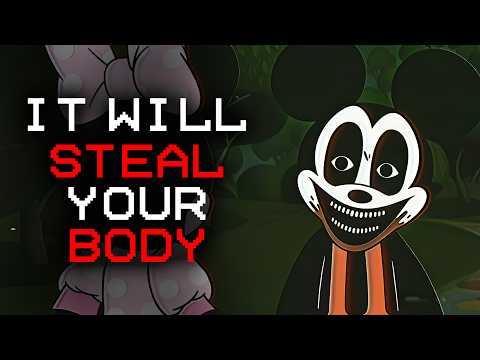
Maggie’s disappearance before Lisa even realizes there is an intruder establishes the Skin Thief as a creature that succeeds through timing and familiarity rather than simple pursuit. The analysis carefully reconstructs the opening attack, noting the creator’s clarification that Maggie was the first victim while refusing to treat Homer’s shotgun blast as proof that the creature was hit. That distinction immediately gives the discussion a useful standard: visible events, later creator information, and interpretation are treated as different levels of evidence.
Apu’s death provides the clearest explanation of what makes the creature more disturbing than an ordinary shapeshifter. It does not merely imitate its victims; it kills them, takes their skin, and uses their familiar appearance as social access. The review of this mechanism is especially effective when following the progression from Apu to Milhouse, where recognition becomes a psychological disadvantage. Milhouse knows the adult following him, or thinks he does, and that uncertainty gives the creature time to close the distance while an increasingly empty Springfield removes any realistic source of help.
The nuclear power plant sequence expands that same idea without abandoning it. Smithers is isolated after a camera failure, apparently killed, and then used as the creature’s route into Burns’ office. Burns’ reaction is the more intriguing detail because he apologizes rather than simply reacting to an unknown attacker, raising the possibility that he understands either what the creature is or why it has come for him. The analysis appropriately stops short of declaring Burns responsible, since neither the unexplained test nor the precise transformation of Frank Grimes has been established.
Frank Grimes gives the horror a recognizable human origin while also creating some of the story’s largest unanswered questions. His history with Homer provides an understandable motive for hostility toward Homer and Burns, and the later installment apparently identifies him as the Skin Thief’s human origin rather than leaving that connection entirely in fan speculation. Yet the indiscriminate murders remain harder to reconcile with that motive. Maggie, Lisa, Marge, Apu, Milhouse, Smithers, and the plant workers broaden the creature’s violence far beyond the people most directly connected to Frank’s resentment, leaving the transformation and its resulting psychology deliberately incomplete.
The Canal 6 material is where the series becomes most ambitious, shifting from individual impersonation into the corruption of public information. A reported mass shooting, Apu being named as a suspect, the survivor’s contradictory account, the interrupted Burns-related revelation, and the subsequent claim that a radical group was responsible create a compelling sequence in which each new explanation becomes less trustworthy. The analysis makes a persuasive case that stolen identities naturally contaminate eyewitness and camera evidence, although its characterization of the later broadcast as deliberate “containment” remains an interpretation rather than something definitively demonstrated by the events described.
Homer’s eventual reappearance brings the central disguise concept back to its most personal form. Applying the established pattern makes the conclusion that Homer was killed and his skin taken substantially stronger than a theory based merely on his disappearance, while Bart’s fate is correctly left unresolved because there is neither a stolen skin nor a confirmed escape. Abraham recognizing his son’s face also provides the cruelest use of the creature’s method: the disguise works not because it is physically convincing up close, but because emotional recognition happens before the victim can process everything that is visibly wrong.
The tear after Abraham collapses is an effective final mystery precisely because the analysis does not force it into a definitive answer. Homer’s consciousness surviving inside the stolen skin would transform the premise into something much darker, but Frank Grimes, copied emotion, retained memory, or another unexplained mechanism remain possible within the material presented. The presentation occasionally repeats the basic idea that familiar faces provide access and sometimes phrases interpretations with more certainty than the underlying ambiguity warrants, but its strongest moments continually return to what is actually shown, what has been clarified, and what remains unresolved.
Pros
- The identity-stealing mechanic is analyzed as a form of psychological and social horror rather than merely a gruesome visual gimmick.
- The progression from Apu to Smithers to Homer clearly demonstrates how each stolen face gives the creature access to increasingly personal targets.
- Burns’ apology, Frank Grimes’ origin connection, the Canal 6 contradictions, and Homer’s tear provide substantial mysteries without being treated as completely solved.
- Homer’s appearance before Abraham gives the established disguise mechanic an effective emotional payoff.
- Bart’s unknown fate and the ambiguous cause of Abraham’s collapse are appropriately distinguished from confirmed events.
Cons
- The explanation of recognition and stolen identities as “access” is repeated several times after the concept has already been firmly established.
- Some conclusions about deliberate information containment and the significance of particular interruptions go beyond what the story definitively confirms.
- Frank Grimes’ motive explains certain targets far better than the creature’s much broader killing spree, leaving the central transformation only partially coherent.
The Skin Thief works best when familiar faces become liabilities, turning Springfield’s relationships into tools that allow a killer to approach its next victim almost unquestioned. The unresolved transformation and occasional interpretive leaps prevent every piece of the mythology from fitting cleanly together, but the careful handling of Homer’s fate and the haunting ambiguity of his final tear give the analysis a particularly effective conclusion.