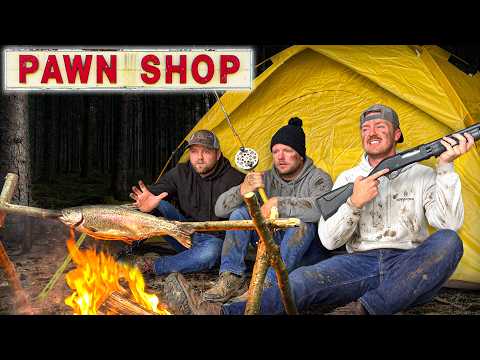
A $300-per-team budget immediately creates a meaningful tradeoff between comfort, food, and outdoor equipment, and the contrast between Walmart and Bass Pro Shops becomes clear before anyone reaches camp. Team Walmart stretches its money across a tent, sleeping pads, pillows, fishing equipment, cookware, and substantial snacks, while Team Bass Pro spends more heavily on a larger tent, sleeping bags, chairs, and fishing gear but sacrifices sleeping pads and carries far less food. That purchasing phase is lengthy, yet it establishes decisions that genuinely matter once temperatures drop and the teams begin burning calories in the mountains.
Fishing provides the challenge with its most effective direct competition. Both teams work the same small trout water with inexpensive equipment, repeatedly dealing with undersized fish, snags, lost lures, tangles, and the difficulty of finding productive spots. Bass Pro initially pulls ahead while Walmart struggles, but both ultimately secure food, and the modest size of the catch prevents dinner from feeling like an easy reward. The joking description of this as a perfectly controlled “scientific experiment” is clearly comedic rather than a serious claim; differences in anglers, lure choices, casts, locations, and luck mean the results cannot establish which retailer objectively sells better fishing equipment.
The camping portion makes the shopping choices more consequential. Team Walmart's sleeping pads prove far more valuable than Team Bass Pro's chairs once nighttime temperatures become the central problem, although neither team appears properly comfortable in its sleeping bags. The larger Bass Pro tent offers generous space but does little to solve the cold ground beneath the campers, while Walmart accepts a tighter tent in exchange for insulation and cushioning underneath. This is where the challenge works best as practical entertainment: an apparently minor purchasing decision made in a brightly lit store becomes a major source of discomfort hours later.
Food strategy produces an even larger separation on the second day. Walmart's biscuits and gravy, Pop-Tarts, cashews, and other snacks give that team something to eat after the trout are gone, whereas Bass Pro is left largely dependent on steak strips and the hope of catching or hunting additional food. After hours on the mountain, C.J. describes running on very few calories and repeatedly waking during the previous cold night, making the team's eventual withdrawal feel like the accumulated consequence of its budget choices rather than an arbitrary ending. The precise calorie estimates offered during these discussions are casual approximations rather than demonstrated nutritional calculations, but the broader contrast in available food is plainly central to the experience being presented.
The elk hunt expands the challenge beyond a simple campsite comparison, though it is also the least productive section in terms of results. Both teams spend long stretches hiking, waiting, watching game trails, examining signs, and hoping movement will increase later in the day, while one participant is also managing a painful foot. An extended sequence involving numerous distant gunshots briefly creates genuine uncertainty, but no source is identified and the speculation ranges from target practice to more alarming possibilities. Appropriately, the footage never establishes what caused the shots, so they function as an unsettling moment rather than evidence for any particular explanation.
Presentation remains energetic throughout, helped by friendly rivalry, recurring jokes about chairs and sleeping pads, inexpensive children's fishing gear, camp cooking, and the personalities of the four participants. The downside is considerable repetition: hunger, cold, Walmart's price advantage, Bass Pro's lack of pads, and predictions that the opposing team will fail are revisited many times. The sponsored debt-relief segment also interrupts the fishing momentum and contains promotional claims about savings, ratings, and debt outcomes that are presented as part of the advertisement rather than independently substantiated within the content.
Team Bass Pro quitting before the final morning gives the competition a clear outcome that follows logically from what came before. Cold ground, limited food, a full day of hunting, and the prospect of repeating the experience finally outweigh the desire to continue, while Walmart survives to day three with its cheaper comfort equipment and larger food supply. The later mention of seeing an elk at close range adds a final hunting moment, although no elk is harvested, so one of the challenge's major objectives remains incomplete. As a retailer comparison, the result demonstrates how these particular teams used equal budgets under these particular conditions rather than proving Walmart is universally superior for outdoor equipment.
Pros
- The equal $300 budgets create meaningful decisions about shelter, sleep, food, fishing equipment, and comfort.
- Early purchasing choices have real consequences once cold temperatures, hunger, and fatigue become factors.
- The fishing competition provides genuine uncertainty, setbacks, and a useful test of inexpensive equipment.
- Friendly rivalry and recurring jokes give the extended survival format plenty of personality.
- Team Bass Pro's eventual withdrawal provides a logical payoff to the food and sleeping-pad decisions established earlier.
- The presentation does not falsely resolve the unexplained gunshots or pretend the unsuccessful elk hunt produced a harvest.
Cons
- Repeated discussion of cold, hunger, sleeping pads, chairs, and Walmart's price advantage makes portions of the challenge feel unnecessarily stretched.
- The elk-hunting sections involve long periods with little activity and ultimately leave a major objective unfulfilled.
- The store comparison cannot meaningfully determine which retailer has objectively better outdoor gear because many uncontrolled variables affect the outcome.
- The lengthy sponsored debt-relief segment disrupts the momentum of the fishing competition and includes promotional claims that are not independently established here.
- Casual calorie estimates and some exaggerated competitive commentary are presented without much supporting detail.
Strong budget constraints turn ordinary shopping decisions into entertaining consequences once the teams encounter cold nights, limited food, difficult fishing, and an exhausting hunt. Although repetition and an inconclusive elk objective keep the three-day format from being consistently tight, the eventual defeat of Team Bass Pro gives the competition a satisfying payoff rooted in decisions made from the beginning.