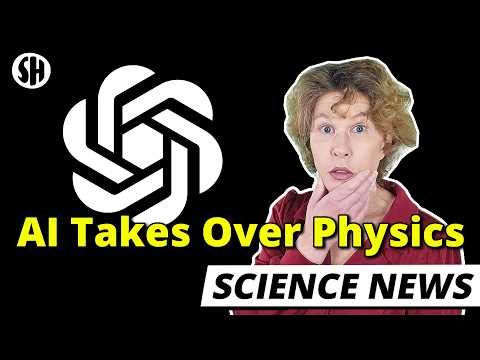
Artificial intelligence is beginning to challenge how theoretical physics produces and evaluates scientific research, but its greatest contribution may not be discovering new particles or solving famous equations. Instead, it could expose weaknesses in a research culture that has spent decades generating mathematically sophisticated theories without necessarily improving our understanding of reality. This provocative argument drives an examination of recent developments in machine-generated mathematics, automated theoretical physics, and the growing difficulty of distinguishing meaningful scientific progress from technically competent but unproductive research.
The discussion begins with OpenAI's reported mathematical work related to the existence of Yang-Mills theories, an important mathematical foundation underlying aspects of particle physics. One of the presentation's strongest explanations concerns the difference between mathematical existence and physical usefulness. A theory can successfully describe experimental observations without mathematicians having established every property needed for a rigorous mathematical construction. This distinction helps explain why an unresolved mathematical problem can remain relevant to a scientific framework that already produces reliable predictions. Importantly, the presenter acknowledges that OpenAI has not established a complete solution and that the precise significance of its reported results remains unclear. That qualification is valuable, although the suggestion that physicists would celebrate identical work from a human researcher attributes motivations to critics without providing sufficient evidence.
The argument becomes considerably more confrontational when attention turns to the established practices of theoretical physics. The presenter contends that researchers working on fundamental questions have produced enormous quantities of speculative mathematical models involving hypothetical particles, forces, and universes, frequently without meaningful connections to experimental evidence. Recent examples of automated paper generation, including one researcher producing approximately 100 papers concerning a possible dark matter candidate, illustrate how easily artificial intelligence can reproduce this kind of theoretical output. The observation raises a legitimate concern about research incentives and publication standards. However, the sweeping characterization of much of foundational physics as irrelevant is presented primarily through the speaker's interpretation rather than a systematic assessment of the field's scientific contributions.
One particularly interesting possibility is that artificial intelligence could improve physics by overwhelming existing publication practices with work that meets conventional technical expectations while contributing little new knowledge. The presenter suggests that this abundance might force researchers to reconsider what constitutes a valuable theoretical result. Rather than celebrating automated productivity, the argument emphasizes the importance of scientific judgment and the ability to identify questions worth answering. This reverses the usual enthusiasm surrounding automated discovery and gives the discussion a distinctive perspective. Nevertheless, the proposed transformation remains speculative, and the presentation does not establish that increased publication volume would necessarily produce better standards rather than simply intensifying existing problems.
The proposed alternative is to prioritize mathematical inconsistencies instead of continually inventing new explanatory frameworks. Drawing on ideas associated with the presenter's book Lost in Math, the discussion argues that resolving genuine contradictions offers a more productive direction than attempting to explain every unexplained numerical feature of nature. An AI-generated paper addressing the fine-structure constant serves as an example of the latter approach, with the presenter criticizing its elaborate numerical construction for offering little explanatory advantage over the constant itself. The underlying principle—that an explanation should provide meaningful insight rather than merely introduce additional complexity—is persuasive. Still, mathematical simplicity alone cannot determine scientific validity, and the presentation would benefit from a clearer account of how researchers should distinguish productive theoretical complexity from unnecessary mathematical invention.
The examination of an institute dedicated to physical superintelligence adds another dimension by questioning whether increasingly capable systems can escape the assumptions embedded in their training material and human guidance. The presenter argues that models trained on decades of questionable theoretical work may reproduce the same habits, particularly when directed by researchers committed to existing approaches. References to the institute's ambitions, the phrase "math is cooked," and the presenter's own work provide a mixture of industry context, skepticism, and personal humor. The commentary is entertaining, but its treatment of the institute's prospects is more dismissive than investigative. Its stated mission receives attention, while its methods and potential scientific contributions remain largely unexplored.
The presentation benefits from a clear argumentative progression, moving from mathematical proofs to automated paper production and finally to the deeper question of what scientific research should accomplish. Its conversational delivery makes difficult subjects approachable without requiring extensive technical knowledge, and the humor gives an otherwise abstract discussion considerable personality. However, several important claims about research quality, institutional resistance, and artificial intelligence's scientific capabilities receive limited supporting detail. The closing sponsorship for Radical Pie, an equation-editing application, is thematically appropriate but interrupts the scientific discussion just as its broader implications could have received further development. Ultimately, the commentary succeeds more as a forceful critique of theoretical physics than as a comprehensive evaluation of artificial intelligence's emerging scientific achievements.
Pros
- Clearly explains the important distinction between mathematical existence and the practical predictive usefulness of physical theories through the Yang-Mills example.
- Uses concrete examples of automated research-paper generation to raise meaningful questions about scientific publication standards and the value of theoretical productivity.
- Presents a distinctive argument that artificial intelligence could expose weaknesses in established research practices rather than simply accelerate existing approaches.
- Offers a constructive alternative by emphasizing mathematical inconsistencies and meaningful explanatory progress over increasingly elaborate speculative models.
- Makes difficult concepts involving mathematical proofs, particle physics, and fundamental constants accessible through conversational explanations and pointed humor.
- Acknowledges uncertainty surrounding OpenAI's reported Yang-Mills results rather than presenting an unresolved mathematical question as a completed breakthrough.
Cons
- Broad claims about the irrelevance of foundational physics research lack systematic evidence and give insufficient consideration to the potential value of exploratory theoretical work.
- Suggestions that physicists dismiss machine-generated achievements because of professional defensiveness attribute motivations without adequately substantiating them.
- The prediction that automated paper production will force meaningful improvements in scientific quality standards remains speculative and lacks a detailed explanation of how such reforms would occur.
- Criticism of the physical superintelligence initiative focuses more on perceived intellectual shortcomings than on a substantive examination of its research methods or results.
- The proposed emphasis on mathematical inconsistencies is compelling but insufficiently developed as a practical framework for determining which scientific problems deserve priority.
- The concluding sponsorship interrupts the discussion without returning to its central scientific questions.
This is an engaging and intellectually provocative examination of how artificial intelligence could reshape theoretical physics by challenging the value of research that produces mathematical sophistication without corresponding scientific insight. Its accessible explanations, unconventional perspective, and willingness to question established practices make it worthwhile viewing, even when its criticisms extend beyond the evidence presented. Although the argument would be stronger with more balanced treatment of speculative research and greater scrutiny of its predictions, it raises an important question about whether scientific progress should be measured by the quantity of theories produced or the understanding they actually deliver.