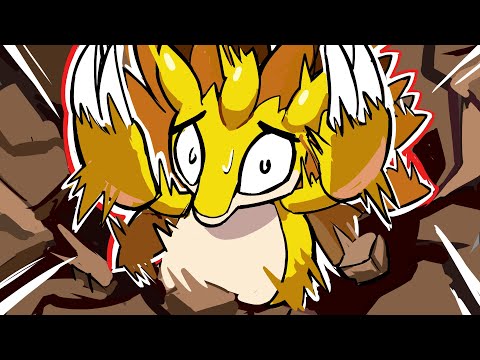
Jynx opening the list with an elaborate Dry Skin strategy immediately establishes what makes this retrospective interesting: these are not simply weak Pokémon that were briefly considered and discarded. The idea of using Skill Swap to give Cresselia Dry Skin, bringing in Politoed for permanent rain, and stacking that healing with Leftovers shows how seriously unconventional possibilities were explored. More importantly, the explanation identifies exactly why the concept failed—the setup consumed too many turns and resources for a Cresselia that still lacked enough offensive pressure.
That balance between creative theory and practical failure carries through picks such as Cursola, Accelgor and Bayleef. Cursola’s Perish Body appears appealing for a player already interested in Perish Trap strategies, but its poor physical durability and Dynamax’s lack of contact undermine the concept. Accelgor’s Me First attempt to punish Latios is even more revealing because the narrator freely admits how bad the strategy proved once tested. Bayleef provides perhaps the clearest competitive lesson of the early selections: surviving Earthquakes and Thunderbolts was useful, but merely absorbing attacks did little good when Bayleef struggled to meaningfully advance the battle in return.
Spinda and Kecleon push the experimentation into especially elaborate territory. Giving Mega Rayquaza Contrary could transform Dragon Ascent and Draco Meteor’s drawbacks into defensive and offensive boosts, while Kecleon’s Color Change strategy attempted to turn Latios into a Normal type before Breloom finished it with Mach Punch. Both plans are clever demonstrations of game-mechanics knowledge, but the discussion is strongest when explaining how opponents could disrupt them. Spinda itself was too vulnerable and required considerable setup, while the Kecleon combination could largely collapse once an informed opponent simply switched Pokémon.
Cherrim and the honorable mentions broaden the retrospective beyond failed gimmicks. Flower Gift’s powerful boost kept drawing the narrator back despite Cherrim’s unimpressive individual stats, while Sandaconda, Type: Null, Ninjask, Arbok and Enamorus illustrate several different reasons an interesting concept might never reach competition. The abandoned 2018 Perish Trap Worlds team is particularly compelling because its absence had nothing to do with theoretical viability: a 5-0 start turned into three consecutive losses, preventing the player from reaching the second day where the alternate team was intended to appear. That personal tournament history gives the concept stakes beyond movesets and damage calculations.
Gurdurr and Silvally make the upper portion of the ranking feel appropriately more substantial. Gurdurr’s Eviolite bulk, Bulk Up and Drain Punch combination receives a particularly good mechanical explanation, including why recovering a percentage of its relatively low HP could complement its boosted defenses. Silvally represents a different kind of failure: repeated experimentation with Choice Scarf, Explosion, alternative types and setup options never overcame its inability to match the strongest Pokémon of the 2017 format. The admission that the Silvally project was abandoned only days before Worlds also illustrates how competitive preparation sometimes requires discarding an idea after investing heavily in it.
Swoobat provides the strongest ending because it turns the entire subject into a genuine career what-if. Simple doubling Calm Mind and Kee Berry boosts, combined with Stored Power, created a coherent strategy that the narrator says performed well enough in testing to merit serious consideration for the 2014 Last Chance Qualifier. Choosing the more balanced Gothitelle-based team instead ultimately resulted in qualification and a ninth-place Worlds finish, so the decision cannot easily be framed as a mistake. That unresolved tension—knowing the conventional choice worked while still wondering what the unusual alternative might have accomplished—is exactly the kind of competitive history the format handles well.
The presentation does occasionally become repetitive because many entries follow the same rhythm: unusual Pokémon, clever interaction, extensive testing, and an explanation of why the idea was ultimately too inconsistent. The lengthy sponsor segment also arrives immediately after the first entry and noticeably interrupts the momentum, while the subscription appeal creates another early diversion. Some honorable mentions could have been condensed further, particularly because the central lesson of bulky Pokémon failing to exert enough pressure has already been established elsewhere.
Pros
- Detailed explanations make unusual competitive strategies understandable without reducing them to simple gimmicks.
- Failed concepts are evaluated critically, with specific reasons such as excessive setup, weak stats, poor damage output and easy counterplay.
- Bayleef, Kecleon and Silvally provide useful examples of the difference between an appealing theory and a tournament-reliable strategy.
- The abandoned 2018 Perish Trap team adds meaningful tournament context beyond individual Pokémon.
- Gurdurr receives an especially clear explanation of how Eviolite bulk and Drain Punch recovery could work together.
- Swoobat gives the ranking a satisfying personal conclusion built around a genuine Worlds decision with no obvious right answer.
Cons
- Several entries repeat the broader lesson that impressive defensive traits or clever mechanics are insufficient without reliable offensive pressure.
- The extended sponsor segment significantly disrupts the retrospective after only one ranked entry.
- Promotional interruptions and some lengthy honorable mentions make an already substantial ranking feel less focused.
- Certain strategies require considerable familiarity with competitive Pokémon mechanics and historical formats to fully appreciate.
What begins as a collection of unused Pokémon develops into an engaging retrospective on how tournament teams are actually evaluated, tested and sometimes abandoned despite promising ideas. The recurring structure becomes somewhat repetitive, but the willingness to dissect failed strategies and revisit consequential Worlds decisions gives the discussion considerably more substance than a simple ranking of forgotten picks.