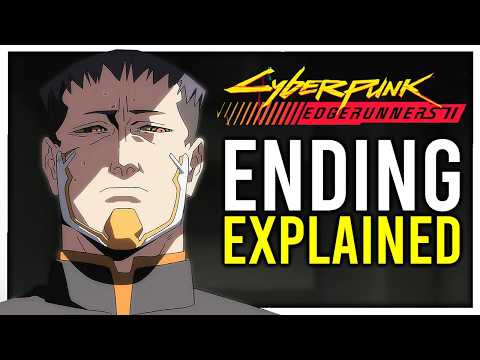
Night City has never been a place where survival comes easily, but the second season of Cyberpunk: Edgerunners apparently finds new ways to explore what makes life worth living. Rather than simply celebrating the violence and tragedy associated with the franchise, this enthusiastic analysis examines how four interconnected characters confront loss, identity, and their uncertain futures. The reviewer argues that the new season delivers stronger thematic storytelling than its predecessor, even if its ambitious ensemble structure prevents several relationships from reaching their full emotional potential.
Roman provides one of the video's most interesting avenues for interpretation. As a young filmmaker documenting the lives of people around him, he represents an unusual form of resistance against Night City's ruthless commercialization of human existence. The reviewer develops this observation into a thoughtful argument about storytelling, memory, and immortality, suggesting that Roman's camera preserves something meaningful even when the people it captures inevitably die. His connection with D becomes especially significant when their roles reverse, allowing Roman to recognize that his own life deserves attention beyond documenting everyone else's suffering. This interpretation gives considerable emotional weight to a character the reviewer otherwise considers relatively underdeveloped.
D's journey receives similarly detailed attention, particularly his inability to find satisfaction through revenge. After discovering that the people responsible for destroying his clan are already dead, D must confront the emptiness of the violence that has defined his existence. The reviewer effectively contrasts his choices with those of David Martinez from the original season, distinguishing sacrifice motivated by love from destruction driven by personal obsession. However, the analysis becomes less convincing when discussing D's relationship with the artificial intelligence Capri. Although the reviewer interprets their final moments as an expression of freedom and emotional fulfillment, he also acknowledges that their relationship receives insufficient development to justify its supposed intensity. That willingness to question the storytelling strengthens the critique, even if the interpretation occasionally stretches beyond the character interactions described.
Kingsley emerges as the reviewer's favorite character and the emotional centerpiece of the discussion. His transition from a formidable mercenary to an aging man struggling with cyberpsychosis, physical limitations, and suicidal despair creates an unusually grounded character arc. Rather than regaining his former strength, Kingsley discovers a new purpose through his relationship with his adoptive daughter, Talia. The examination of his name, contrasting the implications of weakness and kingship, offers an interesting perspective on his fears surrounding vulnerability. More importantly, the reviewer connects Kingsley's acceptance of fatherhood with the distinction between merely surviving and genuinely living. His final declaration, "Let's live," becomes a powerful expression of the season's underlying optimism, particularly after the devastating loss of the woman he loves.
Talia's characterization introduces another compelling dimension through the relationship between cybernetic enhancement and humanity. Unlike characters who pursue modifications primarily for strength or professional advantage, Talia depends on technology to survive a deteriorating physical condition. The reviewer identifies the resulting contradiction: the machinery that makes her appear less human simultaneously allows her to experience ordinary aspects of human life. His comparison between Talia's attempts to preserve her body and Roman's efforts to preserve memories creates one of the analysis's strongest thematic connections. Their relationship also supports a broader interpretation about technology becoming valuable when it enriches human experiences rather than replacing them. While the reviewer briefly questions their apparent age difference, the discussion largely concentrates on the emotional and philosophical significance of their connection.
The comparison between the two seasons provides a useful counterbalance to the otherwise enthusiastic character analysis. The reviewer favors the second season's thematic complexity and relatively hopeful conclusion but considers the original superior in emotional impact, soundtrack, central protagonist, and villain. Adam Smasher's imposing presence and David Martinez's more concentrated character development are presented as advantages that the newer ensemble cannot fully replicate. The criticism of limited screen time is particularly persuasive because it connects several weaknesses to a shared structural problem. Kingsley's earlier experiences, D's attachment to Capri, and the motivations of antagonists such as Kiro Yang all receive less attention than the reviewer believes they deserve. His frustration with Yuppie's rushed involvement and limited emotional impact reinforces this broader concern, although that portion of the commentary relies more on personal irritation than detailed examination.
The presentation succeeds primarily through its combination of enthusiastic fandom and sustained thematic interpretation. Instead of simply recounting major plot developments, the reviewer repeatedly returns to larger questions about grief, personal agency, family, and the consequences of technological advancement. Specific character interactions and closing scenes provide useful foundations for those arguments, while occasional humor and conversational language keep the discussion approachable. Nevertheless, some interpretations are presented with greater certainty than their supporting examples justify, and the commentary occasionally becomes repetitive when emphasizing the importance of living for others. The visual spectacle receives praise without much detailed examination, and the musical comparison remains largely a matter of personal preference. The closing speculation about a possible corporate-background protagonist in a third season is entertaining, but it contributes little to evaluating the season under discussion.
Pros
- Thoughtful analysis of Roman's filmmaking connects storytelling, human memory, and resistance to Night City's disposable culture.
- D's revenge-driven character arc receives meaningful examination, including an effective comparison with David Martinez's motivations and sacrifice.
- Kingsley's struggle with lost strength, grief, and fatherhood provides the discussion's strongest emotional and thematic material.
- Talia's dependence on cybernetic enhancements introduces an interesting exploration of transhumanism, mortality, and the relationship between technology and humanity.
- Comparisons with the first season offer a balanced assessment of narrative structure, emotional impact, music, and antagonists.
- Specific criticism of underdeveloped relationships and limited screen time demonstrates a willingness to acknowledge weaknesses despite the reviewer's enthusiasm.
Cons
- The interpretation of D's emotional connection with Capri occasionally exceeds the relationship development the reviewer acknowledges.
- Several thematic observations become repetitive, particularly those concerning survival, personal purpose, and finding meaning through relationships.
- Praise for the animation and criticism of the soundtrack receive relatively little supporting analysis.
- Some secondary-character criticism depends more on personal frustration than substantive evaluation, while speculation about a third season briefly distracts from the central review.
This engaging character-focused analysis offers a thoughtful examination of how Cyberpunk: Edgerunners uses tragedy, technology, and human relationships to explore the possibility of hope within a brutal fictional world. Its strongest insights emerge from Kingsley's transformation and the thematic parallels connecting the central characters, although occasional repetition and uneven supporting evidence limit its overall precision. Despite those shortcomings, the review delivers a persuasive, emotionally invested assessment that recognizes the season's creative achievements without overlooking its narrative weaknesses.