Two Russian armored carriers moving toward Ukrainian positions become the clearest illustration of Philip Ingram's central argument: mass and speed are increasingly liabilities when reconnaissance drones can detect vehicles early and rapidly hand coordinates to artillery and FPV operators. His breakdown of the Zaporizhzhia attack is particularly effective because it connects the destruction of the vehicles to the broader tactical dilemma facing mechanized forces. Infantry can disperse and hide but struggles to concentrate quickly, while armor can move troops faster but presents a much larger thermal and visual target.
The strongest sections focus on specific technologies and explain why they matter rather than merely displaying dramatic battlefield footage. Ukraine's interceptor drones are presented as an answer to faster Russian jet-powered strike drones, while pre-positioned FPVs waiting in low-power mode are described as a remotely activated obstacle capable of denying roads or channeling advancing forces toward other areas. Ingram's explanation of Russian decoys is similarly useful, especially his Kosovo anecdote about inexpensive emitters being used to attract costly anti-radiation weapons. It reinforces the larger point that modern warfare is partly an economic contest over persuading an opponent to waste expensive weapons on cheap targets.
Some claims deserve more caution than the presentation gives them. The figure of more than 1.5 million Russian killed and wounded is presented as a straightforward total without explaining its sourcing or uncertainty, while highly specific descriptions of battlefield events frequently depend on Ukrainian imagery and reporting. The broad conclusion that Russian mechanized attacks will continue ending disastrously until Moscow solves the drone problem is plausible within the examples shown, but it is stated more categorically than those examples alone can establish.
The European security section is considerably more speculative. Preparations involving evacuation routes, medical capacity, exercises and infrastructure protection can demonstrate that governments are planning for possible conflict, but preparation is not evidence that conflict is imminent. Ingram eventually makes this distinction himself, describing much of the activity as deterrence and strategic signaling, yet he also predicts increasingly severe Russian actions and suggests Putin could eventually attempt a limited Baltic provocation. Those forecasts are presented confidently despite necessarily depending on assumptions about Russian intentions and NATO responses.
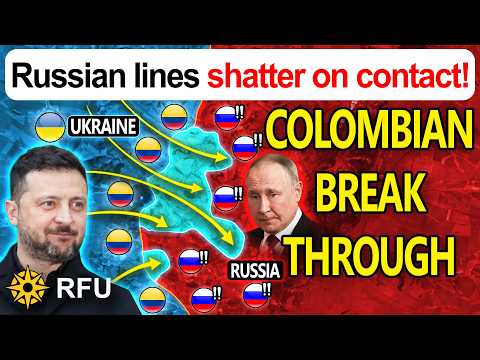
Coverage of Ukraine's localized operations is more convincing because the analysis returns to battlefield mechanics. The discussion of Ukrainian and Colombian troops around the Kupiansk direction explains how forests, road control, river crossings and drone surveillance interact, while also acknowledging uncertainty about language and command issues. The description sometimes treats reported Ukrainian success as settled battlefield reality rather than emphasizing the difficulty of independently confirming fast-moving front-line claims, but the tactical explanation remains clear and accessible.
Operation Vivaldi provides the most interesting material. Heavy aerial drones carrying unmanned ground vehicles into Russian rear areas represent a striking combination of existing technologies, and Ingram explains the operational logic well: robots can bypass minefields and forward defenses, threaten rear positions and force defenders to divert personnel without exposing Ukrainian soldiers performing the initial penetration. His emphasis on dislocation rather than simply destruction makes this section considerably more informative than a compilation of spectacular drone footage would have been.
Pros
- Clearly explains the tactical tradeoff between dispersed infantry and easily detected mechanized formations on a drone-saturated battlefield.
- Connects reconnaissance, FPV drones, artillery and pre-positioned weapons into an understandable sensor-to-shooter system.
- The discussion of deception and inexpensive decoys adds useful historical and economic context.
- Operation Vivaldi's combination of aerial drones and unmanned ground vehicles is explained in terms of its wider tactical purpose rather than treated merely as technological novelty.
- Ingram explicitly distinguishes NATO deterrence preparations from proof that Russia has decided to attack.
Cons
- Several battlefield claims and casualty figures are delivered with limited discussion of sourcing, uncertainty or independent verification.
- Predictions about escalating Russian actions across Europe become considerably more confident than the evidence presented can support.
- Ukrainian battlefield accounts and imagery are frequently accepted at face value when additional qualification would strengthen the analysis.
- The claim that Russian mechanized assaults will continue ending disastrously until the drone threat is solved oversimplifies a battlefield in which tactics and countermeasures continue evolving.
- The lengthy European security discussion pulls attention away from the more focused and persuasive analysis of drone warfare promised by the central subject.
Ingram is at his best when explaining how drones, sensors, deception and unmanned vehicles are changing the practical mechanics of fighting rather than attempting to forecast Moscow's next geopolitical move. The detailed battlefield examples make this an informative examination of rapidly evolving tactics, but firmer sourcing and more restraint around strategic predictions would make its confident conclusions considerably stronger.