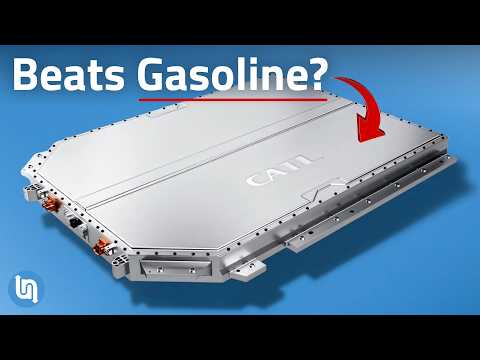
The most compelling part of this explanation is that its central “breakthrough” is primarily a manufacturing story rather than a claim about a miraculous new battery chemistry. The video contrasts conventional wet electrode coating, in which electrode powders and binder are mixed into a slurry, coated onto current collectors and dried, with a dry process intended to eliminate solvents and lengthy drying stages. The donut-glaze and chewing-gum analogies make otherwise specialized manufacturing concepts approachable without completely reducing them to slogans, while the emphasis on production time, energy use and factory equipment gives viewers a clear reason why the process could matter economically.
The explanation of the binder mechanism is particularly useful. The video describes PTFE being mechanically transformed into a fibrous network that holds active electrode particles together, drawing on a Maxwell Technologies patent and contrasting its jet-milling approach with a roller-based process attributed to Fraunhofer. That comparison helps establish that “dry electrode” is a broader manufacturing idea rather than one proprietary machine or procedure. The claim that eliminating ovens and solvents could produce cost savings as high as 25%, however, is presented as an industry estimate without enough detail about what costs are included, how broadly that figure applies or how much of the projected saving has actually been demonstrated at commercial scale.
The discussion becomes more valuable when it addresses why an apparently old idea has taken so long to commercialize. Rather than presenting Maxwell's 2008-era work as proof that mass production should have been straightforward, the video identifies cathode processing as a major obstacle and describes possible chemical incompatibility between PTFE and cathode materials. Its account of Tesla blending PTFE with more stable polymers such as PVDF provides a plausible technical explanation for progress, but this section also contains some of the video's most important uncertainty. The presenter explicitly describes parts of his reconstruction as his own interpretation, and viewers should accordingly treat the explanation of what specifically allowed Tesla to scale the technology as an informed account rather than a conclusively demonstrated history of the engineering program.
That distinction becomes even more important when the discussion expands into competitive positioning. The video suggests that relatively lower investment in established wet-electrode production in the United States and Europe might become an advantage when transitioning to dry manufacturing, while also speculating that Fraunhofer's unnamed European automotive partner could be Volkswagen. Both are interesting possibilities, but neither is established by the material presented. The enthusiasm about this being a rare battery advance not pioneered by China also introduces a geopolitical angle that receives much less analysis than the manufacturing engineering itself, particularly given the sweeping closing suggestion that batteries are becoming less reliant on foreign supply chains.
The strongest performance argument concerns binder migration. The explanation that solvent evaporation during wet processing can redistribute binder, weakening parts of an electrode and constraining electrode thickness, gives the manufacturing change a potential benefit beyond simply lowering factory costs. The video then connects more uniform binder distribution with the possibility of thicker electrodes and higher energy density. That is a useful explanation of why manufacturing technique can affect cell performance, although the progression from thicker electrodes to “better” batteries is somewhat compressed; the presentation does not examine the broader electrochemical and manufacturing tradeoffs that can accompany increasing electrode thickness.
The extension to solid-state batteries is similarly intriguing but appropriately understood as forward-looking. The argument is that moisture-sensitive solid electrolytes can benefit from manufacturing processes that avoid wet processing, potentially making dry coating important to some future battery designs. This is a much more grounded connection than announcing that dry coating itself has solved solid-state batteries, and the video ultimately acknowledges that widespread adoption remains some distance away and that scaling could expose additional quality problems. That caution improves a presentation whose title and occasional bursts of enthusiasm otherwise make commercialization sound more settled and transformative than the evidence shown can fully establish.
The lengthy portable-air-conditioner sponsorship interrupts an otherwise focused engineering narrative, particularly because it introduces another collection of efficiency, cooling-capacity, noise and air-purification claims in the middle of a technical discussion about batteries. Once the main subject resumes, however, the presentation remains unusually effective at explaining why process engineering can be as consequential as new chemistry. Its best contribution is not proving that batteries have suddenly become “insanely cheap,” but showing why eliminating solvent-based electrode coating could reduce manufacturing complexity while potentially improving electrode design—and why converting that elegant laboratory idea into reliable industrial production has been the difficult part.
Pros
- Clearly explains the fundamental difference between conventional slurry coating and dry electrode manufacturing without requiring specialist battery knowledge.
- The PTFE fiber explanation gives useful technical substance to how dry electrode material can hold together without a solvent-based slurry.
- Addresses the difficult question of why technology developed years ago has taken so long to reach meaningful production rather than presenting commercialization as effortless.
- Binder migration provides a concrete explanation for why dry processing could potentially improve electrode performance as well as reduce manufacturing costs.
- The connection to moisture-sensitive solid-state battery materials shows how the manufacturing technique could remain relevant beyond today's lithium-ion designs.
- Explicit acknowledgments of speculation and remaining scaling and quality challenges add useful restraint to an otherwise enthusiastic presentation.
Cons
- The claimed potential cost reduction of as much as 25% lacks enough context to establish how broadly or reliably that figure applies at commercial scale.
- Important explanations of Tesla's cathode progress are partly reconstructed from research and patents rather than demonstrated as a definitive account of its production process.
- The suggestion that Fraunhofer's unnamed automotive partner is Volkswagen is acknowledged speculation and adds little to the core engineering explanation.
- Claims about Western competitive advantages and reduced dependence on foreign supply chains are broader than the evidence presented about electrode manufacturing alone can establish.
- The discussion of thicker electrodes moves too quickly from reduced binder migration to higher energy density without exploring the relevant performance and manufacturing tradeoffs.
- The extended air-conditioner sponsorship substantially disrupts the pacing and introduces numerous unrelated product-performance claims.
This is an accessible and technically substantive explanation of a manufacturing technology whose significance comes from removing costly production steps rather than promising an exotic new chemistry. Its strongest sections explain the mechanics and scaling challenges of dry electrodes, while its weaker moments turn promising developments, estimates and informed speculation into conclusions that sound more certain than the supporting material warrants. With slightly tighter claims and more attention to commercial-scale evidence, it would be an exceptionally strong battery-engineering explainer.