A golden eagle bearing down on a zig-zagging jack rabbit gives the opening stretch a clear demonstration of the hunting strategy the presentation wants to emphasize: altitude, timing, speed, and terrain can matter as much as raw size. Similar examples involving snakes, monkeys, young mountain goats, and fish broaden that idea by showing eagles as adaptable predators rather than simply powerful birds. The narration also supplies useful biological context, although its many precise figures are stated rather than sourced or examined.
The eagle-focused material is strongest when it explains how different species supposedly adapt their approach to particular prey. The brown snake eagle's scaled legs are described as protection during encounters with venomous snakes, while harpy and Philippine eagles are presented as canopy hunters relying on concealment and maneuverability. The discussion of golden eagles using steep terrain against young mountain goats similarly makes hunting behavior more interesting than a simple sequence of attacks. These passages consistently frame predation around opportunity and vulnerability.
There is also a welcome effort to acknowledge limits. Kangaroos are described as difficult targets because of their size and group protection, and the mountain-goat section emphasizes that an eagle cannot simply overpower a much heavier animal. That restraint makes the presentation more credible than its repeated "ruler of the skies" language might suggest. However, claims such as a roughly 750-psi eagle grip, eyesight five times sharper than human vision, and specific ecological effects are delivered confidently without any supporting explanation, sourcing, or distinction between species.
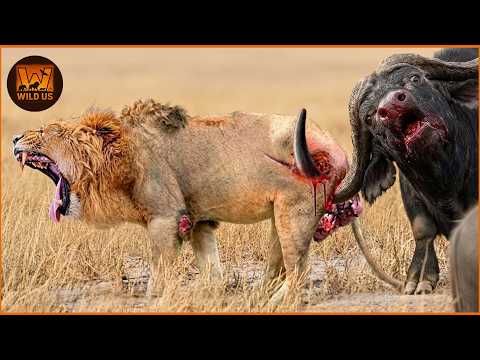
The largest problem is structural. Despite the eagle-centered title and opening, the compilation abruptly spends much of its running time on lions, baboons, oryx, hippos, rhinos, giraffes, wild dogs, crocodiles, zebras, wildebeest, deer, wild boars, and eventually an extended sequence about honey badgers. Some of these encounters are interesting on their own, but they have almost nothing to do with eagle attacks. By the time the narration is explaining honey badgers raiding ostrich eggs, confronting lions, approaching elephants, attacking crocodiles, finding honey, and facing hyenas, the original subject has effectively disappeared.
The repetitive narration compounds that lack of focus. Encounters are repeatedly described through the same vocabulary of "pressure," "advantage," "balance," "timing," "opportunity," and momentary vulnerability. That creates a consistent dramatic tone, but it also makes very different predator-prey interactions sound mechanically similar. There are also conspicuous verbal errors and awkward passages—including malformed measurements, repeated wording in the wild-boar section, and a garbled description of cheetah speed—that weaken the polished wildlife-documentary style the narration is trying to create.
More importantly, the presentation frequently describes highly specific encounters as though their precise sequence and motivation were established: animals wait for openings, coordinate pressure, sense unusual circumstances, or strategically reduce future threats. The narration occasionally uses qualifying language such as "may," "often," and "in some situations," which helps, but it does not explain what footage supports each behavioral interpretation or how representative these scenes are. Statements about ecological population control, hunting success rates, venom tolerance, bite forces, and other biological details similarly receive no visible evidentiary grounding within the presentation.
Pros
- The early eagle sections cover a useful range of hunting environments, prey, and strategies rather than portraying every species as hunting identically.
- Several encounters acknowledge the physical limitations and risks predators face instead of presenting eagles or other apex hunters as unbeatable.
- The emphasis on terrain, timing, concealment, group defense, and vulnerability provides a coherent framework for understanding the featured encounters.
Cons
- The compilation abandons its advertised eagle focus for lengthy sections about lions, crocodiles, honey badgers, and numerous other animals.
- Numerous precise biological statistics and behavioral interpretations are asserted without sourcing or enough explanation to evaluate their reliability.
- Repetitive language about pressure, advantage, timing, and balance makes distinct encounters increasingly formulaic.
- Garbled measurements, duplicated wording, and awkward sentences noticeably undermine the narration's authority and polish.
- Some specific animal motivations and strategies are narrated with more certainty than the presentation demonstrates.
The eagle material offers some engaging descriptions of how birds of prey can exploit altitude, terrain, concealment, and vulnerable targets, but the compilation eventually becomes a much broader and less disciplined collection of predator encounters. Its dramatic wildlife narration remains accessible, yet the severe drift from the advertised subject, repetitive writing, production errors, and unsupported specificity keep it from functioning as a particularly rigorous or focused nature presentation.