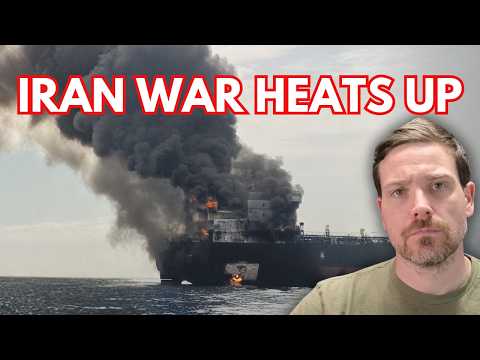
Public opinion becomes the central strategic variable in an episode that deliberately steps away from battlefield mechanics to examine what Americans are willing to tolerate politically. The argument begins with an Economist poll showing only 27% of respondents viewing the war as the right decision while 57% call it wrong, then broadens across Politico and Fox News polling to argue that opposition is not confined to Democrats. That framing is useful because the episode is less interested in declaring that one poll settles the question than in identifying a consistent trend across several surveys: support is declining, disapproval is rising, and the administration may therefore have fewer politically realistic options for escalating the conflict.
The breakdown by political affiliation gives the polling more value than a single national approval number. Independent voters are described as opposing the war by 65% to 13%, while the Republican coalition itself appears divided, with 77% of MAGA Republicans supporting the decision compared with only 31% of non-MAGA Republicans in the Economist figures presented. Politico polling is then used to show movement even within Trump’s strongest supporters, including a reported 13-point decline over two months in the share of MAGA voters who believe the war is worth its economic costs. Those numbers support the narrower claim that domestic patience may be weakening across multiple constituencies, although the presentation does not spend much time examining sample sizes, question wording, methodology, or whether the different surveys are measuring precisely the same thing.
The strongest analytical step is connecting those polling trends to actual strategic choices. The presenter argues that an administration contemplating ground troops, territorial occupation, higher casualties, heavier munitions expenditure, or increased economic pain at home would need substantially more political tolerance than appears to exist. That is a reasonable framework for thinking about democratic constraints on warfare, particularly with midterm elections approaching. The anonymous Politico source claiming that the White House sees its preferred path to victory as “politically impossible” fits that thesis, but the episode correctly flags the source as anonymous rather than treating the statement as an official description of administration thinking.
The possibility of simply ending the campaign receives surprisingly serious attention. A Fox News discussion about Trump potentially walking away and an Atlantic report about allies considering some form of exit are presented as evidence that declaring success and limiting further involvement may now be among the available choices. The presenter does not personally accept that the current situation clearly constitutes victory, but suggests that the administration could emphasize degradation of Iranian forces or damage to the nuclear program as justification for leaving. This section is most effective when it distinguishes between what the administration might politically claim and what the presenter believes the strategic reality actually supports.
Where the analysis becomes less certain is in translating public opinion into concrete government behavior. The claim that lawmakers may eventually enter “self-preservation mode” and resist further escalation is plausible, especially near an election, but no congressional vote counts, legislative proposals, constituent pressure data, or specific statements from vulnerable members are presented to demonstrate that such a shift has begun. Similarly, Fox News commentary is treated as potentially significant because Trump is said to watch the network frequently, yet a host discussing an exit strategy does not establish that the president is moving toward one. These observations are useful indicators, but they remain indicators rather than direct evidence of policy change.
The discussion of Iran’s willingness to continue fighting introduces another important limitation on an American strategy based on maintaining pressure. The presenter argues that the apparent short-term approach is continued airstrikes combined with the hope that Iranian willingness to resist collapses before American political support does. He is openly skeptical of that gamble and acknowledges the lack of reliable polling from inside Iran, which is an important qualification. The conclusion that Iran currently appears prepared for a prolonged struggle is therefore presented as an outside assessment rather than a measurable fact, though more detail about the military, political, or social evidence behind that judgment would strengthen it.
The episode ultimately succeeds because it treats domestic opinion as part of the conflict rather than as a separate political sideshow. Polling cannot determine what military strategy should be, and declining approval does not by itself prove that escalation, withdrawal, or negotiation will follow. What it does show, if the surveys cited accurately capture the broader trend, is that political room for additional sacrifice may be narrowing rapidly. By connecting that pressure with potential casualties, economic costs, elections, continued strikes, and possible exit strategies, the video adds an important dimension to understanding what choices may remain available even while leaving the final trajectory unresolved.
Pros
- Uses multiple recent polls rather than relying on a single survey to support the argument that opposition to the war is growing.
- Breakdowns among independents, MAGA Republicans, non-MAGA Republicans, and the broader electorate make the political picture more informative than a simple national approval figure.
- Clearly identifies the Politico White House source as anonymous and avoids presenting the quote as an official administration statement.
- Connects declining public support with specific forms of escalation, including ground involvement, casualties, economic costs, and greater military expenditure.
- The discussion of a possible withdrawal distinguishes between declaring political victory and demonstrating an unambiguous strategic victory.
- Acknowledges uncertainty about Iranian public sentiment and presents continued Iranian resistance as an assessment rather than established polling evidence.
- Shifting from battlefield operations to domestic political constraints gives the wider war discussion an important perspective that military footage alone cannot provide.
Cons
- Polling results receive little methodological examination, including sample size, wording, weighting, margins of error, and differences between what individual surveys actually ask respondents.
- The claim that collapsing public support will translate into congressional resistance or electoral self-preservation remains speculative without specific evidence from lawmakers or upcoming races.
- Fox News discussion of ending the war is treated as potentially influential on Trump, but commentary from individual hosts cannot establish administration policy.
- Comparisons with the historical unpopularity of Vietnam are striking but receive too little context to determine whether the wars, polling environments, and measures of opposition are genuinely comparable.
- The assessment that Iran is prepared to continue fighting for the long term is cautiously framed but still lacks much supporting evidence beyond the presenter’s reading of the situation.
- The episode focuses heavily on the political viability of escalation without equally examining whether military, diplomatic, legal, or allied considerations might constrain the administration independently of public opinion.
The episode makes a persuasive case that declining American support has become an important variable in determining how much further the United States can politically escalate its conflict with Iran, especially when several polls show opposition spreading beyond predictable partisan lines. Its strongest contribution is connecting public sentiment with casualties, economic costs, elections, military escalation, and possible exit strategies rather than treating polling as an isolated popularity contest. Some conclusions about congressional behavior, White House options, and Iranian endurance remain speculative, but the careful attribution of survey results and repeated acknowledgment of uncertainty make this a useful examination of how domestic politics can narrow the choices available in an ongoing war.