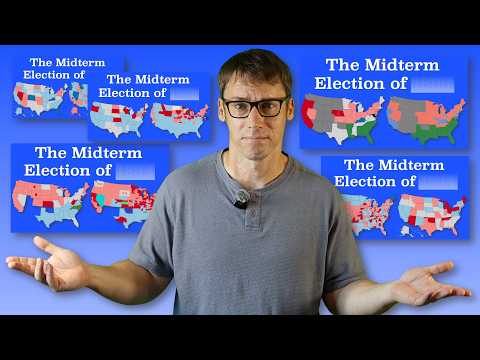
Donald Trump's reported loss of both chambers of Congress in the 2026 midterm elections provides the starting point for an ambitious examination of presidential power, political survival, and the consequences of divided government. With Democrats described as flipping seven Senate seats and gaining control of the House, the presentation argues that Trump now faces a challenge experienced by five previous presidents since 1900. Rather than treating the election as an isolated political event, the narrator builds a historical comparison around three possible responses: confrontation, compromise, or political decline. It is an engaging premise that gives viewers a useful framework for understanding how congressional defeats can reshape the remainder of a presidency. However, the contemporary election results, economic conditions, and military developments are presented as established facts without identifying supporting sources, making the reliability of the opening scenario an important limitation.
Woodrow Wilson's experience following the 1918 midterms establishes the dangers of refusing to compromise with a hostile Congress. The account explains how Wilson's appeal for Democratic victories backfired, leaving Republicans in control of both chambers just as World War I ended. His subsequent battle with Senator Henry Cabot Lodge over the Treaty of Versailles and the League of Nations demonstrates how congressional opposition can derail a president's defining international ambitions. The discussion effectively connects Wilson's political inflexibility, exhausting nationwide speaking tour, deteriorating health, and eventual defeat over treaty ratification. Dramatically reconstructed conversations help bring the period to life, although the presentation wisely acknowledges that these exchanges are imagined rather than documented dialogue.
Harry Truman's political comeback provides one of the most entertaining and informative sections. The narrator connects the Republican victories of 1946 to postwar inflation, labor unrest, meat shortages, and widespread dissatisfaction with the administration. Senator William Fulbright's suggestion that Truman resign introduces an especially memorable example of how politically vulnerable a president can become after losing Congress. The subsequent account of Truman's 1948 campaign, including the Turnip Day special session, attacks on the Republican-controlled Congress, whistle-stop train appearances, and the famously incorrect Dewey Defeats Truman headline, illustrates how an apparent political disaster can become an electoral opportunity. Importantly, the presentation also recognizes that Truman cooperated with Republicans on major foreign policy initiatives, including European reconstruction, rather than portraying his presidency as an uninterrupted partisan confrontation.
Dwight Eisenhower's relationship with Democratic congressional leaders Sam Rayburn and Lyndon Johnson offers a valuable contrast to Wilson and Truman. Instead of emphasizing political retaliation, the narrator highlights cooperation on defense, budgets, and the creation of the Interstate Highway System. Eisenhower's experience traveling across America in a military convoy and his observations of German highways provide an effective explanation of his interest in modern transportation infrastructure. His overwhelming reelection victory in 1956, despite Democrats retaining Congress, reinforces the argument that voters can reward a president without giving his party complete control. The historical comparison is persuasive as an illustration of bipartisan possibilities, though it occasionally simplifies complex legislative negotiations into personal relationships and presidential choices.
Bill Clinton's confrontation with Newt Gingrich and the Republican Congress introduces the most complicated example of political survival. The account follows the Republican revolution of 1994, Clinton's struggle to demonstrate his continued relevance, the government shutdowns of 1995 and 1996, and his eventual cooperation with Republicans on welfare reform and fiscal policy. The dispute surrounding Gingrich's treatment aboard Air Force One supplies a memorable illustration of how political messaging can influence public perceptions during a legislative crisis. The discussion then connects Clinton's reelection and subsequent budget surplus with the investigations that culminated in his 1998 impeachment and 1999 acquittal. This section successfully demonstrates the risks of congressional overreach, although its treatment of economic outcomes and political recovery would benefit from greater attention to factors beyond the Clinton-Gingrich confrontation.
George W. Bush's experience following the 2006 midterms brings the discussion back to wartime leadership. The narrator presents Democratic congressional victories as a response to growing dissatisfaction with the Iraq War, then examines Bush's decision to pursue a troop surge despite calls for withdrawal. Congressional investigations, the resignation of Attorney General Alberto Gonzales, and cooperation during the 2008 financial crisis illustrate how confrontation and compromise can exist within the same administration. The comparison between Bush's unpopular war and the narrator's description of Trump's military involvement with Iran gives the closing argument a coherent direction. Nevertheless, the suggestion that the fates of Wilson and Bush reveal a meaningful predictive pattern rests on a very small group of historically distinct presidencies. The broader narrative also contains some imprecise chronology and compressed causal explanations that weaken its authority as rigorous historical analysis.
The final section brings these presidential experiences together to consider investigations, veto confrontations, government shutdowns, judicial nominations, and the approaching 2028 election. The discussion of congressional subpoena powers, impeachment requirements, presidential succession, and the Twenty-Second Amendment adds useful constitutional context. It also makes an important distinction between Trump and the presidents who recovered politically by seeking reelection: the constitutional two-term limit prevents him from following their electoral path. To its credit, the presentation outlines both supporters' and critics' interpretations rather than claiming to know the eventual outcome. Still, the recurring formula of fighting, dealing, or sinking sometimes forces complex political histories into overly tidy categories, while the absence of identifiable historical and contemporary sources limits the confidence viewers should place in its more specific assertions.
Pros
- Uses five presidential case studies to provide an accessible historical framework for understanding divided government and political survival.
- Effectively contrasts Wilson's resistance, Truman's comeback, Eisenhower's cooperation, Clinton's strategic compromises, and Bush's wartime difficulties.
- Delivers particularly engaging historical storytelling through Truman's whistle-stop campaign, the Interstate Highway System, and the Clinton-Gingrich shutdown confrontation.
- Incorporates meaningful constitutional and institutional context, including congressional investigations, veto overrides, impeachment, presidential succession, and term limits.
- Acknowledges that divided government can produce major bipartisan legislation rather than inevitably resulting in political paralysis.
- Presents competing arguments about Trump's political prospects and recognizes that historical comparisons cannot establish a certain outcome.
Cons
- Treats the reported 2026 congressional election results, economic conditions, and Iran conflict as established facts without providing identifiable sources or verification.
- Relies on a small number of historical examples to suggest recurring political patterns, without sufficiently addressing differences in circumstances, institutions, and electoral conditions.
- Sometimes oversimplifies complex political developments by attributing legislative achievements, economic outcomes, and electoral victories primarily to presidential strategy.
- Includes occasional chronological imprecision and dramatic reconstructions that, despite some disclosure, diminish the presentation's historical precision.
- Provides limited sourcing for specific statistics, historical quotations, political claims, and interpretations of congressional investigations.
This is an entertaining and informative historical examination of how presidents respond when Congress falls into opposition hands, with particularly effective storytelling surrounding Truman, Eisenhower, and Clinton. Its chronological structure, memorable political episodes, and attention to constitutional limitations make complicated institutional conflicts accessible, although unverified contemporary claims and simplified historical comparisons weaken its analytical credibility. The presentation succeeds as an introduction to the possibilities and dangers of divided government, but its predictions deserve to be treated as interpretations rather than conclusions established by history.