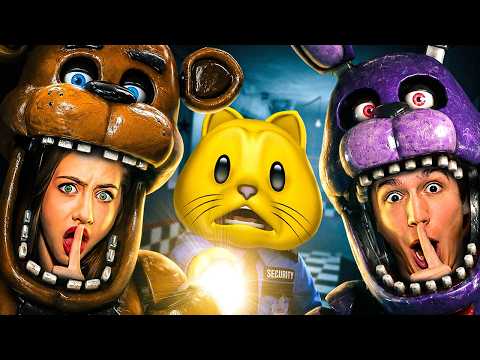
The opening throws its human players and animatronics immediately into a familiar Among Us problem: three impostors need to be identified before the group is eliminated. That simple framework becomes considerably more chaotic once the pizzeria's history, William Afton, infected animatronics and competing suspicions enter the equation. The result is deliberately frantic, with accusations beginning almost immediately and characters repeatedly trying to turn personality quirks into evidence. It captures the social-deduction energy effectively, even when the actual reasoning is far less disciplined than the arguing around it suggests.
The tasks give the episode a useful second source of momentum. Players have to repair and clean the pizzeria for its planned reopening, creating a victory condition beyond simply voting people out. Replacing batteries, fixing equipment and completing assorted repairs also provide excuses to separate characters and move them through the building, where new clues can emerge. The running joke that anyone would consider reopening such an obviously dangerous establishment for children fits the video's knowingly absurd tone without requiring the story to take its own premise too seriously.
The stronger mystery emerges around the toy animatronics and the withered ones. Initial suspicion treats the animatronics largely as a single threatening group, but the story gradually establishes an important distinction: the toys claim they woke after detecting someone who was hurt, while the withered animatronics remained connected to charging stations that had become infected. From there, the purple eyes are interpreted as evidence of a "purple virus" linked to Afton. This is fictional lore operating within the video's story rather than an attempt at a rigorous deduction, but it gives the animatronics a more sympathetic role and creates a reason for the players to reconsider their assumptions.
That reversal becomes the video's most effective narrative idea. The animatronics explain that entertaining children was what they wanted, while Afton's actions led to the pizzeria closing and the withered characters deteriorating after being left outside. Their fear that they will remain locked away collecting dust gives emotional stakes to what could otherwise have been nothing more than a noisy costume-based elimination game. Helping a small creature escape and worrying about an injured person further reinforces the distinction between threatening appearances and actual intentions.
The human investigation is much messier. Billy's knowledge of Afton and fascination with his work make her an obvious suspect, while Glenn attracts attention for aggressively directing the group's suspicions toward everyone else. Alex becomes suspicious for almost the opposite reason: he has done so little incriminating that the characters decide Afton, described as a skilled liar, might deliberately behave perfectly. There is some fun in that escalating paranoia, but the logic becomes increasingly elastic. Nearly any behavior can be interpreted as guilt, innocence or sophisticated deception depending on what the scene currently needs.
The presentation embraces that disorder with rapid dialogue, recurring jokes, sudden accusations and characters talking past one another. Running material such as the argument over whether "red is sus," Alex's strangely relaxed responses and the hostility toward particular animatronics keeps the social-deduction scenes playful rather than grim. At the same time, the combination of FNAF terminology, Among Us rules, character relationships, sabotage, Afton lore and several simultaneous suspects can make important clues difficult to separate from throwaway comedy. The mystery is therefore more enjoyable as energetic role-play than as something viewers could realistically solve alongside the characters.
The conclusion wisely returns to the task mechanic rather than depending entirely on another accusation. Completing the remaining work restores the pizzeria, the withered animatronics are repaired, and Billy's suspicious activity is reinterpreted as building replacement parts rather than assisting Afton. The group even persuades the town that Afton was responsible and that the animatronics can be trusted, allowing them to perform again. It is an upbeat payoff to the video's strongest theme—judging the animatronics by what they actually do rather than simply how frightening they look—even if the resolution arrives more cleanly than the preceding confusion would suggest.
Pros
- Combines Among Us-style tasks and accusations with FNAF characters and lore in a way that gives both parts of the crossover a role.
- Gradually distinguishes the toy and withered animatronics instead of treating every frightening character as automatically guilty.
- Gives the animatronics sympathetic motivations through their desire to help people, entertain children and eventually reopen the pizzeria.
- Uses task completion as a meaningful alternative path to victory rather than making every development depend on voting.
- Maintains a playful tone through recurring jokes, exaggerated suspicions and intentionally strange character interactions.
- Billy's apparently suspicious repair work receives a satisfying innocent explanation when the restored animatronics are revealed.
Cons
- The deduction frequently relies on highly flexible reasoning in which almost any behavior can be interpreted as evidence of being an imposter.
- Numerous suspects, jokes, FNAF references and rapidly changing accusations make the central mystery harder to follow than necessary.
- Important discoveries about the charging stations, purple virus and Afton's involvement arrive largely through exposition rather than especially strong investigative deduction.
- The ending resolves the pizzeria's restoration and the animatronics' reputation rather abruptly after spending much of the video emphasizing how dangerous and mistrusted the situation has become.
The crossover succeeds primarily as energetic character comedy, but its best material comes from turning the frightening animatronics into misunderstood participants with a genuine reason to want the pizzeria restored. The deduction is too inconsistent to make the mystery especially satisfying on its own, yet the tasks, shifting alliances and sympathetic animatronic storyline give the chaos enough structure to carry the adventure.