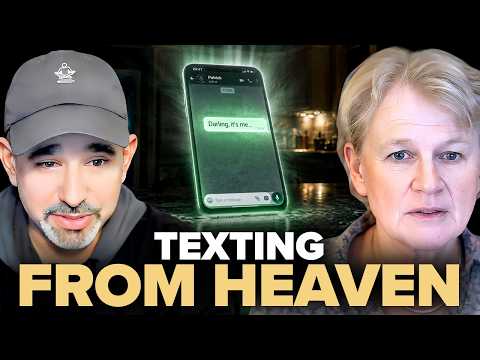
This interview centers on neuroscientist and psychiatrist Dr. Tara Swart's deeply personal account of losing her husband and how that experience transformed both her worldview and her professional interests. Rather than presenting a conventional neuroscience discussion, the conversation evolves into an exploration of grief, consciousness, intuition, spirituality, and the possibility that the mind may exist independently of the brain.
One of the interview's greatest strengths is its openness. Dr. Swart speaks candidly about the emotional devastation following her husband's death, describing experiences that she says challenged everything she previously believed as a scientist and psychiatrist. She acknowledges how uncomfortable these claims may sound, particularly given her own medical background, and repeatedly describes the internal conflict between her scientific training and her personal experiences. That vulnerability makes the discussion engaging even for viewers who remain unconvinced by its conclusions.
The interview also benefits from an interviewer who consistently presses for clarification rather than simply accepting extraordinary claims at face value. Questions about confirmation bias, coincidence, altered states of consciousness, and the difference between subjective experience and scientific evidence help frame the discussion in a way that encourages critical thinking instead of passive acceptance. Those exchanges are often the most compelling parts of the conversation because they allow competing perspectives to coexist without becoming hostile.
The conversation covers a remarkably broad range of topics, including expanded human senses, grief, trauma, somatic therapies, intuition, creativity, gut-brain communication, terminal lucidity, near-death experiences, dark retreats, altered states of consciousness, and the philosophical relationship between mind and brain. While this breadth keeps the interview engaging, it also means many subjects receive only introductory treatment before the discussion moves elsewhere.
Importantly, many of the interview's central claims extend beyond established scientific consensus. Dr. Swart argues that she is convinced it is possible to communicate with deceased loved ones and suggests that consciousness may exist independently of the physical brain. She supports these conclusions with her personal experiences, interpretations of near-death experiences, reports of terminal lucidity, and discussions of consciousness theories proposed by various researchers. However, these topics remain areas of ongoing debate and philosophical inquiry rather than established scientific fact. The interview generally distinguishes between documented phenomena—such as reports of near-death experiences or terminal lucidity—and the broader interpretations drawn from them, but viewers should recognize that the proposed explanations are speculative rather than scientifically settled.
Where the discussion is most firmly grounded is in its treatment of grief and recovery. The interview offers practical observations about processing loss through emotional expression, talking therapy, physical movement, creative activities, time in nature, and maintaining meaningful relationships. These portions remain accessible regardless of whether viewers accept the broader spiritual framework and provide thoughtful ideas that many people experiencing bereavement may find valuable.
The neuroscience portions are similarly mixed. Explanations involving trauma, gut-brain communication, inflammation, the vagus nerve, creativity, and attention are presented alongside more speculative extensions involving intuition, expanded consciousness, and communication after death. The result is an interview that blends established neuroscience with hypotheses that are considerably less supported, making it important for viewers to distinguish between evidence-based research and personal interpretation.
Ultimately, the conversation is less about proving life after death than about exploring how profound loss can reshape one's understanding of consciousness, purpose, and human potential. Even skeptical viewers are likely to appreciate its compassionate treatment of grief and its willingness to explore difficult questions without presenting simplistic answers.
Pros
- Honest and emotionally compelling discussion of grief from both a personal and professional perspective.
- The interviewer regularly challenges extraordinary claims with thoughtful, skeptical questions.
- Provides practical reflections on grief, trauma, creativity, nature, and physical approaches to healing.
- Clearly distinguishes many firsthand experiences from broader philosophical interpretations.
- Encourages curiosity and open discussion about consciousness without relying solely on sensationalism.
Cons
- Covers an unusually wide range of topics, limiting the depth devoted to each.
- Several major conclusions—including communication with the deceased and consciousness existing independently of the brain—are presented as personal convictions rather than conclusions established by mainstream scientific evidence.
- Discussions of near-death experiences, terminal lucidity, intuition, and altered states often move from documented observations to speculative interpretations.
- Viewers expecting a conventional neuroscience interview may find much of the discussion philosophical and spiritual rather than empirically focused.
This is a thoughtful and emotionally powerful conversation that combines personal loss with wide-ranging discussions about consciousness, grief, neuroscience, and spirituality. Its strongest contributions come from its compassionate exploration of bereavement, its encouragement of curiosity, and its willingness to examine questions that science has not fully answered. At the same time, many of its most significant conclusions should be understood as interpretations and hypotheses rather than established scientific findings. Viewers who maintain that distinction will likely find an engaging interview that stimulates reflection regardless of where they ultimately stand on its central claims.