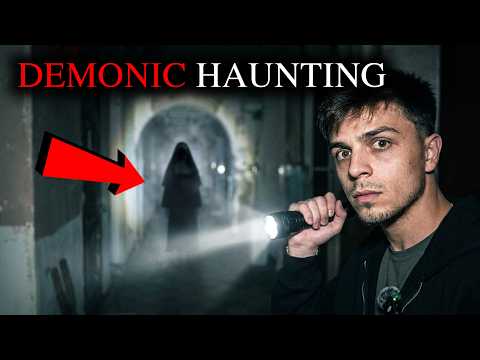
An abandoned Irish asylum shaped like a giant X provides the setting for a paranormal investigation that quickly becomes as much about avoiding security as communicating with spirits. Sam, Colby, and Josh enter the deteriorating facility while workers are reportedly preparing to secure the property for a potential sale. With boarded windows, surveillance concerns, unstable floors, and limited daylight, the group faces immediate practical dangers before attempting any supernatural experiments. The combination of a historically troubled institution and the possibility of being discovered establishes an unusually tense atmosphere.
The exploration gains additional weight through accounts of the asylum's treatment of vulnerable patients. The investigators discuss nineteenth-century commitment laws, overcrowding, alleged mistreatment, and individuals supposedly confined for decades despite having no serious psychiatric conditions. They also describe a fatal burning incident involving a patient named Sarah Carr and the story of a caregiver identified as Lady English. These accounts provide disturbing historical context, but the presentation rarely identifies supporting records or distinguishes documented incidents from local stories. Claims that sealed patient records indicate a deliberate institutional cover-up are particularly speculative, especially without examining alternative explanations for restricted archival access.
The building itself supplies some of the investigation's most effective moments. Narrow corridors, deteriorating rooms, abandoned medical supplies, and a confusing network of staircases create an oppressive environment without requiring supernatural explanations. The discovery of what appears to be a former medical storage area, complete with syringes and medication containers, adds a tangible connection to the facility's previous operations. Meanwhile, holes in the floors, suspected asbestos, and evidence that other people may have entered the building introduce genuine safety concerns. Unfortunately, the group's willingness to navigate these hazards in darkness sometimes makes the adventure feel unnecessarily reckless.
The initial paranormal sessions take place in the basement, where the investigators use an audio recorder to search for electronic voice phenomena. They believe they hear greetings, numerical responses, and other unexplained sounds, although the interpretations remain uncertain. Their disagreement over whether a recording contains the number 31 or 65 illustrates how easily ambiguous audio can produce conflicting conclusions. The investigators occasionally acknowledge ordinary explanations, including noises from pipes and environmental disturbances, but their excitement frequently encourages supernatural interpretations before those possibilities receive meaningful examination.
The investigation becomes more elaborate when the group recreates a large mirror that supposedly occupied the asylum's central intersection for approximately 140 years. They propose that the original mirror might have functioned as a supernatural portal and position a replacement alongside motion-sensitive cat toys and electronic response devices. A series of apparent yes, no, and maybe responses leads them to believe unseen entities dislike the replacement and fear looking into it. This sequence provides the video's most distinctive paranormal experiment, combining an unusual historical feature with sustained suspense. However, the theory that mirrors trap spirits or preserve supernatural energy remains entirely unverified, and the equipment responses do not establish intelligent communication.
As the investigators move upstairs and eventually reach the clock tower, the supernatural narrative increasingly overlaps with concerns about security personnel. Word-generating devices produce terms such as "police," "night," "hurry," and "danger," which the group connects to their circumstances. Later responses involving the mirror, possible attachments, and warnings about leaving become part of an increasingly elaborate supernatural storyline. The difficulty is that randomly generated or selectively interpreted words can appear meaningful when investigators already anticipate danger. Repeated questions and dramatic reactions reinforce that interpretation without demonstrating that the responses originate from spirits.
The final climb into the clock tower delivers an energetic conclusion, particularly when the group attempts to place an Explore sticker near the original bell before alarms sound and a bright light appears inside the building. Their hurried descent and escape provide a convincing sense of immediate danger, even though the identity of the person carrying the light is never established. The ending also exposes the production's biggest contradiction: the investigators repeatedly acknowledge the risks of trespassing, structural collapse, and attracting security, yet continue pursuing increasingly hazardous objectives. Promotional interruptions for a banking service and paid exclusive footage further disrupt the atmosphere, making the presentation feel commercially driven at moments when the investigation would benefit from greater focus.
Pros
- The abandoned asylum's distinctive X-shaped layout, deteriorating interiors, and clock tower provide a memorable and naturally unsettling setting.
- Combines paranormal investigation with genuine suspense surrounding security patrols, alarms, and the possibility of discovery.
- Incorporates historical accounts and discussions of institutional mistreatment that give the location more significance than a conventional haunted-building exploration.
- The recreated mirror experiment offers an unusual centerpiece and generates sustained interaction between the investigators and their equipment.
- Strong group chemistry and spontaneous reactions maintain energy throughout the exploration.
- The clock tower sequence and subsequent escape provide a dramatic conclusion with clear physical stakes.
Cons
- Serious historical allegations, including claims of abuse, suspicious deaths, and deliberately concealed records, receive insufficient documentation or verification.
- Ambiguous recordings, electronic responses, and unexplained noises are repeatedly interpreted as paranormal communication without adequate controls or alternative explanations.
- The mirror portal theory develops into increasingly elaborate speculation without convincing supporting evidence.
- Navigating unstable floors, suspected hazardous materials, and deteriorating staircases while avoiding security demonstrates questionable judgment.
- Frequent promotional segments interrupt the investigation and weaken its atmosphere.
- Repetitive expressions of fear and increasingly leading questions occasionally substitute excitement for meaningful investigative progress.
An atmospheric and frequently suspenseful paranormal adventure that benefits from an extraordinary location, engaging personalities, and a genuinely frantic conclusion. The mirror experiment provides a memorable central mystery, but speculative historical claims, unreliable supernatural interpretations, and unnecessary physical risks limit the investigation's credibility. As entertainment, the exploration succeeds in generating excitement and uncertainty, even if its most dramatic supernatural conclusions remain unsubstantiated.