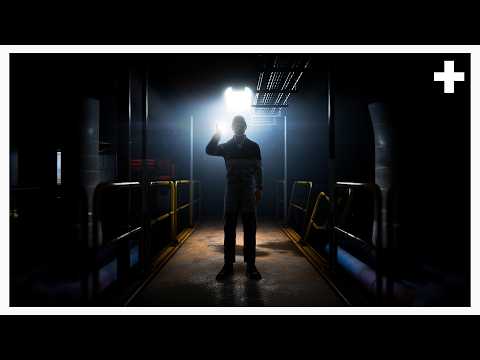
The funniest idea in this playthrough is how quickly one hospital employee becomes responsible for nearly every profession in the building. Jay begins as something resembling a receptionist, but soon he is registering patients, taking temperatures, connecting IV pumps and heart monitors, setting broken limbs, applying casts, cleaning beds, restoring electricity, and performing exorcisms with a crucifix. His running realization that he is simultaneously doctor, receptionist, custodian, priest, and practically everything else becomes a useful joke because it also captures the game's deliberately absurd structure. Ordinary medical tasks provide the routine, while supernatural anomalies force him to decide whether the person waiting for treatment is actually a patient at all.
The first night works particularly well as discovery. Jay initially struggles just to understand how the paperwork functions, restarts after an early encounter goes badly, and gradually learns the treatment sequence for broken arms and legs. Registering a patient, moving them to a bed, checking vital signs, setting the limb, and applying the various layers of a cast quickly becomes familiar enough that deviations feel suspicious. The repeated broken limbs are inherently silly—Jay repeatedly wonders whether anyone can arrive with a different problem—but that repetition establishes a baseline the horror can interrupt. Floating patients, strange sounds, disappearing figures, unsettling phone calls, altered paintings, visual distortions, and impossible behavior become more effective because they invade a procedure the player has started to understand.
Jay's commentary provides most of the personality. Patients are mocked for their clothes, hairstyles, attitudes, names, glasses, and faces, while medical procedures become opportunities for increasingly ridiculous improvisation. He jokes about being an expert at snapping limbs back into position, questions whether normal vital signs are actually normal, and occasionally creates his own problems by testing mechanics or pressing the wrong control. The humor is intentionally crude and frantic, but it fits a game that repeatedly asks him to perform serious-looking medical tasks without anything resembling a realistic hospital environment. His uncertainty also helps the gameplay because viewers are learning the anomaly rules alongside him rather than watching someone mechanically execute a solved system.
The anomaly system creates the strongest scares when the warning signs are ambiguous. Abnormal heart rates can identify something supernatural, faceless patients should not be stared at for too long, later enemies can imitate previously treated people, and hallucinations mean not everything Jay sees should be trusted. He sometimes reacts correctly—such as recognizing the wildly abnormal 427 BPM reading or denying a patient without a face—and sometimes makes mistakes by exorcising an innocent person or judging someone largely because they look suspicious. That uncertainty gives the hospital premise more tension than a simple jump-scare game would have, because every unusual detail can become a decision about whether to treat, deny, or banish someone.
Night two smartly expands the rules with shapeshifters, faceless visitors, more aggressive anomalies, sanity management, electrical problems, and eventually a fire. The faceless Walter encounter is especially effective because the game has already warned Jay not to stare at such patients, allowing recognition rather than pure surprise to drive the response. Other moments are less subtle, including patients crawling unnaturally, extreme monitor readings, figures appearing directly in the room, and repeated threats about seeing him again. The fire provides the largest escalation because Jay has to escape and then continue working while his sanity is collapsing, turning the final patients into a race against a system rather than another isolated scare.
That escalation also exposes the game's limitations. By the second night, Jay explicitly notices that much of the experience has become repetitive: treat another broken arm or leg, clean another stain, react to another visual disturbance, and wait for another jump scare. The anomalies initially work because their appearances are unpredictable, but repetition gradually teaches both player and viewer what kind of interruption to expect. Jay says essentially the same thing after finishing, observing that repeated jump scares eventually stop affecting him. His own reactions demonstrate the diminishing returns particularly well—early anomalies produce genuine panic, while later ones are more likely to be mocked, anticipated, or dismissed after their identifying clue appears.
The final stretch still manages to generate tension because Jay nearly loses the second night despite becoming better at the basic job. The fire heavily damages his sanity, subsequent treatment becomes increasingly frantic, and he dies while working on a late patient's broken leg before using a free revive. Completing the night with a 76 percent result, up from 71 percent on the first, gives the playthrough a small but satisfying progression arc: he is objectively making mistakes, but he is also getting better at recognizing the game's logic. His conclusion that this experience is creepier than Animal Hospital, particularly in its anomalies and jump scares, matches what the playthrough shows, while his admission that the scares lose power through repetition keeps the verdict from becoming inflated praise.
Pros
- Combining routine hospital procedures with supernatural anomaly detection gives the game an effective structure for alternating repetition and sudden horror.
- Jay's confusion about being receptionist, doctor, custodian, and exorcist becomes a recurring joke that fits the game's intentionally absurd responsibilities.
- The first night introduces paperwork, vital signs, casting, sanity, hallucinations, and exorcisms gradually enough for viewers to learn the mechanics alongside the player.
- Shapeshifters, faceless patients, abnormal readings, environmental disturbances, and the second-night fire expand the threat beyond simple visual jump scares.
- Genuine mistakes—including exorcising an innocent patient and nearly losing the second night—keep the playthrough unpredictable instead of presenting a flawless run.
- Jay's increasingly confident reactions provide a clear progression from early panic to recognizing and mocking many of the game's tricks.
Cons
- Treating repeated broken arms and legs makes the medical gameplay increasingly mechanical once the casting sequence has been learned.
- Heavy reliance on jump scares causes the horror to lose effectiveness as similar interruptions accumulate, something Jay himself notices by the end.
- Some anomaly decisions feel less like careful investigation and more like reacting to an obviously abnormal appearance or extreme monitor reading.
- Constant jokes, insults, and rapid commentary occasionally overwhelm quieter moments when the hospital atmosphere could generate tension on its own.
The playthrough works because Jay's chaotic humor gives personality to a simple loop of treating injuries while trying to identify which patients are supernatural threats. The first night's uncertainty and the second night's expanded anomalies, sanity pressure, and fire create several effective scares, even though repetitive treatments and increasingly predictable jump scares gradually weaken the horror. His messy but improving performance makes the experience more entertaining than a polished run would have been.