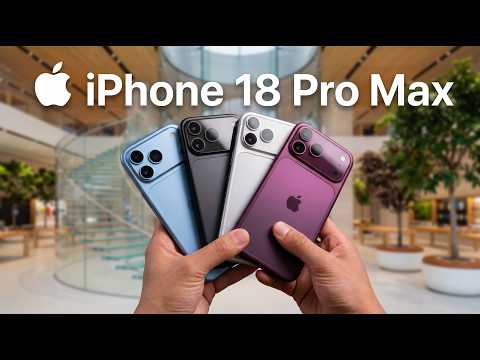
Apple’s 20th-anniversary iPhone provides an obvious foundation for speculation about a major redesign, and the presentation quickly builds its case around that milestone. The central idea is that Apple could repeat the kind of generational shift associated here with the iPhone X, making the next cycle worth waiting for rather than upgrading immediately. It is an effective framing device, although the anniversary itself does not establish that Apple will deliver the sweeping changes envisioned.
The proposed design is easily the most visually distinctive part of the package. Custom renders depict curved edges, glass flowing slightly around the sides and a front that appears essentially bezel-free, giving viewers a concrete interpretation of the reported direction. The host does make clear that these are renders, but the presentation occasionally slides from discussing rumors into describing features as though their final implementation were already known. With a product this far from release, a firmer distinction between reported information, interpretation and pure expectation would make the preview more credible.
Several display and interface rumors fit together into a convincing concept even if their accuracy remains uncertain. LTPO Plus technology is presented as a route to greater screen efficiency, while under-display Face ID would remove visible authentication hardware and haptic controls would replace conventional mechanical buttons. The comparison with Apple's earlier haptic Home button and MacBook trackpads helps explain what the latter change might feel like. The discussion of an under-display camera on another Apple device is also used to acknowledge that hiding components beneath a screen can introduce image-quality compromises rather than treating the technology as automatically superior.
Camera and processor speculation receives some of the strongest enthusiasm. A custom Apple-designed camera sensor is portrayed as an opportunity to bring hardware and software integration closer together, with the company's chip development offered as the reason for optimism. Likewise, the anticipated A21 Pro is described as a second-generation 2-nanometer design that could improve upon the A20 Pro. These are reasonable subjects for a future-device preview, but statements that the camera will be "phenomenal" or that the processor will push boundaries are predictions, not demonstrated performance findings.
The modem, memory and connectivity section becomes noticeably more speculative. A possible transition to another Apple modem is tied to battery efficiency, while worldwide satellite data is floated as something that might finally arrive. Faster memory technology is similarly associated with productivity and AI workloads without concrete specifications or benchmarks. The host generally signals uncertainty with phrases such as "maybe" and "we'll have to wait and see," but grouping possibilities alongside supposedly established leaks makes it difficult to judge how much confidence viewers should assign to each item.
Battery technology produces the boldest numerical prediction. The proposed move toward a more silicon-based battery is explained as a way to increase capacity without necessarily increasing physical size, and that possibility complements the efficiency arguments made for the display, processor and modem. However, the jump from that concept to an expectation of easily exceeding 50 hours is unsupported by testing or finalized hardware. The same issue applies to the broader recommendation to consider skipping a current generation: the collection is entertaining as a forward-looking rumor roundup, but too uncertain to serve as a strong purchasing argument on its own.
Pros
- Custom renders give the rumored redesign a clear visual identity and make the design discussion easier to follow.
- Organizing the preview around ten specific areas keeps a highly speculative subject reasonably structured.
- Explanations of haptic controls, display efficiency and increased battery energy density make several technical ideas accessible.
- The host occasionally acknowledges uncertainty and potential compromises, particularly around under-display camera technology.
Cons
- Rumors, expectations and the host's own predictions are not always separated clearly enough from one another.
- Major claims about the custom camera sensor, A21 Pro performance and future memory technology lack concrete evidence or specifications.
- Possible worldwide satellite data connectivity is especially tentative and contributes little to a reliable upgrade comparison.
- The prediction of battery life exceeding 50 hours goes beyond the evidence presented.
- Encouraging viewers to consider delaying a purchase depends heavily on features that remain unconfirmed.
The roundup creates an appealing picture of what a major anniversary iPhone could become, particularly through its bezel-free design concept, hidden Face ID and potential battery improvements. Its accessible explanations and renders make the speculation enjoyable, but the case for skipping an existing generation is weakened by how frequently reported rumors blend into personal predictions about performance and features.