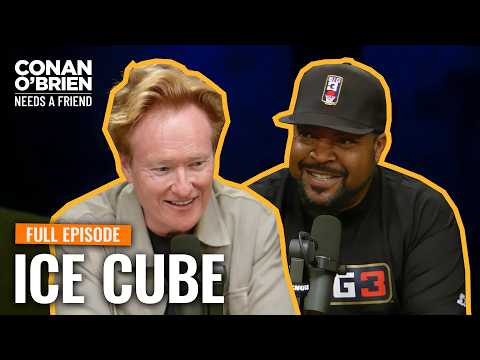
John Cena's recollection of being a scrawny 13-year-old who responded to bullying by methodically working through every exercise in a home-gym booklet establishes the central idea that follows him through nearly the entire conversation. Whether discussing wrestling, acting, learning piano or eventually leaving the ring, he describes progress as accumulated repetition rather than a sudden discovery of talent. Conan O'Brien recognizes that pattern early, and the interview becomes much more interesting than a conventional tour through Cena's résumé because it keeps returning to how he approaches work rather than simply cataloguing what he has accomplished.
The wrestling material is especially revealing because Cena is unusually willing to describe his successful persona as something constructed through trial, failure and practical necessity. He recalls being placed on the list for possible cuts, improvising rap backstage because he had little left to lose, and then treating even minor television appearances as opportunities to commit completely to the emerging character. His explanation of the increasingly recognizable clothing is similarly grounded: the jean shorts were partly an aesthetic choice but also survived the physical demands of wrestling better than alternatives. O'Brien's observation that professional wrestling and comedy both require performers to discover a voice and commit to it gives this section a useful framework, while Cena extends the comparison by emphasizing repetition, coachability and continual reinvention.
That same willingness to examine failure makes the discussion of Cena's acting career stronger than the usual celebrity account of crossing into movies. Rather than treating his early films merely as unfortunate projects, he accepts some responsibility for not being fully invested because wrestling was still where he wanted to be. He describes approaching his later opportunity in Trainwreck differently, deciding to bring the same commitment to acting that he had brought to wrestling and becoming comfortable with being the joke rather than protecting a heroic image. His appreciation for learning around Judd Apatow, Amy Schumer, Tina Fey, Amy Poehler, Will Ferrell, Seth Rogen and others reinforces one of his most persuasive themes: entering a room without needing to be its smartest or most important person can be an advantage.
O'Brien is an excellent conversational partner for that subject because he connects Cena's wrestling instincts directly to comedy performance. Their discussion of Peacemaker gets at why an outrageous character can be funny without behaving as though he knows he is in a comedy: Cena talks about never dropping the act, while O'Brien emphasizes the humor produced by treating absurd material with complete sincerity. Later, their discussion of Cena and Eric Andre as contrasting personalities in Little Brother continues that point. These exchanges offer more insight into Cena's acting than generic questions about favorite roles would have, because they focus on technique and the lessons transferred between two seemingly different careers.
The conversation becomes unexpectedly thoughtful when it moves from professional discipline to hobbies and expectations. Cena says he began learning piano at 40, remains well below the ability of serious musicians after years of practice, and is perfectly content with that because improvement rather than mastery is the objective. From there, he and O'Brien discuss how social media can expose young people to exceptional performers, physiques and possessions so constantly that ordinary progress can feel inadequate. Cena's broader conclusions about modern attention and motivation are personal observations rather than demonstrated findings, but they fit coherently with his own experience of spending years pursuing activities without knowing whether they would produce exceptional results.
There is also a substantial promotional component. Coyote vs. Acme receives an enthusiastic endorsement from O'Brien, and Cena discusses director Dave Green's preparation, performing opposite digital characters and his belief that creative work benefits from actually reaching an audience. Cena is notably measured when discussing the earlier decision not to release the film, acknowledging the owner's right to make that decision while explaining why he personally prefers art to be used rather than stored away. Still, O'Brien's praise of the finished movie is presented as his reaction rather than an independent assessment, and the multiple lengthy advertising breaks for mattresses, Hyundai, T-Mobile and Apple Card noticeably interrupt an otherwise unusually fluid conversation.
The looseness cuts both ways. The opening discussion about the Batman mansion, Pasadena lore and increasingly elaborate sexual jokes runs for a long time before Cena even appears, and several historical assertions are tossed around amid the comedy without serious verification or careful qualification. Once Cena arrives, however, the digressions generally become assets. A lengthy exchange about muscle cars, a Honda Civic Type R and O'Brien's neglected Ford Taurus SHO sounds peripheral on paper, yet it reveals genuine shared enthusiasm and prevents the interview from feeling mechanically structured around career milestones. The closing discussion is better still: Cena's insistence that wrestling, acting and celebrity will eventually end leads both men into a candid consideration of identity beyond professional success. Cena's point that he invested in wrestling for the audience present that night rather than for permanent commemoration gives the conversation an unusually satisfying final perspective.
Pros
- Cena gives unusually specific accounts of how failure, repetition and adaptation shaped both his wrestling and acting careers.
- O'Brien draws productive connections between professional wrestling, comedy and committed character performance.
- The discussion of learning piano and accepting gradual improvement expands naturally into a thoughtful examination of ambition and comparison.
- Cena's reflections on retirement and separating personal identity from professional success give the closing section genuine substance.
- Casual exchanges about cars and other interests create convincing chemistry rather than making the interview feel like a promotional checklist.
Cons
- The lengthy pre-interview Pasadena discussion delays the main conversation and becomes increasingly self-indulgent.
- Several historical claims in the opening banter are treated casually enough that entertainment takes precedence over reliability.
- Multiple substantial sponsor segments repeatedly disrupt the momentum of the interview.
- The extended praise for Coyote vs. Acme is engaging but remains largely promotional and subjective rather than a critical examination of the film.
Cena's combination of self-awareness, discipline and willingness to discuss unsuccessful periods gives O'Brien far more to work with than a standard celebrity promotional appearance. Some indulgent opening banter and intrusive advertising make the full presentation uneven, but the central conversation succeeds as a funny and unexpectedly reflective examination of performance, persistence and knowing that even a remarkable career is temporary.