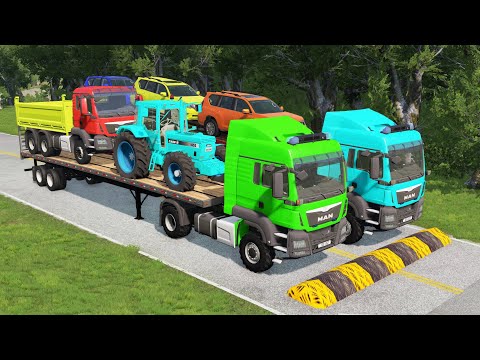
Lightning McQueen-inspired vehicle rescues, flatbed truck transportation, and road obstacles form the foundation of this BeamNG Drive gameplay installment. Rather than presenting a detailed driving simulation or an elaborate storyline, the experience relies on brief exchanges, urgent requests for assistance, and repeated encouragement to keep moving. The result is a straightforward automotive entertainment concept that prioritizes action and recognizable characters over narrative complexity.
The central theme revolves around vehicles needing help and others responding to their requests. Repeated cries of "Please help me" establish a rescue-oriented atmosphere, while responses such as "Okay, let's go" and "Good job" suggest cooperation and successful progress. These simple interactions make the intended scenario easy to understand, particularly for younger viewers who may enjoy watching vehicles overcome obstacles without needing extensive explanations.
Road hazards provide another element of the experience, with a speed bump specifically mentioned during the action. The title also emphasizes potholes and vehicle transportation, suggesting that navigating difficult road conditions is an important attraction. BeamNG Drive is a suitable platform for this type of entertainment because of its vehicle physics and potential for dramatic driving situations. However, the spoken exchanges provide little indication of how challenging the obstacles become or whether the gameplay introduces meaningful variations.
The presentation relies heavily on short, repetitive dialogue rather than detailed commentary. Commands such as "Go go go go go" create a sense of urgency, while occasional expressions of surprise and apology introduce small changes in tone. This approach keeps the communication accessible, but the limited vocabulary also makes individual moments difficult to distinguish. More varied reactions or clearer explanations of what is happening would help establish a stronger connection between the dialogue and the driving action.
One potentially interesting moment occurs when a request for assistance receives a direct refusal, followed by an apology. This briefly interrupts the otherwise cooperative pattern and introduces the possibility of conflict between vehicles. Unfortunately, the exchange is too short to establish a meaningful disagreement or explain its consequences. The moment demonstrates how even a simple rescue scenario could benefit from more developed interactions and a clearer sense of progression.
The repeated requests for help also create a predictable rhythm that may appeal to viewers seeking uncomplicated, familiar entertainment. There is no indication that the presentation attempts to teach driving techniques, explain vehicle mechanics, or explore the simulation's technical capabilities. Its purpose appears primarily recreational, making its effectiveness dependent on the visual action and the viewer's enjoyment of repeated vehicle encounters. Without more substantial dialogue or narrative development, the entertainment value rests largely on the gameplay itself.
As the 80th installment in a pothole-versus-car series, the concept appears designed around a familiar formula rather than a major creative departure. That consistency can be appealing to an established audience, but it also highlights the importance of introducing fresh situations to prevent repetition. The simple rescue exchanges provide an accessible framework, yet the limited characterization and lack of a clearly developed objective make this a modest entry rather than a particularly memorable automotive adventure.
Pros
- The combination of Lightning McQueen-inspired vehicles, flatbed transportation, and road obstacles offers an accessible automotive entertainment concept.
- Repeated rescue requests and cooperative responses establish a simple scenario that younger viewers can easily follow.
- Short commands and enthusiastic encouragement create a lively, uncomplicated tone.
- The BeamNG Drive setting provides a suitable foundation for vehicle-based challenges and simulated road hazards.
Cons
- Repetitive dialogue, particularly the recurring requests for help and responses of "Okay," limits variety and engagement.
- The rescue scenarios lack sufficient narrative development to establish clear stakes or memorable outcomes.
- Road obstacles and transportation challenges receive little meaningful explanation, reducing the sense of progression.
- Brief moments of conflict or surprise are not developed enough to add substantial personality or dramatic interest.
- The familiar gameplay formula offers limited evidence of creative innovation or a distinctive new challenge.
This BeamNG Drive installment delivers a simple vehicle-rescue concept built around familiar characters, road hazards, and repetitive interactions. Its accessible presentation may entertain younger viewers or fans of straightforward automotive gameplay, but limited dialogue variety and underdeveloped scenarios restrict its broader appeal. It works as casual, uncomplicated entertainment rather than a particularly creative or substantial driving simulation experience.