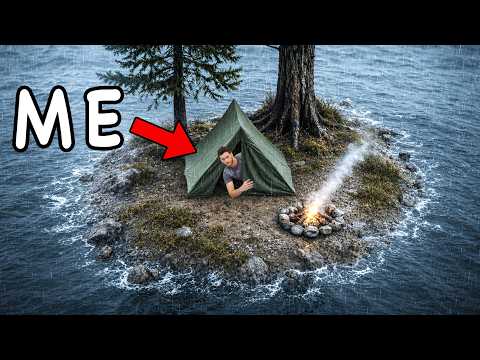
A wool blanket, hatchet, small pot, fishing tackle and a canoe leave very little margin for comfort once camp is established on an island in the Ontario wilderness. With no food, conventional shelter or fire starter, the challenge quickly becomes less about dramatic danger and more about solving basic problems with what is available. That modest approach works well because the difficulties feel tangible: mosquitoes arrive when the breeze disappears, the ground needs insulating, clean water requires attention, and even a relatively mild summer night proves cold enough to wreck his sleep.
Shelter building provides an effective early demonstration of improvisation. Rather than stripping large amounts of vegetation to construct an elaborate structure, he incorporates the canoe into a simple windbreak and gathers spruce boughs for bedding. His explanation of insulating himself from the ground gives the work a practical purpose, while the first night provides an immediate reality check when the blanket proves inadequate. The resulting exhaustion is more convincing than pretending that a minimal kit automatically becomes comfortable in experienced hands.
Fire making becomes one of the trip's most satisfying successes. Dry cedar, gathered fibers, sap and a bow-drill setup eventually produce the fire needed for hot coffee and cooking, giving the second morning a genuine sense of progression after a miserable night. He also repeatedly emphasizes slowing down while handling the hatchet and knife, drawing on his own history of cuts rather than treating edged tools casually. The later use of heated rocks to improve nighttime warmth shows another attempt to adapt after the original sleeping arrangement falls short, although sleep remains poor.
Food is considerably less reliable, which gives the challenge much of its tension. Frogs are collected as bait, fishing initially disappoints, and eventually catching fish feels consequential because so much time and effort has gone into obtaining a relatively small meal. An attempted slow cook or smoke takes roughly two and a half hours without working as intended, and he openly admits the experiment has failed before simply cooking the fish. A better fishing result the following day helps, but his estimate that he might need around eight fish to sustain himself underlines how labor-intensive this strategy would become.
Foraging adds variety without being exaggerated into an effortless wilderness pantry. He identifies plants including wintergreen, bunchberries, cattail and Labrador tea while repeatedly acknowledging that some available foods provide little energy or are not especially appealing. That restraint is valuable, although several statements about edibility, medicinal or insect-repelling properties, and plant use are presented informally rather than with supporting evidence. The same caution applies to his water treatment discussion: he explains why he does not want to risk untreated lake water, but his specific claim that four to eight drops of Betadine followed by a half-hour wait should eliminate all parasites is presented without enough detail to establish it as broadly reliable purification guidance.
The excursion to the nearby marsh gives the final stretch more purpose than simply waiting out another night. Signs he interprets as recent moose activity, abundant frogs, cattails, tamarack and other vegetation let him assess a noticeably different environment for potential resources, while discovered pieces of old material prompt some entertaining speculation about how they might be repurposed in a genuine emergency. Earlier, a mother and calf moose swimming across the lake also provides an unexpected wildlife encounter without being inflated into manufactured peril.
Presentation is strongest when the challenge is allowed to remain imperfect. The poor sleep, unsuccessful smoking experiment, limited calories and acknowledgment that rain could have made the shelter seriously problematic prevent the outing from feeling overly controlled. Humor around absurd seasoning, cold-brew coffee and improvised survival ideas keeps the slower stretches personable, though the extended therapy sponsorship interrupts the early momentum and some practical claims would benefit from more careful qualification. Ultimately, the limited equipment succeeds as more than a gimmick because it forces visible compromises in warmth, food gathering, fire making and camp construction.
Pros
- The minimal equipment creates genuine practical constraints rather than merely serving as a premise.
- Failed sleep arrangements, difficult fishing and an unsuccessful smoking attempt are shown openly, giving the challenge credibility.
- Bow-drill fire making, canoe-assisted shelter construction and heated-rock experimentation provide satisfying examples of adaptation.
- Fishing and foraging are portrayed as time-consuming and uncertain rather than effortless sources of wilderness food.
- The marsh exploration and moose encounter add variety and a strong sense of the surrounding environment.
- Humor and self-deprecation keep a physically uncomfortable trip entertaining without erasing its difficulties.
Cons
- Several plant-use and water-treatment claims are presented casually without enough qualification to serve as dependable survival guidance.
- The lengthy sponsored segment arrives early and noticeably disrupts the wilderness setup.
- The shelter is fortunate to avoid serious rain, leaving its effectiveness against bad weather largely untested.
- Limited calories and repeated poor sleep constrain how much the challenge develops beyond maintaining fire, catching fish and enduring the nights.
The combination of cold nights, scarce food and a deliberately stripped-down kit produces an engaging test precisely because many of the solutions remain imperfect. Strong wilderness atmosphere, visible trial and error and an enjoyable sense of improvisation outweigh the occasional unsupported practical claim and slower stretches.